Highest military spending in Europe since Cold War: study / Photo: © AFP

Europe's military spending grew at a record pace in 2022, reaching a level unseen since the Cold War following Russia's invasion of Ukraine, global security researchers said Monday.
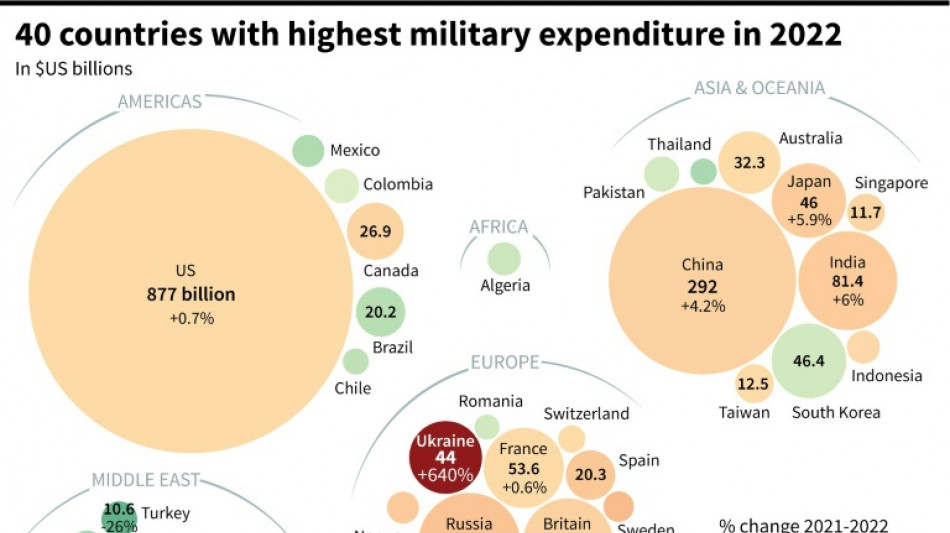
The rise in Europe helped global military expenditures reach an eighth straight record at $2.24 trillion, or 2.2 percent of the world's gross domestic product, according to the Stockholm International Peace Research Institute (SIPRI).
"It's driven by the war in Ukraine, (which is) driving European budget spending upwards, but also the unresolved and worsening tensions in East Asia between the US and China," researcher Nan Tian, one of the study's co-authors, told AFP.
Europe spent 13 percent more on its armies in 2022 than in the previous 12 months, in a year marked by the Russian invasion of Ukraine.
The figure does not take into account sharp inflation rates, which means actual spending was even higher, the think tank said.
That was the strongest increase in more than 30 years, and a return, in constant dollars, to the level of spending in 1989 when the Berlin Wall fell.
"In Europe, it is at its highest level since essentially the end of the Cold War," Tian said.
Ukraine alone increased its spending seven-fold to $44 billion, or a third of its GDP. The country has additionally benefitted from billions of dollars of weapons donations from abroad, SIPRI noted.
At the same time, Russian spending rose by 9.2 percent last year, estimates showed.
"Irrespective of whether you remove the two warring nations, European spending has still has increased by quite a lot," Tian said.
Spending in Europe, which totalled $480 billion in 2022, has already risen by a third in the past decade, and the trend is expected to continue and accelerate over the next decade.
The continent could "potentially" see growth levels similar to 2022 for several years, Tian said.
After declining sharply in the 1990s, global military expenditure has been on the rise since the 2000s.
The upturn was initially the result of China's massive investments in its military, which was then followed by renewed tensions with Russia after its annexation of Crimea in 2014.
- US, China account for half -
The US alone accounted for 39 percent of global military expenditure. Together with China, which came in second at 13 percent, the two nations accounted for more than half of the world's military spending.
Those next in line lagged far behind, with Russia at 3.9 percent, India at 3.6 percent and Saudi Arabia at 3.3 percent.
"China has been increasingly investing in its naval forces as a way to expand its reach to Taiwan of course, then further out than the South China Sea," Tian said.
Japan, as well as Indonesia, Malaysia, Vietnam and Australia are all following the trend.
Britain is the top spender in Europe, coming in sixth place overall and accounting for 3.1 percent of global expenditures, ahead of Germany at 2.5 percent and France at 2.4 percent -- figures which include donations to Ukraine.
Britain, Ukraine's second-biggest donor behind the United States, "spends more than France and Germany. It also gave more military aid than France and Germany," said Tian.
Countries like Poland, the Netherlands and Sweden were among the European countries that increased their military investments the most during the past decade.
Modern and costly weapons also explain some spending hikes, as in the case of Finland which last year purchased 64 US F-35 fighter jets.
(S.A.Dudajev--DTZ)