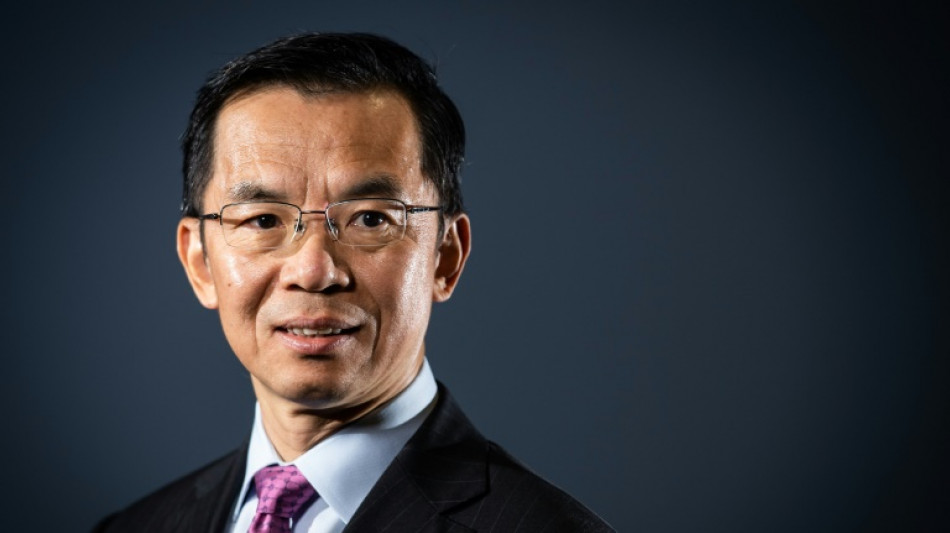
China says it respects sovereignty of ex-Soviet states after uproar / Photo: © AFP

China insisted it respects the sovereignty of all ex-Soviet countries on Monday, after comments by its ambassador to France drew ire in Europe and threw into question Beijing's efforts to position itself as a neutral mediator of the Ukraine war.
The European Union's three Baltic countries summoned China's envoys to account for Ambassador Lu Shaye questioning the sovereignty of former Soviet states.
In a meeting "planned for some time" at the French foreign ministry on Monday, Lu was told to "make his public remarks in line with the official position of his country", the ministry said.
In comments to French broadcaster LCI on Friday, Lu said countries that emerged after the fall of the Soviet Union "don't have effective status under international law because there is not an international agreement confirming their status as sovereign nations".
The ambassador appeared to be referring not just to Ukraine, which Russia invaded in February 2022, but to all former Soviet republics which emerged as independent nations after the fall of the Soviet Union in 1991.
- 'Inviolable' -
French President Emmanuel Macron on Monday criticised the Chinese ambassador for the remarks, saying "it's not the place of a diplomat to use that kind of language."
He offered "full solidarity to the countries that have been attacked in their reading of their history and their borders", insisting that those frontiers were "inviolable".
Beijing distanced itself from Lu's remarks -- while also defending its claimed neutral stance on Russia's war in Ukraine.
President Xi Jinping has sought to act as peacemaker in the conflict as he seeks a greater role for China on the global stage -- even as Western leaders have accused Beijing of providing diplomatic cover to Russian President Vladimir Putin.
"China respects the sovereignty, independence and territorial integrity of all countries and upholds the purposes and principles of the UN Charter," foreign ministry spokeswoman Mao Ning told reporters on Monday.
"After the collapse of the Soviet Union, China was one of the first countries to establish diplomatic relations with relevant countries."
She accused "some media" of misinterpreting China's position on Ukraine and "sowing discord in relations between China and relevant countries".
"We will be vigilant about this," she added.
The French foreign ministry said it "took note of these clarifications", including that the ambassador's remarks had been made in a "personal capacity".
- Wave of outrage -
Lu's comments last week sparked a wave of outrage across Europe, including in the EU's Baltic countries.
Lithuanian Foreign Minister Gabrielius Landsbergis wrote on Twitter that "if anyone is still wondering why the Baltic States don't trust China to 'broker peace in Ukraine', here's a Chinese ambassador arguing that Crimea is Russian and our countries' borders have no legal basis".
Estonia's foreign ministry said it had told China's envoy in the country that it hoped Beijing's diplomats "refrain from expressing these kinds of opinions in the future".
"We believe it was a single incident and we hope it will not affect the relations of Estonia and China," it said.
Latvia's foreign ministry said the comments were "totally unacceptable if they cast doubts on certain countries and their international rights status".
Samija Sherifa, head of the ministry's bilateral relationship department, said "such statements from the Chinese ambassador in France would not benefit the further EU-China dialogue."
Lu has previously acknowledged being part of the so-called "Wolf Warrior" class of Chinese diplomats, a nickname given to those who respond vehemently to critics they perceive as hostile to China.
In January 2019, as ambassador to Canada, he accused the North American country of "white supremacy" for calling for the release of two Canadians detained in China, days after Meng Wanzhou, a Chinese national and Huawei executive, was arrested in Canada at the request of the United States.
And last August, he sparked outrage by suggesting Taiwanese people would need to be "re-educated" following a Chinese takeover of the self-ruled island.
(N.Loginovsky--DTZ)