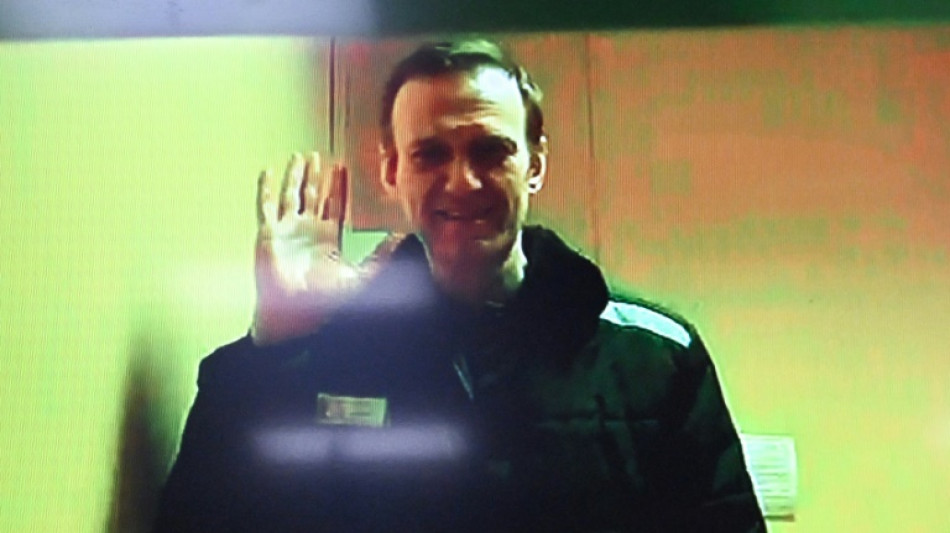
Russia's Navalny, ex-mayor face charges in latest dissent crackdown / Photo: © AFP

Jailed Kremlin critic Alexei Navalny said Wednesday he could face life in prison on "terrorism" charges while another popular opposition politician went on trial in Russia's escalating clampdown on dissent.
Authorities are taking the crackdown on freedoms in Russia to an unprecedented new level over a year into Moscow's assault on Ukraine, with independent media shut down and most key opposition figures behind bars or in exile.
Navalny's team says authorities are preparing a major new trial against the star enemy of Russian President Vladimir Putin.
"They have brought absurd charges against me, according to which I am facing up to 35 years," said Navalny, who wore his prison uniform and appeared gaunt but defiant.
Navalny, 46, said that within the framework of the new extremism case he was told he would be separately judged by a military tribunal over "terrorism" charges.
He said he could face life in prison.
Last October, Navalny said that investigators had launched a new criminal case against him on allegations of "extremism" and "terrorism" and "rehabilitating the Nazi ideology".
The court gave Navalny until May 5 to read the 196 tomes of materials comprising the extremism case, his team said.
Navalny's spokeswoman Kira Yarmysh said a new major trial against the opposition politician was expected to begin "before the end of May."
Then he is expected to stand a separate trial on "terrorism" charges, Yarmysh said on social media.
She called the appearance of the new case while Navalny was behind bars "mindboggling".
Navalny, who used to mobilise massive protests against the Kremlin, is currently serving a nine-year prison sentence on embezzlement and other charges.
He shot to global prominence after he barely survived a poisoning with Novichok, a Soviet-designed nerve agent, which the opposition politician blames on the Kremlin. He was arrested in January 2021 upon returning from Germany after recovering from the poisoning attack.
- 'I have no fear' -
More than 1,500 kilometers (around 930 miles) to the east of Moscow, Navalny's friend and popular former mayor Yevgeny Roizman went on trial in the Urals city of Yekaterinburg over accusations of discrediting the Russian army over its offensive in Ukraine.
Roizman is Russia's last prominent opposition figure who is still in the country and not behind bars. He faces up to five years in prison.
In 2013, Roizman, 60, became Russia's highest-profile opposition mayor and held the position in the Urals city of Yekaterinburg for five years. Tall, sporty and charismatic, he is a hugely popular figure in Yekaterinburg and beyond.
He had until recently remained largely untouchable but in August 2022, authorities opened a criminal probe against Roizman.
Dressed in blue jeans and a white T-shirt, Roizman pleaded not guilty at the start of the trial in Yekaterinburg, according to a live YouTube broadcast of the hearing.
Asked by the judge if he admitted his guilt, Roizman said "no".
In the courtroom, the opposition politician sat next to lawyers in front of the judge.
Roizman, who openly denounces Putin and his assault in Ukraine, has said he knows he could go to prison at any moment.
"I have no illusions," the tough-minded opposition politician told AFP in an interview last year.
"But I also have no fear."
Roizman has a penchant for crude language and has peppered Twitter with swear words to mock officials, much to the delight of his supporters.
All top opposition figures are either in prison or in exile.
Roizman first shot to prominence as an anti-drugs activist fighting Russia's severe narcotics epidemic.
When he served as mayor, he made himself accessible to his constituents, receiving the city's neediest people to help them solve their problems.
He resigned after authorities moved to scrap mayoral elections, but he has been closely involved in his charity's work.
Last week, a Russian court sentenced another Kremlin critic, Vladimir Kara-Murza, to 25 years in a high security prison on treason and other charges for criticising the Ukraine assault.
It was the harshest sentence delivered against a Kremlin critic since the start of Moscow's offensive in Ukraine.
(V.Sørensen--DTZ)