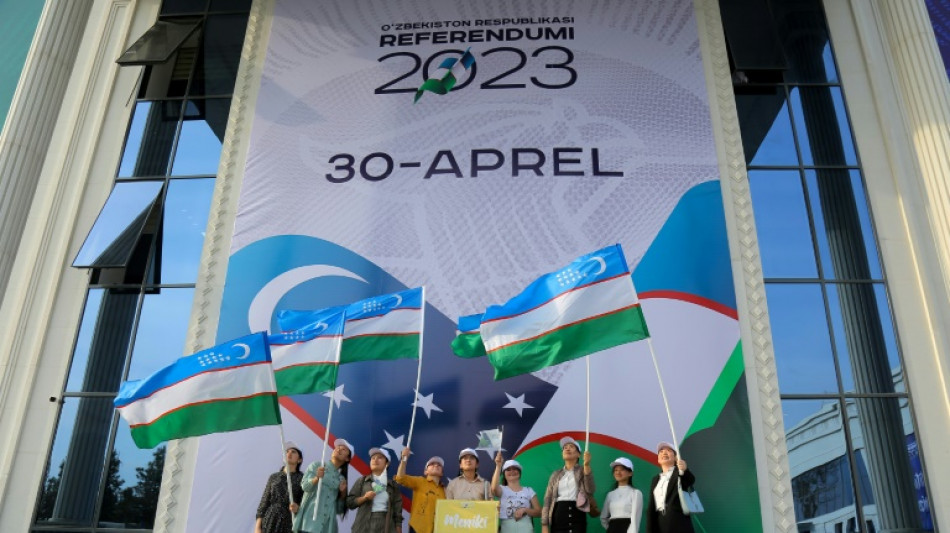
Uzbeks vote on reforms to strengthen president / Photo: © AFP

Uzbekistan votes Sunday in a constitutional referendum that could allow President Shavkat Mirziyoyev to remain in power until 2040.
Authorities say the overhaul of the constitution will improve governance and quality of life in the Central Asian country of 35 million people, whose rights have long been heavily restricted.
But it is Mirziyoyev who is expected to benefit most in the majority-Muslim country, say political observers.
One of the main reforms is expected to be extending presidential terms from five to seven years; and allow the 65-year-old Mirziyoyev to serve two more terms and extend his time in power until 2040.
There is little doubt the amendments will be adopted in a country where the media is heavily controlled.
Two journalists working for Uzbek state media told AFP on condition of anonymity that they had been "ordered to cover Uzbekistan, the referendum and the president in a positive way".
Both said that censorship had grown during the referendum campaign.
The government has gone to some lengths to give the vote a veneer of legitimacy, enrolling local celebrities at large rallies and concerts to praise both the proposals and the president.
Billboards around the capital Tashkent, the biggest city in Central Asia, carry imaginary message chats between voters.
"Dad, shall we go to the park?"
"No, we have to vote first", reads one of the posters.
- 'New Uzbekistan'? -
The campaigning appears to be working.
Agay Danilov, an 18-year-old student, told AFP the referendum was "a good idea."
"We can choose the future of our country," Danilov added.
Since coming to power in 2016 in the wake of the death of hardline predecessor Islam Karimov, Mirziyoyev has spearheaded a series of reforms in Uzbekistan, including a clampdown on forced labour in the cotton fields.
But activists say rights abuses persist, and authorities have shown no sign of allowing a political opposition to emerge.
In 2022, at least 21 people died during demonstrations in the autonomous region Karakalpakstan. Rights activists accused the authorities of having used lethal force against the protesters.
Olivier Ferrando, a researcher at the Catholic University of Lyon in France, said the reform was a "flagship measure" for Mirziyoyev in his attempt at "emancipation" from the legacy of his predecessor.
Karimov died in 2016 after a quarter century of brutal rule.
Mirziyoyev was his loyal prime minister for 13 years but now presents himself as a much more progressive figure.
"Many analysts see, understandably, an effort by Mirziyoyev to stay in power but it would be a shame to dismiss this text as just an authoritarian turn," Ferrando told AFP, referring to the amendments.
Among the proposals are a ban on capital punishment and the protection of human rights for what Mirziyoyev calls a "new Uzbekistan".
"We will have to see, of course, if this constitutional reform, one of whose aims is to give guarantees to the international community of democratic development in the new Uzbekistan, will be able to go beyond a simple cosmetic effect and be fully implemented in people's daily lives," Ferrando said.
- Bloody protests -
Uzbekistan's population is emerging from a particularly harsh winter marked by shortages of fuel and is faced with enduring poverty and endemic corruption.
Despite some economic progress and social improvements, such as the criminalisation of domestic violence, the government brooks no dissent.
In July 2022, demonstrations against a constitutional amendment in the Karakalpakstan region, which would have reduced the autonomy of the vast territory, were put down in a bloody crackdown. Dozens of people were jailed.
The controversial amendment has since been withdrawn.
(O.Zhukova--DTZ)