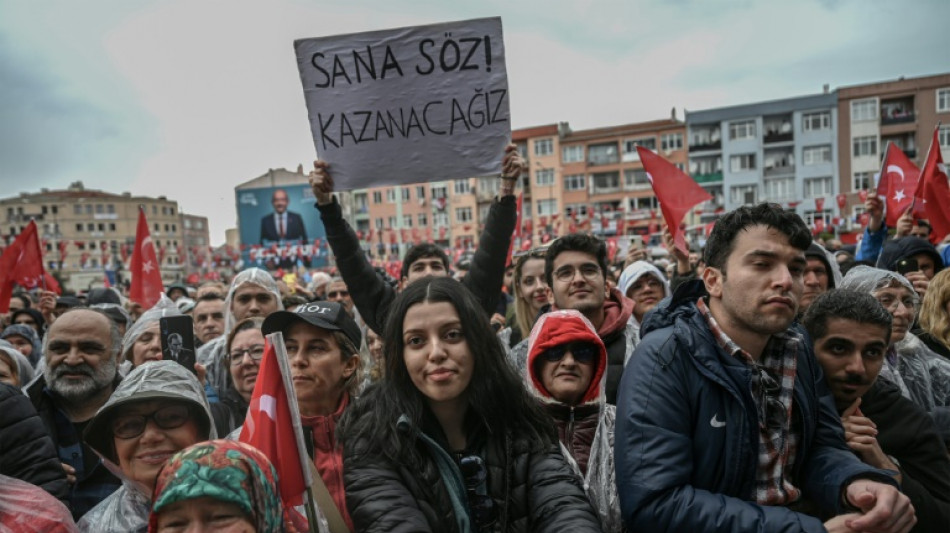
Turkey's first-time voters turn away from Erdogan / Photo: © AFP

Student Emre Ali Ferli has known no leader other than Recep Tayyip Erdogan.
That's enough to make the 18-year-old back the Turkish president's main rival when he votes for the first time on May 14.
"I am tired of getting up every day and thinking about politics," said Ferli, referring to the tumult of Erdogan's 20-year rule.
"When President Erdogan is gone, young people will be able to focus on their exams and to speak freely."
Like Ferli, around 5.2 million Turks who reached voting age since Erdogan came to power in 2003 -- eight percent of the electorate -- will have their first say on election day.
The 69-year-old president's chief opponent, 74-year-old former civil servant Kemal Kilicdaroglu, is banking on students such as Ferli.
"It is through you that spring will come," the grandfatherly leader of Turkey's main secular party told a youth rally in Ankara.
Opinion polls suggest that Kilicdaroglu has reason to be optimistic.
One survey showed only 20 percent of Turks in the 18-25 age bracket ready to vote for Erdogan and his Islamic-rooted party in the presidential and parliamentary polls.
Both past Turkey's retirement age, Erdogan and Kilicdaroglu have been trying to seduce Gen Z voters with pledges to abolish a tax on mobile phone purchases and free internet packages.
Adding to Erdogan's problems, a third candidate, 58-year-old secular nationalist Muharrem Ince, is posing as a more fresh-faced alternative.
"The Erdogan vote is lower among young people," said Erman Bakirci, a researcher at the Konda polling institute.
"First-time voters are more modern and less religious than the average voter, and more than half are dissatisfied with the life they lead."
- 'Anyone is better' -
In Kasimpasa, a working-class Istanbul district where Erdogan played street football growing up, some have no fear of speaking out against their native son.
"Erdogan must go! All my neighbours will vote for him, but not me," Gokhan Celik, a 19-year-old in a green tracksuit, declared under two flags emblazoned with the president's face.
Firat Yurdayigit, 21, a textile worker, criticised Erdogan for building a third airport for Istanbul "instead of taking care of people".
"I will vote for Muharrem Ince," Yurdayigit said. "But no matter who is elected, anyone is better than Erdogan."
His friend Bilal Buyukler, 24, tried to defend the Turkish leader.
But even he conceded that Erdogan was "partly responsible" for years of economic turmoil, including historically high inflation and a currency collapse.
"I can't find work because of the Syrian refugees," said Buyukler, blaming his unemployment on the 3.7 million people who fled war on Turkey's southern border to big cities such as Istanbul.
"I can't get married -- it's too expensive," he said. "But I don't see any alternative.
"I can't vote for Kilicdaroglu because of religion. He walked on a prayer rug with his shoes!" he exclaimed, pointing to a campaign faux pas by the opposition leader highlighted by pro-government media and Erdogan.
- 'Obstacle to my dreams' -
Kilicdaroglu has taken pains to dispel the staunchly secular image of his CHP party, a constant worry for socially conservative voters who found a home in Erdogan's AK Party.
Last year, Kilicdaroglu proposed a law guaranteeing women's right to wear headscarves, trying to peel away voters won over by Erdogan's unshackling of religious restrictions.
"Mr Kemal will never let you lose your gains," Kilicdaroglu said in a video message aimed at conservative women.
His six-party alliance also includes three conservative Islamic groups, which Seda Demiralp, an associate professor at Istanbul's Isik University, called "a message of reconciliation intended for the religious electorate".
Sevgi, 20, lives in Eyup, one of Istanbul's most conservative districts.
She will vote on May 14 but does not want to "mix politics and religion".
"Erdogan is the main obstacle to my dreams," said the young woman, who is working to raise money to pay for design school.
Her boyfriend interrupted, listing some of Erdogan's achievements.
But Sevgi shook her head. "Even if he was a good president, he shouldn't be able to rule for so long," she said.
(I.Beryonev--DTZ)