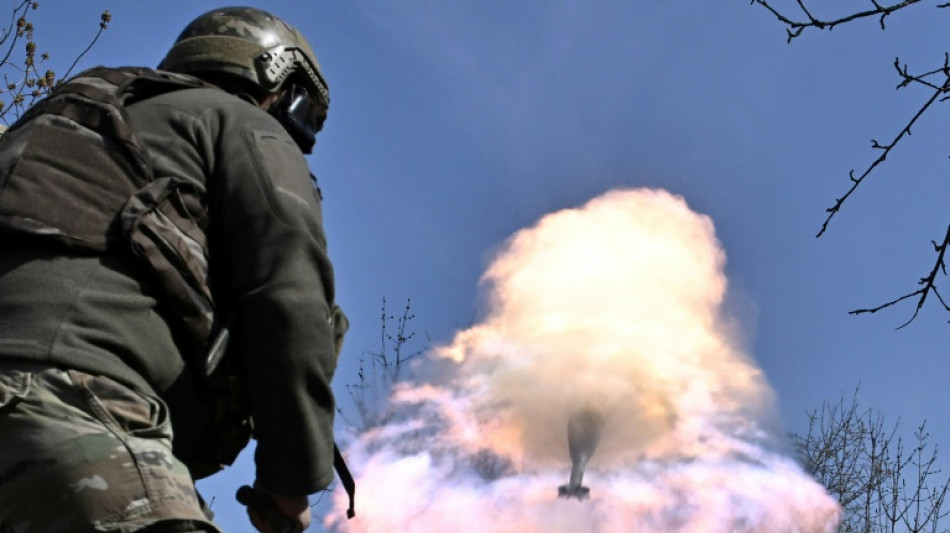
In east Ukraine, Belarusians fight Russia's 'dictatorship' / Photo: © AFP/File

In eastern Ukraine, a few soldiers bustle around an old Soviet mortar stuck in the mud. All Belarusian volunteers, they have taken up arms against Russia's invasion to fight for democracy.
One of them, a 42-year-old named Mark with round spectacles and a pipe dangling from his mouth, looks like he could be a hipster relaxing at a cafe.
Yet here he is crouched between two destroyed houses just three kilometres (two miles) from the ravaged city of Bakhmut on Ukraine's eastern front.
The explosions rocking his surroundings do not seem to bother him as he waits for his order to go pick up a mortar shell for the men to launch.
"I have no military education, I repaired cars my whole life, but I am prepared to do anything to help," he said.
Mark is part of the Kastus Kalinouski Regiment, named after a 19th-century Polish-Belarusian writer and revolutionary who was a leader of an uprising against the Russian Empire.
While he is the least experienced of the group, he was actually the first to arrive in Ukraine, on February 28, 2022, just days after Russia invaded using Belarus as a staging ground.
"When I saw tanks rolling into my country, I left my auto repair shop and packed my bags. Then I joined this battalion formed by a Belarusian friend," he said, beaming with pride.
"It is a war between democracy and dictatorship. And I have picked my side," he told AFP.
- 'Worth dying for' -
Mark entered through Poland to join his fellow volunteer fighters.
His unit's commander, Salam -- in his 30s and sporting a neat moustache and tactical glasses -- is furiously scribbling in his notebook.
He has just received the coordinates of a Russian ammunition depot. In the next moment, he shells it.
"I've been expecting this war since I was little, because I knew that Russia couldn't handle losing its influence over Belarus and Ukraine," he said, once the mortar's deafening sound had faded.
"I thought the war would start in Belarus, but as it turns out, our Ukrainian neighbours were the first to suffer," he added.
Salam said he occasionally finds fault with democracy "but compared to what is happening in Russia, it's a fight worth dying for."
While awaiting further instructions, the soldiers shelter in a cottage cellar -- a chance for each of them to get a little bit of privacy.
Sitting on a lumpy cot, Mark looks at a photo of his child by candlelight. He missed the birth because he set off for war when his wife was still two months pregnant.
Mark knows that returning to his country would mean running the risk of a heavy prison sentence, as the authorities would consider him a "terrorist".
Salam echoes the sentiment: In 2014, after Russia annexed Crimea, "I thought about coming here to back the Euromaidan movement in its fight against Russian imperialism".
"But this time, no excuses! I have to help save Ukrainian society and do my part to free Belarus," he said.
When Salam speaks of his country, the volunteer fighter is unable to hold back tears.
"What led me to all these adventures over the past year is the fact that I cannot go back," he said.
"I am willing to do anything to return to my hometown."
- Only the beginning -
Not far from the mortar, the wounded are brought in from the front to receive first aid.
Among the team of volunteer doctors and nurses is ambulance driver Filin. He is petting a dog while he waits for the next call.
In the span of just a couple of months, the Belarusian went from a regular taxi driver in Poland to a soldier in Ukraine.
"My grandfather used to say that where there are Russians, there is nothing good," he said.
When the war broke out, Filin quit his job and told friends he was "going to Belarus for a week to visit relatives".
"But in fact, I came here," he said.
For Filin, the romance of waging war for democracy vanished once the wounded began appearing.
"I arrived with a rosy outlook, but everything fell apart in one day," he said.
"When you see someone who was literally right next to you being brought back dead five minutes later, your brain doesn't register it at first. You can't comprehend how it's even possible."
For Mark, the fighting in Ukraine "is only half of our journey" before the volunteers turn their attention to Belarus.
"We are learning here, uniting, becoming a brotherhood, but our war still awaits us."
(T.W.Lukyanenko--DTZ)