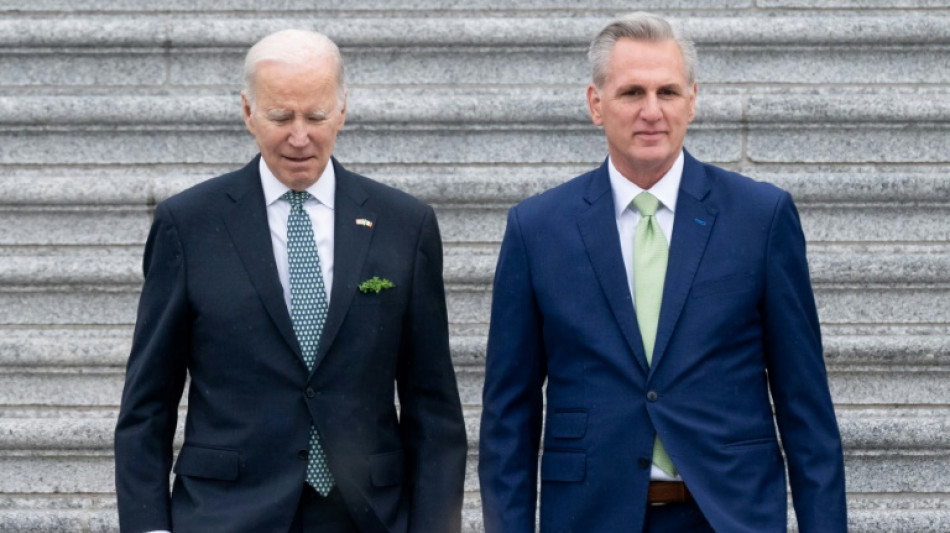
Biden meets Republican leaders in debt limit standoff / Photo: © AFP/File

President Joe Biden will convene a high-stakes meeting with Republican leaders Tuesday in hopes of breaking an impasse over the US debt limit -- with repercussions that could extend to next year's presidential election.
The White House gathering involves Biden, House Speaker Kevin McCarthy and Senate Republican leader Mitch McConnell, setting in motion the deciding round of a power struggle that also threatens massive consequences for the world's largest economy.
The lifting of the national debt ceiling, which allows the government to pay for spending already incurred, is often routine.
But raising the borrowing limit, currently at $31.4 trillion, has been a contentious issue for the past several years, with congressional Republicans pushing for spending curbs and a smaller budget deficit in exchange for lifting the ceiling.
A 2011 impasse resulted in the United States losing the coveted AAA debt rating.
This year, McCarthy and his Republican Party have decided to say no to a debt ceiling hike -- unless Democrats first agree to sweeping budget cuts.
Time is critical. On Sunday, Treasury Secretary Janet Yellen warned that unless Congress acts in the coming weeks, "financial and economic chaos would ensue."
- Digging heels in -
On Tuesday, Biden and the Republicans will be joined by the top Democrats in Congress: House of Representatives Minority Leader Hakeem Jeffries and Senate Majority Leader Chuck Schumer.
"Congress must act. That's what the President is going to make very clear, with the leaders tomorrow. Congress must avoid default without conditions," White House Press Secretary Karine Jean-Pierre said Monday.
But the talks are not anticipated to produce a quick resolution to disagreements.
Biden has called for a "clean" lifting of the US borrowing limit, arguing that the deficit spending has already been approved by Congress and is therefore not up for debate.
Top House Democrat Jeffries, in an interview Sunday, would not commit to supporting a short-term extension of the debt ceiling, saying the "only responsible" move is to approve a clean increase.
Democrats have also referred to a plan passed by House Republicans, to raise the borrowing limit with drastic government spending cuts, as the "Default on America Act."
The Senate is bracing for a clash too, as 43 Republicans in the chamber signed a letter to top Democrat Schumer over the weekend, expressing their collective commitment to oppose raising the debt ceiling "without substantive spending and budget reforms."
Failure to address the debt limit impasse may not just trigger Wall Street turmoil, but could impact Biden politically as he forges ahead into a re-election campaign.
- Uncertainties ahead -
It remains unclear when the government will run out of funds to pay its bills, a situation that could spark financial market unrest and other consequences. Last week, the Treasury warned this could happen as early as June 1.
Should the United States be unable to meet all its obligations, the Treasury would likely prioritize spending so that debt payments and interest payments are made.
But this could mean delays in other areas such as payments to Social Security beneficiaries or Medicare providers.
Financial markets would also be rattled by the uncertainty.
In a recent report, Moody's Analytics projected that the most likely date the Treasury Department will exhaust its accounting measures is June 8, signaling "precious little time" for Democrats and Republicans to reach agreement.
This date means Treasury payments will likely be disrupted for a few days "until a mid-June surge of tax payments materializes" and helps with revenue flows.
But financial markets are sure to react negatively if lawmakers allow this date to arrive, with the consequent selloff in equity markets likely to "catalyze subsequent action on Capitol Hill" to resolve the issue.
While analysts generally expect the impasse will be resolved, Nancy Vanden Houten of Oxford Economics told AFP that the current group of lawmakers could be "more willing to risk something unprecedented in the service of what they are trying to achieve."
"I think the risks are certainly elevated compared to prior debt limit standoffs," she said.
(V.Sørensen--DTZ)