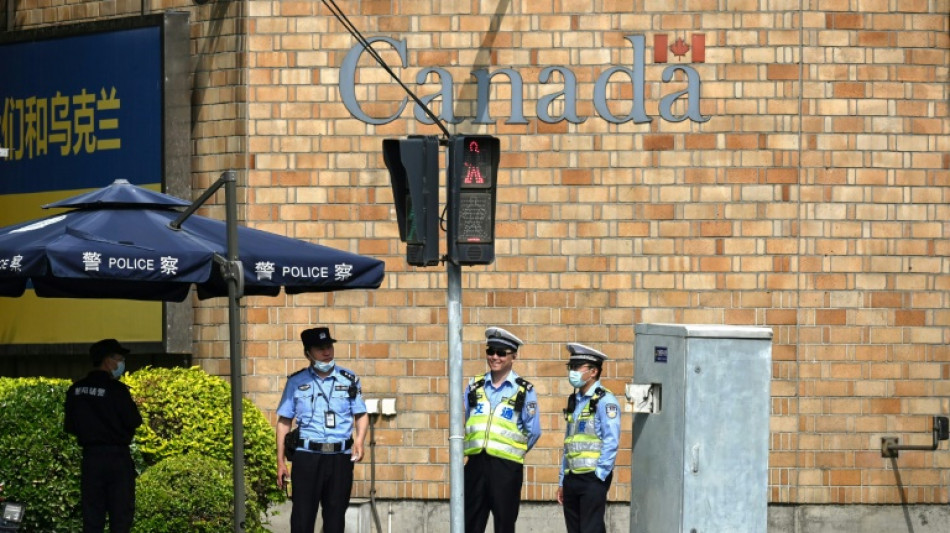
The key issues straining China-Canada relations / Photo: © AFP

Canada's expulsion of a Chinese diplomat accused of intimidating a lawmaker has sparked a fresh row between Ottawa and Beijing.
It was the latest episode in a souring of relations between the two countries that began five years ago:
- Arrest of Meng Wanzhou -
Their once-rosy relations began to sour in 2018 when Canadian police arrested Huawei CFO Meng Wanzhou, who is also the daughter of the Chinese telecom giant's billionaire founder.
The arrest, at the behest of the United States, was linked to fraud charges relating to Meng's alleged efforts to hide violations of US sanctions on Iran involving a Huawei affiliate.
Meng, who now serves as Huawei's rotating chairwoman, remained under house arrest in Vancouver for almost three years while fighting extradition to the United States.
- The two Michaels -
Days after Meng's arrest, China detained two Canadians: former diplomat Michael Kovrig and businessman Michael Spavor.
Beijing was accused of using the two men in a bout of "hostage diplomacy" to pressure Ottawa into releasing Meng.
She was allowed to return to China in September 2021 after striking a deal with US prosecutors.
Hours after that deal was announced, the two Michaels -- who were detained for over 1,000 days -- were put on a plane home.
In December 2022, the US Justice Department dropped all charges against Meng.
- Uyghur 'genocide' -
Canada's growing outspokenness about China's alleged human rights violations has also worsened relations.
In 2021, Canadian lawmakers voted overwhelmingly to declare China's treatment of Uyghurs and other Turkic Muslim minorities in its northwestern Xinjiang region as "genocide".
MP Michael Chong led that effort -- prompting an alleged Chinese plan to target the lawmaker and his relatives in Hong Kong with sanctions.
And in February this year, Canada's parliament unanimously passed a non-binding proposal to take in 10,000 Uyghur refugees who have fled China but are now facing pressure to return.
- Tech battles -
The two countries have also traded barbs over tech, with Canada moving to curb the presence of Chinese firms in its communications infrastructure.
Last May, Ottawa said it would ban Huawei from Canada's 5G networks, citing concerns over national security. Chinese telecom firm ZTE was also banned.
Beijing said the restrictions were imposed "under the pretext of groundless security risks and without any solid evidence".
Canada in February this year followed the United States and the European Commission in banning the Chinese-owned video-sharing app TikTok from all government devices.
- Xi-Trudeau spat -
The bad blood was on full display in November last year at the G20 summit in Indonesia, when Chinese President Xi Jinping gave Canadian Prime Minister Justin Trudeau an on-camera dressing down.
Video recorded by reporters at the summit showed Xi scolding Trudeau over the leaked details of talks between them.
The comments came after Trudeau raised with Xi the issue of what he called Chinese "interference" with Canadian citizens and Beijing's alleged meddling with Canada's democratic and judicial systems.
- Alleged interference -
That issue has since ballooned.
Trudeau in March appointed a special rapporteur to investigate alleged Chinese interference in Canada's last two federal elections, accusations that Beijing denies.
The Globe and Mail, citing unidentified intelligence sources, reported in February that China worked to defeat conservative politicians considered unfriendly to Beijing.
The newspaper also later reported that Ottawa had turned a blind eye to Chinese interference in Canadian affairs.
Citing classified documents and an anonymous security source, it said Chinese intelligence had planned to target lawmaker Chong and his relatives in Hong Kong and "make an example" of him for his alleged anti-Beijing positions.
On Monday, Canada announced that it will expel the Chinese diplomat accused of trying to intimidate Chong.
China responded with a warning for Canada to "step back from the brink".
(Y.Leyard--DTZ)