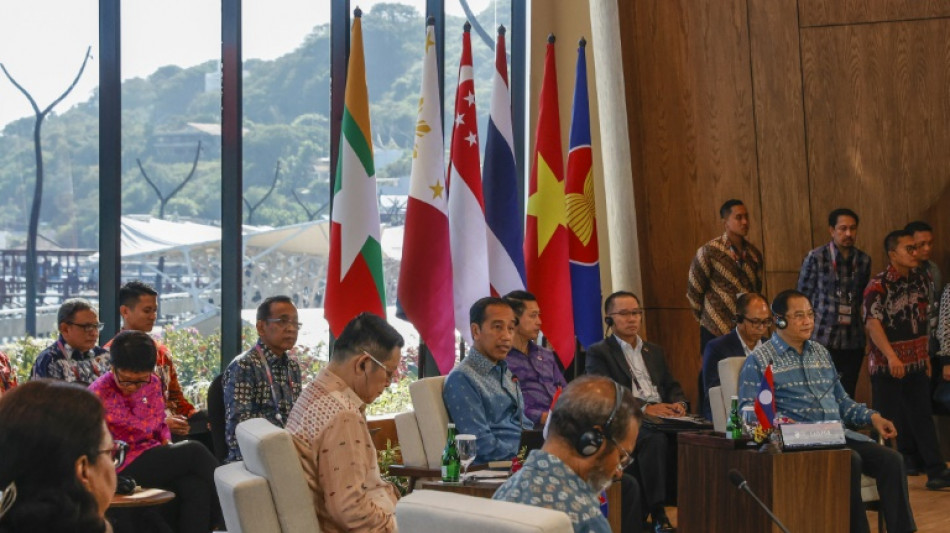
Indonesian president says no real progress on Myanmar peace plan / Photo: © POOL/AFP

Southeast Asian nations have made "no significant progress" on implementing a peace plan to end the bloodshed in Myanmar, Indonesian President Joko Widodo said Thursday as a summit wrapped up.
Violence in junta-ruled Myanmar dominated the three-day meeting of the Association of Southeast Asian Nations (ASEAN) on the Indonesian island of Flores.
Since the Myanmar military ousted civilian leader Aung San Suu Kyi's government in 2021 it has overseen a bloody crackdown on dissent that has killed thousands of people.
ASEAN has spearheaded diplomatic efforts to resolve the crisis but its mostly fruitless attempts to enact a five-point plan agreed upon with Myanmar two years ago have fuelled warnings the regional bloc risks irrelevance.
"I have to be honest that on the implementation of the five-point consensus, there's been no significant progress," Widodo said on the final day of talks in the fishing town of Labuan Bajo.
Widodo insisted ASEAN members must remain united in resolving the crisis or risk the "break up" of the bloc.
"There cannot be a party within or outside ASEAN that can benefit from internal strife in Myanmar. The violence must end," he told reporters through a translator.
But the member countries were divided over how to handle the issue.
An internal report on discussions this week between foreign ministers of the bloc said some countries wanted to invite the junta back to ASEAN meetings because "the time for isolation has served its purpose".
"There was also an observation that ASEAN might be experiencing a 'Myanmar fatigue', which might distract ASEAN from larger goals of ASEAN community building," said the document seen by AFP.
- Hamstrung -
Myanmar still belongs to the 10-member ASEAN bloc but has been barred from its summits due to the junta's failure to implement the peace plan.
The military has spurned international criticism and refused to engage with its opponents, which include ousted lawmakers, anti-coup "People's Defence Forces" and armed ethnic minority groups.
An air strike on a village in a rebel stronghold last month that reportedly killed about 170 people sparked global condemnation.
Jakarta's chairing of the bloc this year had raised hopes that ASEAN could succeed in pushing for a peaceful solution, using its economic weight and diplomatic experience.
But beyond expressing concern over the continued bloodshed, ASEAN leaders at the summit did not come up with anything concrete to move the peace process forward.
An end-of-summit statement did not provide a timetable or plan for implementation of the five-point consensus.
There are fears that peace efforts could stall next year when communist-ruled Laos becomes chair.
ASEAN leaders at the summit also discussed "serious incidents" in the South China Sea and ongoing negotiations for a code of conduct aimed at reducing the risk of conflict there.
Beijing claims almost the entire sea while four ASEAN countries -- the Philippines, Malaysia, Vietnam and Brunei -- have overlapping claims to part of it.
"We must ensure that the South China Sea does not become a nexus for armed conflict," Philippine President Ferdinand Marcos told the gathering.
ASEAN has long been decried by critics as a toothless talking shop, and its charter principles of consensus and non-interference have hamstrung its ability to take action.
Malaysian Prime Minister Anwar Ibrahim said it was time to review the non-interference principle to give ASEAN the ability to deal with challenges such as the Myanmar crisis that have regional implications.
ASEAN needs "a new vision that could give us some flexibility in order to navigate and manoeuvre the way forward", he told fellow leaders in a video posted on his Twitter account.
(O.Tatarinov--DTZ)