Fresh clashes on Armenia-Azerbaijan border / Photo: © AFP

Fresh border fighting erupted Friday between Armenian and Azerbaijani forces, both sides said, a day after deadly clashes threatened to derail EU-led weekend peace talks between the two countries.
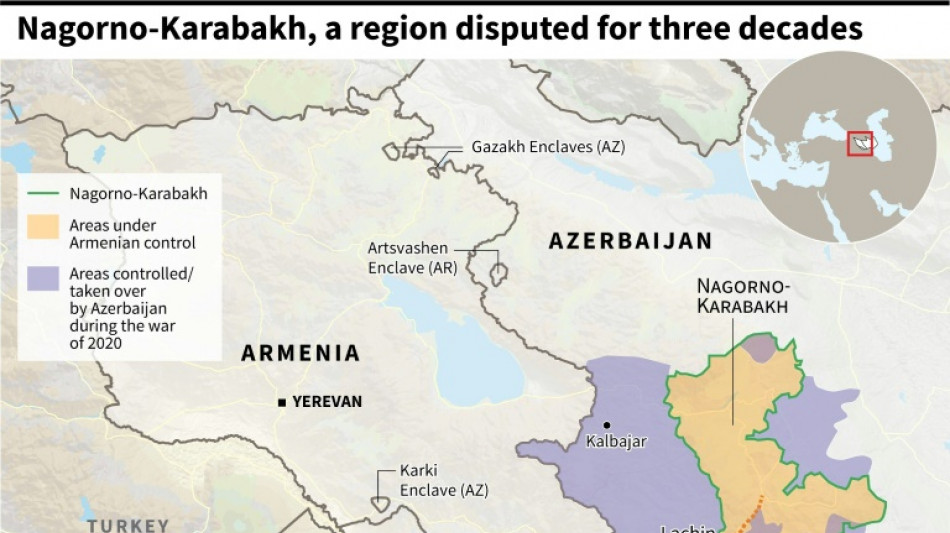
The Caucasus neighbours are locked in a decades-long territorial dispute over Azerbaijan's Armenian-populated region of Nagorno-Karabakh, over which they have fought two wars.
On Friday morning, "Azerbaijani Armed Forces violated the ceasefire in the direction of Sotk (eastern part of the state border) using UAVs (drones)," said a defence ministry statement from Yerevan.
Two of its soldiers had been wounded and one was in critical condition, it added.
Later Friday, the ministry said Azerbaijani forces had opened fire using heavy weapons on the Armenian positions near the village of Kut, in the Gegharkunik province near the border with Azerbaijan.
Azerbaijan's defence ministry said: "Armenian armed forces opened fire from trench mortars on Azerbaijani positions" at the border.
On Thursday, an Azerbaijani serviceman was killed and four Armenian troops were wounded during border clashes.
Armenian Prime Minister Nikol Pashinyan and Azerbaijani President Ilham Aliyev are scheduled to meet Sunday in Brussels for talks led by European Council President Charles Michel.
The rival leaders have also agreed to jointly meet the leaders of France and Germany on the sidelines of a European summit in Moldova on June 1, according to the EU.
- Western mediation -
On Thursday, Pashinyan accused Azerbaijan of seeking to undermine the talks in Brussels. He warned there was "very little" chance of signing a peace deal with Azerbaijan at the meeting.
A draft agreement "is still at a very preliminary stage and it is too early to speak of an eventual signature", Pashinyan said.
The EU-led diplomacy comes after US Secretary of State Antony Blinken brought the Azerbaijani and Armenian foreign ministers to Washington for talks in early May.
The West has stepped up mediation as the influence of Russia, historically the major powerbroker between the former Soviet republics, has waned since its invasion of Ukraine.
Armenia, which has traditionally relied on Russia as its security guarantor, has grown increasingly frustrated with Moscow.
It has accused Russia of having failed to fulfil its peacekeeping role when Azerbaijani activists blocked Karabakh's only land link to Armenia last December.
The two countries went to war in 2020 and in the 1990s over disputed territories, mainly Nagorno-Karabakh.
Tens of thousands of people have been killed in the two wars over the region.
(Y.Leyard--DTZ)