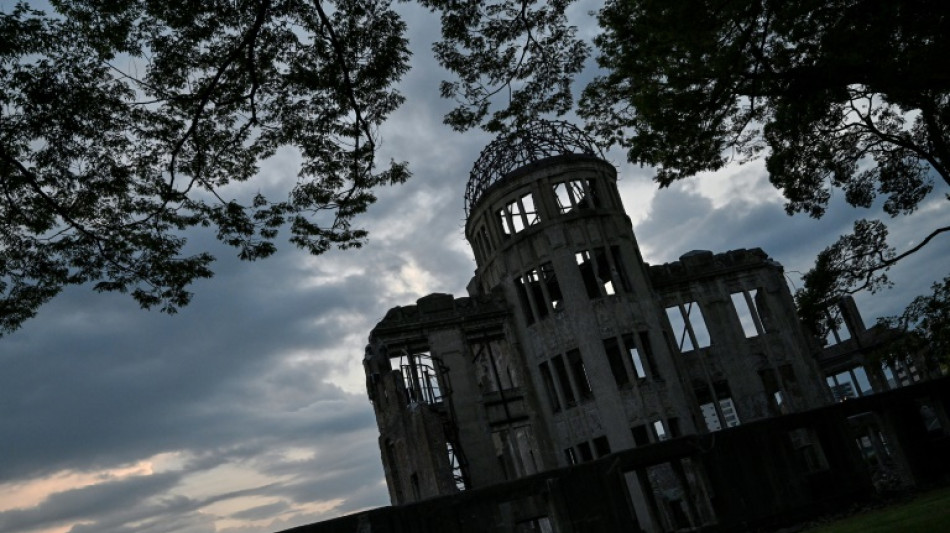
G7 leaders meet to pressure Russia, find China unity / Photo: © AFP

G7 leaders meet in Hiroshima this week looking to tighten the screws further on Russia over the Ukraine war and agree a united line on China's growing military and economic power.
The three-day summit of leading developed democracies will cover everything from energy to AI, but a key focus will be targeting those who have helped Moscow blunt the impact of Western-led sanctions.
The leaders will also chart a careful course on Beijing, projecting unity on Taiwan and emphasising the need to "de-risk" crucial supply chains by diversifying away from China, while also attempting to avoid further inflaming tensions.
Last month's G7 foreign ministers' meeting, seen as setting the stage for the Hiroshima talks, had a heavy focus on China, and put Beijing on notice over "militarisation activities" in the South China Sea.
It also insisted there was "no change" on Taiwan policy after French President Emmanuel Macron, following a trip to Beijing last month, said Europe should avoid "crises that aren't ours".
Ministers warned Beijing on everything from its nuclear arsenal to its business practices, and this week's summit is expected to endorse extracting crucial supply chains from Chinese influence.
Washington has taken an aggressive approach, blocking China's access to the most advanced semiconductors and the equipment to make them, and has convinced Japan and the Netherlands to follow suit.
But Europe's foreign policy chief this week warned the bloc needs to "define" and "recalibrate" its position.
"We seek a multifaceted approach to our economic relationships with China," European Commission President Ursula von der Leyen said Monday.
"It is characterised by de-risking, and not decoupling," she added.
- 'Vulnerable to coercion' -
She cited specific examples of Chinese attempts at economic coercion, targeting Lithuania, Japan and Australia.
"We are most vulnerable to coercion... where dependencies build up. That's why we are taking action," she added, calling critical raw materials one area for work.
Europe has already enraged Beijing by proposing to restrict exports of sensitive tech to eight Chinese firms suspected of shipping it on to Russia.
And the Hiroshima summit is expected to push for similar actions to help close gaps in the sanctions regime G7 countries have imposed on Russia.
The bloc groups Japan, Britain, the United States, Canada, France, Germany, Italy and the European Union.
Ukrainian President Volodymyr Zelensky, fresh off a tour of European capitals before an expected spring offensive, will address the summit by video.
"I expect key issues will be sanctions compliance and enforcement, especially in non-aligned, Global South countries, as well as potentially lowering the oil price cap, which Ukraine is pushing for," said Maria Snegovaya, senior fellow for Russia and Eurasia at the Center of Strategic and International Studies (CSIS).
- 'Anti-West messaging' -
An unusually long list of non-G7 invitees will be present, as Japan tries to expand the bloc's influence in the developing world, with leaders from India, Brazil and Indonesia among those taking part.
While the war in Ukraine has breathed new relevance into the G7, Tokyo and others believe more efforts are needed to win over major unaligned countries who are reluctant to take sides in disputes with Moscow and Beijing.
The need is heightened by the gridlock in the larger Group of 20, where China and Russia have opposed references to the Ukraine war.
"Japan believes that both China and, to a lesser degree, Russia, are making inroads with economic assistance and anti-West messaging," said Chris Johnstone, Japan chair at CSIS.
Other invitees include African Union chair Comoros, Pacific Island Forum chair the Cook Islands, ASEAN chair Indonesia, and Vietnam.
Australia and South Korea, with which Japan is quickly patching up long-frayed ties, will also take part.
The G7 leaders are expected to issue a statement on disarmament, which Japanese Prime Minister Fumio Kishida has tried to move up the agenda by hosting the meeting in his constituency of Hiroshima.
Both G7 leaders and non-members are likely to visit the Peace Park and museum.
On the sidelines, a US-South Korea-Japan trilateral will help further cement efforts to rebuild ties between Tokyo and Seoul.
In a first, Kishida and his counterpart Yoon Suk Yeol are expected to visit a memorial to Koreans killed in the atomic bomb attack.
(V.Sørensen--DTZ)