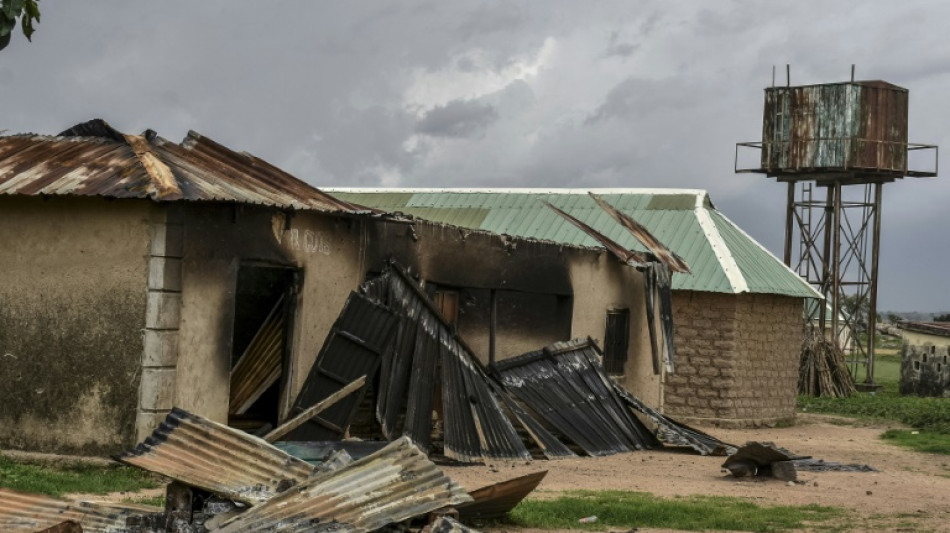
Huge security challenges await Nigeria's new president / Photo: © AFP/File

Violence has surged in Nigeria following a brief lull for elections earlier in the year, serving as a cruel reminder of the significant security challenges faced by incoming President Bola Tinubu.
Barely a week goes by in Africa's most populous nation without attacks or kidnappings by criminals known as "bandits" in the northwest and centre, jihadists in the northeast or separatists in the southeast.
It was feared that the frequency and intensity of the violence would threaten elections held in February and March, with the relative calm during the polls surprising many observers.
Tinubu, the 71-year-old winner of the presidential election, is set to be sworn-in on May 29.
He will take over from 80-year-old Muhammadu Buhari of the same party, who has been accused of not delivered on his promise to tackle entrenched insecurity during his two terms.
Despite the opposition claiming electoral fraud during the polls, officials have said the voting was free and fair, declaring Tinubu the winner.
One of the new government's most urgent tasks will be to tackle insecurity, which has resurfaced in full force since April.
"More than 100 people dead and 3,000 displaced after clashes", "25 kidnapped from a church", "US convoy attacked by gunmen" -- those are just some of the recent headlines in the country.
- 'Little or no resistance' -
For Emeka Okoro, security analyst with the Lagos-based consultancy SBM Intelligence, "the incoming president will likely face significant security challenges upon assuming office."
The most urgent, Okoro told AFP, is in the centre and northwest of the country, where old tensions between herders and farmers have morphed into a deadly conflict involving heavily armed criminal gangs.
Impunity as well as insufficient security and wider government presence has allowed the violence to fester, Okoro said, despite some ongoing military operations against the groups.
Bandits "invade a community, kill people and destroy their properties, with little or no resistance from the security officials," said Muhammadu Sa'ad Abubakar III, the Sultan of Sokoto, one of the states affected by the violence.
During the presidential campaign, Tinubu promised that he would "accelerate the reforms commenced" under Buhari "in building a more robust, re-energised armed forces."
He said he would "recruit, train and better equip additional military, police, paramilitary and intelligence personnel."
But for Idayat Hassan, of the Abuja-based Centre for Democracy and Development, the incoming administration should also move towards "a non-military" approach and address some of the root causes of the violence.
"This includes (tackling) unemployment, poverty, addressing real and perceived marginalisation, justice sector reform... stemming the flow of arms and securing the borders," she said.
- Jihadist conflict -
A major front for the Tinubu administration is the 14-year-old jihadist insurgency in the northeast, which has resulted in some 40,000 deaths and two million more displaced.
Under Buhari, the military recaptured territory that had been under the control of the jihadist group Boko Haram. But rivals linked to the Islamic State group, ISWAP, have since emerged as the dominant threat.
The choice of Tinubu's vice president Kashim Shettima, the former governor of the most affected region Borno State, could "make a lot of difference" in ending the conflict, Hassan said, though some have blamed Shettima for deteriorating security when he was in office.
In the southeast, Tinubu also faces separatist agitation, a highly sensitive issue in Nigeria where around one million people died in a three-year civil war in the late 60s between federal forces and Igbo secessionists.
To this day, some in the southeast feel marginalised and were disappointed that Igbo presidential candidate Peter Obi lost to Tinubu.
Hassan said she believed it is "unlikely security will improve in the southeast" unless the "Tinubu administration builds bridges."
Many Nigerians are also hoping that the new government will put an end to years of grave human rights abuses reportedly committed by security forces across the country.
Human Rights Watch, one of the organisations that has documented rights violations in the country, has urged Tinubu to "reverse course on significant human rights backsliding."
(V.Korablyov--DTZ)