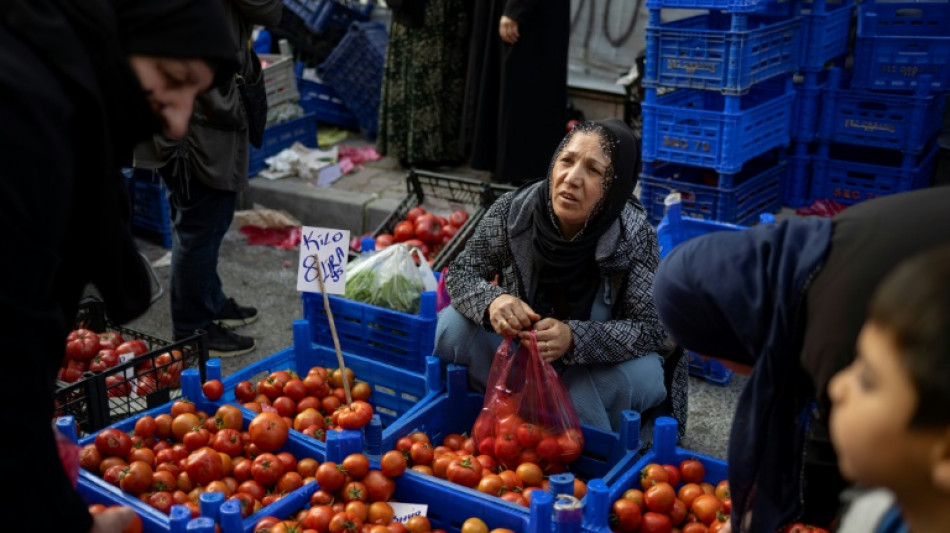
Erdogan's priorities for last term as Turkey president / Photo: © AFP

Recep Tayyip Erdogan has a huge in-tray waiting for him at his presidential palace after extending his two-decade rule over Turkey for one last time in Sunday's runoff.
From a crippling economic crisis to a diplomatic standoff with allies, AFP examines the priorities facing Turkey's longest-serving leader.
- Fight against inflation -
A biting cost-of-living crisis has eroded Turks' purchasing power, with annual inflation running at around 40 percent in April after officially peaking at 85 percent last year.
Spiralling prices were exacerbated by Erdogan's unorthodox policy of cutting interest rates in the belief they would lower inflation, a stance he doubled down on during the election campaign.
The central bank justified its last cut of 0.5 percentage points in February as a way of supporting jobs and industrial production after that month's devastating earthquake.
The policy rate Turkey set for banks is now far below that at which prices are rising, meaning that people are effectively losing money if they leave their liras unspent in their accounts.
This is speeding up spending, further feeding the inflationary spiral.
The lira has lost more than half of its value in two years and on Friday briefly traded at 20 liras to the dollar for the first time, despite massive state interventions aimed at averting politically sensitive falls before the vote.
Official data showed the central bank burning through $25 billion in a month while trying to prop up the lira.
- Sweden's NATO bid -
Turkey's NATO partners, led by the United States, are anxious for Ankara to lift its veto on Sweden joining the world's most powerful defence alliance.
Stockholm applied to join with Nordic neighbour Finland in 2022 after Russia's invasion of Ukraine triggered a major shift in the countries' long history of military non-alignment.
But Ankara blocked the bids, demanding the extradition of Turkish figures suspected of links to outlawed Kurdish militants.
Sweden's adoption of fresh anti-terrorism legislation, a new constitution and high-level diplomatic talks have not swayed Ankara and fellow holdout Hungary to ratify the bid.
NATO foreign ministers meet in Oslo a few days after the election, hoping for progress on the issue before a summit of heads of state in Lithuania this July.
Turkey eventually ended its opposition to the entry of Finland, which became NATO's 31st member earlier this year.
- Reconciliation with Syria -
Relations with neighbouring Syria are at a low ebb after Erdogan backed opposition forces who took up arms to overthrow President Bashar al-Assad during the country's long and bitter civil war.
In 2016, Ankara launched the first of several incursions against jihadist and Kurdish fighters in northern Syria and maintains a military presence there.
Erdogan has attempted to mend ties in recent months, but Russian-mediated talks have failed to normalise diplomatic relations even as Assad emerges from years of isolation with Arab neighbours.
As a precondition to any meeting with Turkey's head of state, Assad has demanded the withdrawal of Turkish forces from rebel-held parts of northern Syria and the end of support for armed opposition groups.
Turkey also seeks to return the more than three million Syrian refugees who made the country home after fleeing the conflict.
Erdogan's government this month announced plans to build hundreds of thousands of housing units in northern Syria to facilitate the "voluntary" return of at least one million people.
- Earthquake reconstruction -
The 7.8-magnitude earthquake that struck on February 6 devastated swathes of southeastern Turkey, killing more than 50,000 people and reducing entire cities to mounds of rubble.
In addition to the vast loss of life, the economic and social challenges posed by the disaster remain colossal almost four months on.
Hundreds of thousands of traumatised survivors were displaced and many are still living in tents or other temporary accommodation.
Some rely on humanitarian assistance for essentials such as food, water, clothing and medical supplies.
The cost of the damage is officially estimated at more than $100 billion and the huge reconstruction effort is still at an early stage.
A fundraising conference hosted by the European Union in Brussels in March raised donor pledges worth seven billion euros ($7.5 billion) for Turkey as well as Syria, which was also affected.
Europe's development bank cut its outlook for Turkey's 2023 economic growth partly due to the catastrophe, with hundreds of thousands of people losing their livelihoods overnight.
(O.Tatarinov--DTZ)