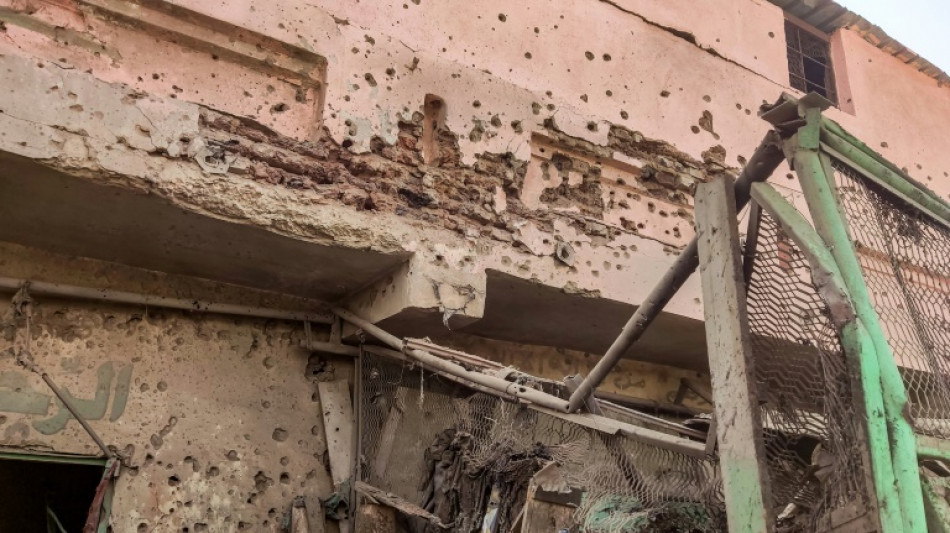
US slaps sanctions on Sudan warring sides as ceasefire crumbles / Photo: © AFP

The United States announced sanctions Thursday on Sudanese leaders it blames for the breakdown of US and Saudi-brokered ceasefire efforts after shelling and air strikes killed 18 civilians at a Khartoum market.
For nearly seven weeks, Khartoum and other parts of Sudan have been gripped by deadly fighting between the army and the paramilitary Rapid Support Forces, both of which Washington held responsible for violating the ceasefire and provoking "appalling" bloodshed.
Fighting continued Thursday, with witnesses reporting "heavy artillery fire" in north Khartoum, days after the two sides had agreed to extend a ceasefire meant to allow essential aid deliveries.
On Wednesday, the army blasted RSF bases in the capital after pulling out of the truce talks in the Saudi city of Jeddah, accusing its rival of violating the ceasefire.
"Eighteen civilians were killed and 106 wounded" by army shelling and air strikes on a market in south Khartoum, a committee of human rights lawyers said.
The toll was confirmed by a neighbourhood group that organises aid, which said the situation was "catastrophic" and appealed for medical help and blood donations.
In both north and south Khartoum on Wednesday, troops loyal to army chief Abdel Fattah al-Burhan attacked key bases of the RSF led by commander Mohamed Hamdan Daglo, residents told AFP.
- Sanctions 'a tool' -
"We are following through by levying economic sanctions, imposing visa restrictions against actors who are perpetuating the violence," US National Security Advisor Jake Sullivan said in a statement.
The sanctions target four companies, according to the US Treasury Department, including two affiliated with the army.
Of the two linked to the RSF -- run by Daglo and two of his brothers -- one is involved in Sudan's gold mining industry.
A 2019 investigation by non-profit Global Witness found that both RSF-linked companies funnelled millions of dollars through dirham accounts in the United Arab Emirates.
"Sanctions are a tool," according to Sudan expert Alex de Waal, who calls the north African country "a classic case where sanctions never solved the problems" they had meant to.
Sudan's warring sides amassed considerable wealth during the rule of longtime dictator Omar al-Bashir, whose government was subjected to decades of international sanctions before his overthrow in 2019.
Daglo's RSF controls many of the country's lucrative gold deposits.
According to Sudanese pro-democracy activist and author Raga Makawi, sanctions bring "inhumane consequences on communities and cities at large: they weaken economies and turn them towards illicit transactions".
Since fighting erupted on April 15, more than 1,800 people have been killed, according to the Armed Conflict Location and Event Data Project.
The UN says 1.2 million people have been displaced inside Sudan and more than 425,000 have fled abroad.
Humanitarian corridors that had been promised under the latest ceasefire never materialised, according to aid agencies that have managed to deliver a fraction of the relief supplies they need.
"The security situation is significantly hampering our ability to undertake humanitarian activities in Khartoum," said Fatima Mohammed Cole of the UN refugee agency (UNHCR) after two of its offices in the capital were looted.
- Looting of food -
World Food Programme chief Cindy McCain condemned "the looting of WFP food and assets happening right now in El Obeid", the North Kordofan state capital.
"Food for 4.4 million people is at stake," McCain wrote on Twitter.
More than half the population -- 25 million people -- are now in need of aid and protection, the UN says.
Entire districts of Khartoum no longer have running water, electricity is only available for a few hours a week, and three quarters of hospitals in combat zones are not functioning.
Hundreds have been killed in Darfur, on Sudan's western border with Chad, the United Nations said.
The UNHCR said more than 100,000 Sudanese refugees had fled to Chad since April, and called for emergency financial support.
Darfur has never recovered from a years-long conflict that erupted in 2003 between ethnic minority rebels and Arab tribes recruited by Bashir's government to form the notorious Janjaweed militia, from which the RSF are descended.
Analysts say Burhan has been facing mounting pressure from his own Islamist supporters and remnants of the Bashir regime.
(L.Møller--DTZ)