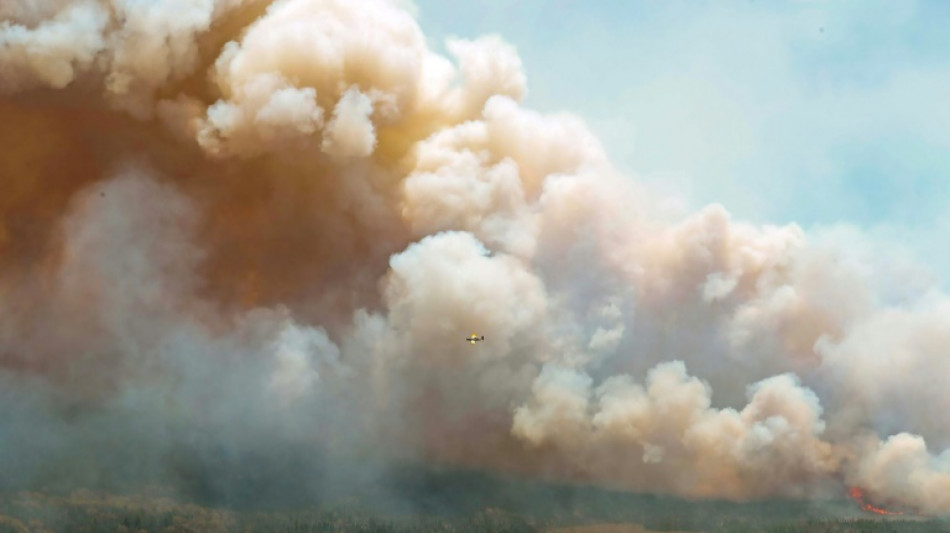
Heat wave and wildfires scorch east Canada / Photo: © Nova Scotia Government/AFP

Eastern Canada sweltered under a record-breaking heat wave on Thursday that risked inflaming wildfires ravaging the Atlantic coast and other parts of the country with "unprecedented" ferocity and scale.
More than 210 fires were burning across Canada, including 82 out of control. And more than 2.7 million hectares have been scorched already this year, eight times more than the last three decades' average, say officials.
"These conditions this early in the season are unprecedented and of course they are deeply concerning," Emergency Preparedness Minister Bill Blair told a news conference in Ottawa.
After major flareups in the west of the country in May, notably in the Prairies provinces of Alberta and Saskatchewan, firefighting shifted in the past week to Nova Scotia on the Atlantic coast -- which is unaccustomed to severe wildfires -- following hot, dry weather moving eastward.
"It's a simple fact that Canada's experiencing the impacts of climate change, including more frequent and more extreme wildfires," Natural Resources Minister Jonathan Wilkinson said, projecting the amount of forest burned by wildfires to double by 2050.
In Nova Scotia, 16 fires were burning on Thursday. Two hundred homes have been destroyed and nearly 20,000 residents have been displaced.
"The numbers are really breath-taking," said Nova Scotia Premier Tim Houston. "Our province is experiencing tremendous trauma."
The Coast Guard and water bombers from neighboring provinces have been helping out, additional kit has been shipped in from Ontario, and firefighters from the United States and South Africa are en route.
"We are far from being out of the woods. We are still dealing with a very dangerous and volatile situation," local natural resources official David Steeves said.
"We need Mother Nature to get on side with us on this."
- Hot, hot, hot -
A large blaze that forced the evacuation of more than 16,000 residents threatens the northwest suburbs of Nova Scotia's main city of Halifax, though it now appears to be partially under control.
But another fire near Lake Barrington poses a challenge for fire crews after burning more than 20,000 hectares. It is the largest fire ever recorded in the province.
More than 2,000 residents in the path of that fast-moving blaze were forced to flee at a moment's notice earlier this week.
Smoke from the fires has covered much of the province and blew down the Atlantic coast, prompting air quality alerts for the US state of New Jersey and parts of Pennsylvania, including the Philadelphia area.
Major Canadian cities Montreal and Toronto, as well as the capital Ottawa saw temperatures soar above 30 degrees Celsius (86 Fahrenheit), breaking heat records.
Line Blette, a construction worker in downtown Montreal, drenched herself with water to cool down, telling AFP: "It's the only way to we can work."
Passerby Nora Amar, 33, sporting a white hat to protect her from the sun, said the city needs more trees to provide shade as the weather undergoes "a drastic change."
In Ottawa, vendors at the ByWard Market were busy watering potted plants and herbs.
Christine Shaikin, sipping an iced drink outside a coffee shop on a nearby shaded cobblestone path, pulled a "cooling shirt" soaked in cold water over her dog to keep it from overheating.
"I keep her indoors mostly, and then let her out a little bit in the morning before it gets really too hot," Shaikin said.
In Western Canada, more than 60 fires are still burning in oil-rich Alberta -- about half the peak number at the start of May that triggered a state of emergency -- and about 20 in neighboring Saskatchewan province.
Canada, which is warming faster than the rest of the planet due to its far north location, has been hit repeatedly by extreme weather in recent years, exacerbated by global warming.
(N.Loginovsky--DTZ)