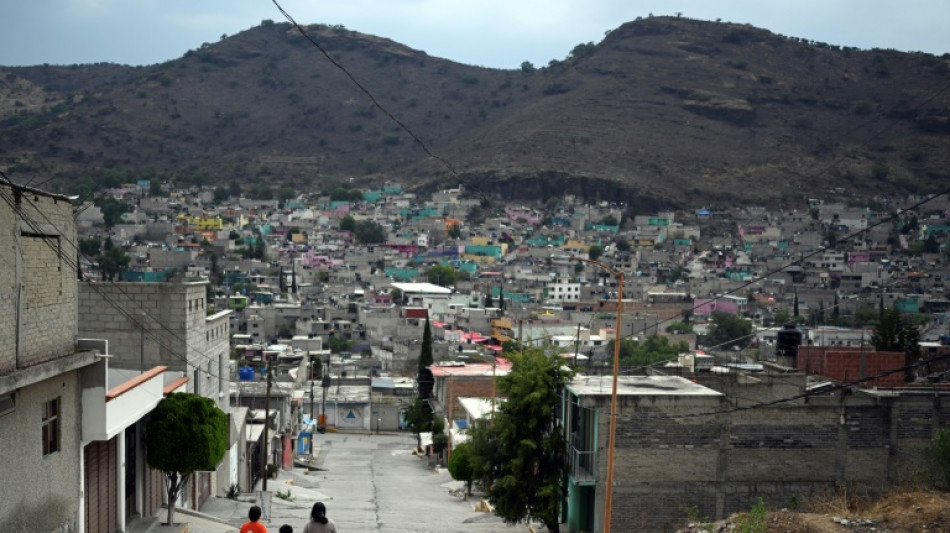
Mexican 'mini-republic' votes in prelude to presidential election / Photo: © AFP

Sara Esquivel gets up before dawn to arrive at work in Mexico City on time. She travels by crowded public transport, afraid of being robbed, but she has no choice.
It is a daily struggle to survive in her neighborhood of Los Reyes La Paz in the sprawling State of Mexico, home to 16.9 million people who will elect a new governor on Sunday.
The vote is a test of the popularity of President Andres Manuel Lopez Obrador's ruling Morena party ahead of presidential elections next year.
It takes two hours by bus and subway to reach the mansions and skyscrapers of the capital from Esquivel's corner of the country's most populous state, but good jobs are scarce closer to home.
"I had to travel further to work because there are expenses in this house. I had to support three children, pay the rent, the electricity, the telephone," the 54-year-old cleaner told AFP.
In Los Reyes and similar districts, a store employee earns about 800 pesos ($45) a week, so every day thousands of people commute to the capital where they can earn double that.
- 'Deeply fragmented' -
The State of Mexico is in many ways a microcosm of the country: half of its population lives in poverty.
Many of its residents lack basic services, even though they sometimes live alongside wealthy areas replete with luxurious homes that illustrate the glaring wealth inequalities of the Mexico City metropolitan area.
The State of Mexico is also home to the famous Teotihuacan pyramids and the plants of foreign industrial giants such as Nestle and Ford.
It has the second-biggest economy out of Mexico's 32 states.
"It's a deeply fragmented Mexican mini-republic" that includes both economically and politically connected modern areas, as well as more traditional and rural zones, said Miguel Tovar, a political scientist at the consulting firm Alterpraxis.
On Sunday, Delfina Gomez, a former teacher affiliated with Lopez Obrador's Morena party, hopes to win the governorship of the State of Mexico.
A victory for Gomez would end nine decades of dominance of the State of Mexico by the Institutional Revolutionary Party (PRI), which ruled the country for more than 70 years until 2000.
Now it is Morena that is tightening its grip across the country.
Despite approval ratings of around 60 percent, however, the constitution requires Lopez Obrador to leave power next year at the end of a single six-year mandate, leaving his political allies jostling to replace him.
- Risk-filled commute -
Sunday's election is also a reminder of the lack of opportunity, insecurity, and inequality that people like Esquivel face throughout Mexico.
Her daily commute involves fighting for space on crowded bus and subway lines where robbery is common.
In contrast, the affluent neighborhoods where she works "don't have any problems," she said.
"There's no crime because they're areas with money," added Esquivel, who hopes that the new governor will at least put security cameras in the buses she uses.
The State of Mexico has the second-highest number of murders out of the country's 32 states -- more than 900 between January and April of this year, out of a total of around 9,900 nationwide.
Juan Jose Mendez, a 50-year-old resident, said that police avoid his district, Tlalnepantla, and being sent there is seen as a punishment for them.
"They keep treating us as if we were just a town or a ranch," he said in the cleaning products business that he opened due to the lack of jobs.
Esquivel leaves home when it is still dark and returns at night, doing her best to avoid falling victim to robberies that sometimes turn violent.
She fears for the safety of her adult daughters, since the State of Mexico registers the country's highest rates of gender violence.
Living in Mexico City itself is not an option given the cost of living in the capital.
Years of broken promises mean residents like Esquivel and Mendez are not getting their hopes up ahead of Sunday's vote.
"It's always the same story," Mendez said.
(P.Hansen--DTZ)