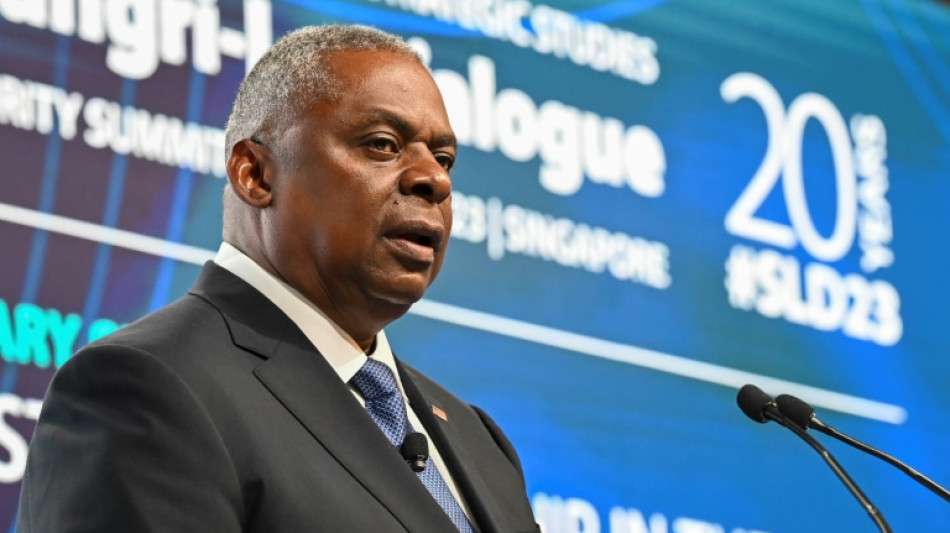
US says talks with China 'essential' to curb risk of conflict / Photo: © AFP

US Secretary of Defense Lloyd Austin said Saturday it was "essential" to renew dialogue with China to avoid "misunderstandings" that could lead to a conflict between the two superpowers.
The United States had invited Austin's Chinese counterpart Li Shangfu to meet on the sidelines of a defence summit in Singapore, but the Pentagon said Beijing declined.
A member of China's delegation told AFP that the removal of US sanctions on its minister is a precondition for talks.
"The United States believes that open lines of communication with the People's Republic of China are essential -- especially between our defence and military leaders," Austin told the Shangri-La Dialogue.
"The more that we talk, the more that we can avoid the misunderstandings and miscalculations that could lead to crisis or conflict."
Austin is on a tour of Asia that previously took him to Japan and will also include a visit to India -- part of a push by top US officials to shore up regional alliances and partnerships to help counter a more assertive China and an increasingly bellicose North Korea.
In his speech Saturday, Austin said he was "deeply concerned that (China) has been unwilling to engage more seriously on better mechanisms for crisis management between our two militaries", expressing hope that this would soon change.
Li, who will address the meeting on Sunday, was sanctioned by the US government in 2018 for buying Russian weapons, but the Pentagon says that does not prevent Austin from conducting official business with him.
Members of the Chinese delegation hit back swiftly over Austin's remarks, with Senior Colonel Tang Hefei, spokesperson for China's defence ministry, saying that the Pentagon chief "made several false accusations".
Another Chinese delegation member, Senior Colonel Zhao Xiaozhuo, said Washington had no business telling China what to do.
"What we do in the Chinese military is based on maintaining the core interests of China's security, which is fundamental," he said.
Zhao said removing the sanctions on Li is "one of the pre-conditions for substantial talks" with Austin.
Tensions between Washington and Beijing have soared this year over issues including Taiwan and an alleged Chinese spy balloon that was shot down by a US warplane after traversing the country.
Austin and Li shook hands and spoke briefly for the first time at the opening dinner on Friday, but there was no substantive exchange.
While high-level military-to-military ties between the United States and China have been cut off for months, other top US officials are still in communication with Beijing.
CIA Director William Burns made a secret trip to China last month, while US National Security Advisor Jake Sullivan and top Chinese diplomat Wang Yi met in Vienna in May.
- 'Risky intercepts' -
Austin also took aim at Beijing for conducting "an alarming number of risky intercepts of US and allied aircraft flying lawfully in international airspace", including one last week.
In that incident, the US military said a Chinese fighter pilot performed an "unnecessarily aggressive" manoeuvre near a US surveillance aircraft over the South China Sea.
Video footage released by the US military showed a Chinese jet crossing in front of the US aircraft, which could be seen shaking from the resulting turbulence.
But China's military said the US plane "broke into" a military training area.
Another recent flashpoint in China-US relations has been high-end microchips.
Beijing said last month that US semiconductor giant Micron had failed a national security review and would not be allowed to sell to operators of "critical information infrastructure".
The announcement came after Washington and its allies took measures in recent months that China claimed were designed to restrict its ability to purchase or manufacture cutting-edge chips.
In April, Beijing launched three days of military exercises around Taiwan, simulating targeted strikes and a blockade of the democratic, self-ruled island.
China considers Taiwan a part of its territory to be taken one day and the island lives under the constant fear of invasion.
The Chinese exercises came in response to a meeting between Taiwanese President Tsai Ing-wen and US House Speaker Kevin McCarthy in California.
(Y.Ignatiev--DTZ)