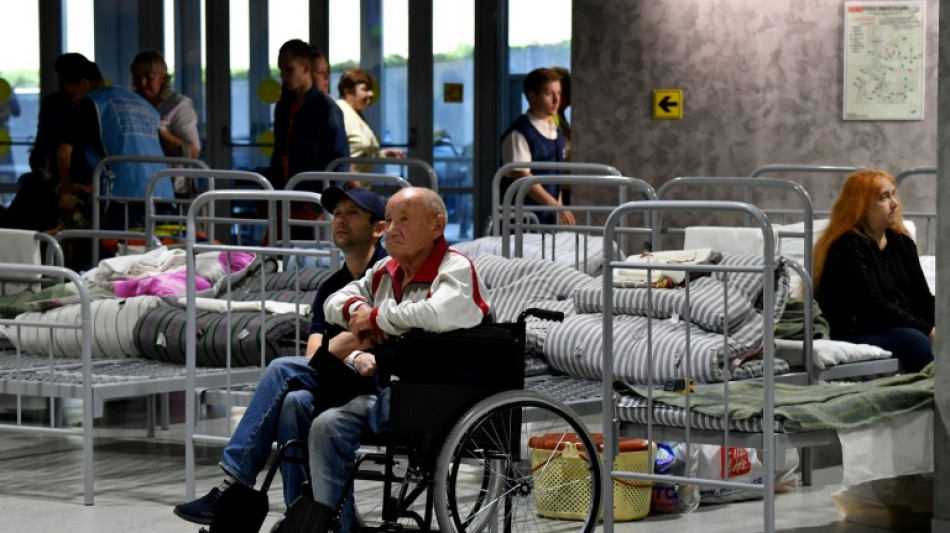
'Frightening': thousands of Russians flee shelling to Belgorod / Photo: © AFP

Since the start of Moscow's offensive in Ukraine, Russian pensioner Antonina Zaikina had a bag prepared in case she had to flee her town of Shebekino on the border with Ukraine.
This week, 15 months into the conflict, she finally used it.
Shebekino, a town of 40,000 people in the western Belgorod region, has been intensely shelled for days.
The attacks have come after a dramatic armed incursion from Ukraine and pushed thousands to flee border villages to the regional hub of Belgorod.
"We left as (Shebekino) was bombed so much that our windows broke," Zaikina, a retired engineer, told AFP.
She said a neighbour in his thirties had his hand amputated after being injured in shelling.
"Many houses have been destroyed," she said.
The 75-year-old said Shebekino had been hit by numerous attacks before, but never this intensely.
"Now, they hit the centre of the town."
Zaikina got in a car with a friend and drove 30 kilometres (18 miles) to Belgorod city, where authorities have placed displaced villagers in the local sports venue Belgorod Arena.
Moscow has appeared to downplay the situation in border regions, that have been intensely shelled this week, despite local authorities announcing evacuations.
The mayor of Belgorod, Valentin Demidov, on Friday told AFP that around 5,000 people who fled border villages have registered with city authorities, with several hundred in temporary housing.
- Addressing Putin -
At the crowded sports arena, evacuees told AFP they had fled Shebekino in panic during intervals of shelling.
"We left as there was a small break (between strikes)," said 30-year-old Margarita Nikolayeva
She left with her husband, two children, three cats and a dog.
"We were in the cellar from three to six in the morning. Then, when things got a bit quieter, we got in a car," the tech assistant said.
The family had moved to Shebekino from Siberia during the Covid pandemic.
"We moved to the safest place in Russia," Nikolayeva said, ironically.
Nadezhda Otstavnaya left Shebekino with her husband "in our old rusty car."
They took the back roads to Belgorod because "they were shelling the centre of the town."
"It was very scary," the retired laboratory worker said.
Like many others, she praised local governor Vyacheslav Gladkov, who has given daily updates on the worsening situation in Belgorod.
But she had questions for Russia's powerful state media -- and even the Kremlin -- as to why events in Belgorod are not at the forefront of Russian news.
"I want to address.. our central television, so that our town and region would be featured not for three seconds, so that people (Russians) know about us," she said.
"We, the people of Shebekino lost everything."
She also urged "the Russian government, Mr Putin, to pay attention to us."
- 'Chase them away' -
On makeshift beds in the hastily prepared sports arena, evacuees saw no end in fighting in sight.
Ksenia, a 31-year-old shop worker who did not want to give her last name, left Shebekino with her husband and parents on an evacuation bus.
"It's a hopeless situation," she said.
She said locals in Shebekino "don't get into" the politics of the offensive, a common approach in Russia.
She expressed support for Putin's policies and the Russian army.
"Of course we hope that somehow it will all be OK, that our guys will win," she said, adding:
"That our guys will chase (Ukrainians) away and we can go back to our homes."
Yevgeny Klyuchnikov, a 44-year-old carpenter, said he knew it was time to leave Shebekino when he was woken up by flying rockets earlier this week.
He said the town had got used to being attacked occasionally but is emptying now that the shelling has intensified.
"We were always jumping from the noise but then we got used to it quietly," he said.
"But this shelling.. It is very, very scary."
He said he was counting on the Russian state to step in.
"If the government does not help rebuild, not give us housing, then we will all be homeless."
(M.Dorokhin--DTZ)