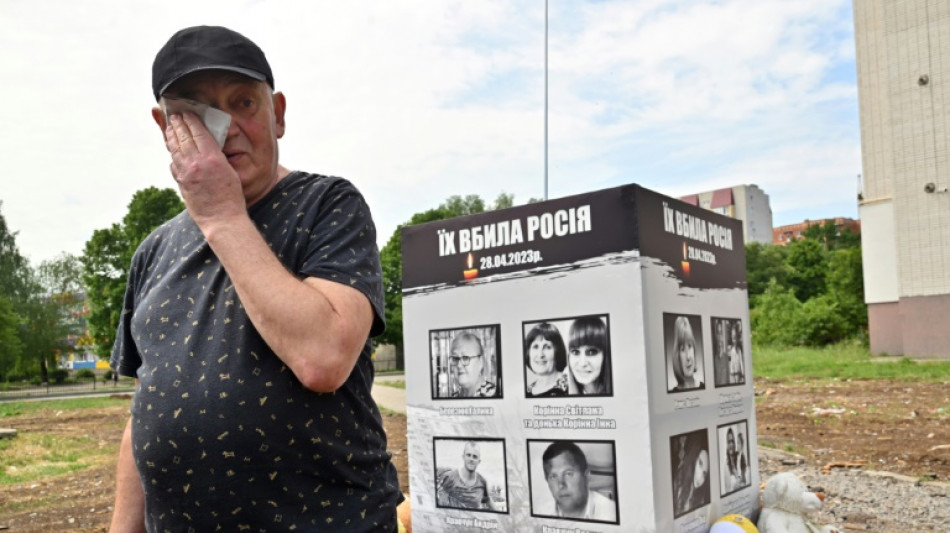
10,368: The incomplete count of Ukraine's civilian dead / Photo: © AFP

The Russian missile strike took nearly everything from Oleksandr Remez -- his wife Natalia and their home in central Ukraine. He only survived because he was up early in the kitchen on that April morning.
Standing before the remains of his apartment block in Uman weeks later, with the acrid smell of smoke still in the air, he voiced a simple demand -- that every single victim of the war be counted.
"We need not only numbers, but also names because no-one should be forgotten," said the 63-year-old, speaking through tears.
The official Ukrainian toll counts at least 10,368 civilians killed and 14,404 wounded since the Russian invasion last year.
"These are only the people we know," said Oleg Gavrysh, senior adviser to the head of the Ukrainian president's office.
"We expect that, most likely, the toll will be five times larger. That is, it could be 50,000," he added.
Ukraine's partial figures are in line with the United Nations' most recent civilian toll, which counted 8,709 killed and 14,666 wounded up to the end of April.
The UN also believes the actual figure to be "considerably higher".
Capturing a full and accurate human cost of the war faces many barriers but experts see it as essential to eventual recovery –- and a reckoning.
"They (Russia) must be held responsible for each one," Remez said, standing near a memorial for his wife and the 22 others killed in the April 28 strike.
Four children were among the dead.
Russian air attacks, such as indiscriminate artillery and missile fire, have been particularly deadly in Ukraine, but it is difficult to say how many they have killed.
- 'Hiding criminal acts' -
A key gap in casualty counts is the lack of information from Russian-occupied places like the port city of Mariupol, where tens of thousands of civilians are believed to have died.
The battle for the city became a symbol of Ukrainian resistance and it saw horrific levels of destruction and killing.
Experts fear that even if Ukraine were to re-capture the city, perpetrators of civilian killings may have hidden the evidence.
"They have an incentive to hide their criminal acts," said Philip Verwimp, an expert on demography in conflict situations, speaking of fighters' actions in wartime.
In areas that are effectively levelled by combat, like Russian-claimed Bakhmut, it can also be difficult to establish even who is missing and potentially dead or who fled.
As a result, documenting a toll can take years of work, as was the case after the 1990s fighting in Bosnia and the decades of sectarian conflict in Northern Ireland.
Seminal research gathered the names of roughly 97,000 people killed in Bosnia's 1992-1995 war, a toll that was less than half of a figure that had been widely used.
The resulting Bosnian Book of the Dead is considered the most comprehensive data analysis of the bloodshed that followed the collapse of Yugoslavia.
Verwimp, who participated in a review of the book's underlying data, said it is crucial to have a number that can be verified.
"Ukrainians are very fast doing this. As soon as they have recaptured villages, they have already investigating teams going there to document Russian war crimes," he added.
- 'Never again' -
Ukraine has been recording alleged violations from the start of the invasion.
They range from civilian deaths to sexual assault and the destruction of homes or cultural sites.
While the fighting is raging though, Ukraine has offered no recent accounting of its military losses.
A leaked Pentagon document estimated that up to 17,500 of Kyiv's soldiers were killed in action as of February.
Having a toll of verified, individual names can bring some closure to families, said Jakub Bijak, a demography professor who worked with the UN's special court for the former Yugoslavia court to establish the victims of the Bosnian war.
"But, also politically, (it's important) to ascertain the amount of loss the country suffered in the war," he added. "Numbers matter."
For Oleksandr Remez, however, just getting from one day to the next is very difficult.
The only thought that gives him some comfort is documenting his wife's death so it does not happen to anyone else.
"We need to know all this, to do everything possible to prevent this from happening again. Small children, babies, what are they dying for?" he asked.
(A.Nikiforov--DTZ)