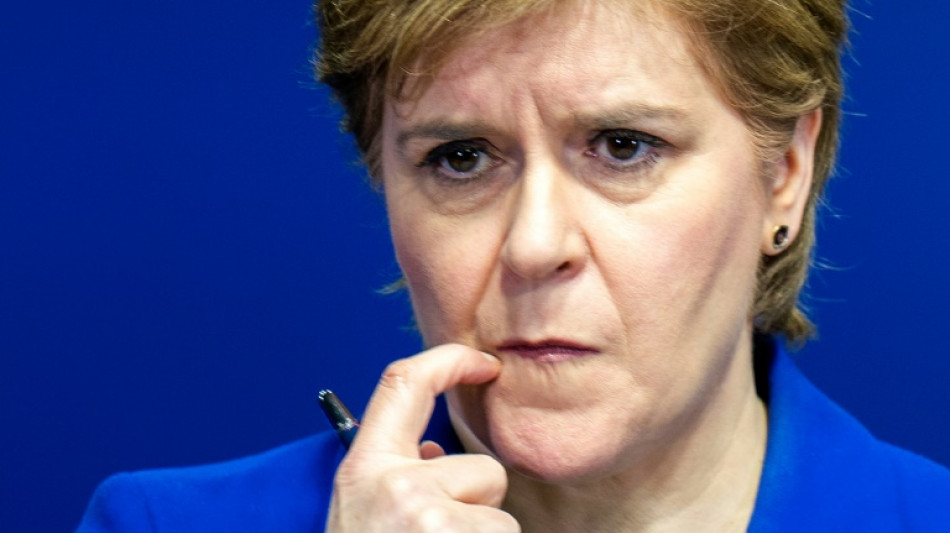
Nicola Sturgeon: from 'Queen of Scots' to financial crimes suspect / Photo: © POOL/AFP

Nicola Sturgeon kicked off the year with the vow that she still had "plenty in the tank" after eight years as Scotland's leader, only to quit her role shortly after.
Her arrest on Sunday as part of a financial probe into the Scottish National Party (SNP) capped a spectacular fall from grace for the woman once dubbed the "Queen of Scots."
Regarded as one of Britain's most formidable politicians, the 52-year-old Sturgeon quit as first minister and SNP leader in February after coming under pressure in a fierce row over transgender rights.
She was also struggling to find momentum for the party's raison d'etre -- Scottish independence.
There were also rumblings about a possible police probe into party finances dangerously close to home.
Those rumours were realised when her husband Peter Murrell was arrested in March, followed soon after by the SNP treasurer.
Sturgeon's arrest had been largely expected, a blow for a woman regarded as an almost invincible presence at the head of Scottish politics.
Acknowledging the strains of office, Sturgeon said on her departure that she felt unable to give "every ounce of energy that it needs" to see out the high-pressure job.
"I am a human being as well as a politician."
- Internal splits -
The transgender controversy erupted over a male rapist who had changed gender after being convicted. Under contentious reforms pushed through by her SNP government, they would have been allowed to serve in a women's prison.
In a move unprecedented since Scotland won back self-government in 1999, the law was blocked by the UK government in London, and Sturgeon's handling of the affair drew internal SNP criticism.
She also had a very public falling out with her former mentor and predecessor as first minister Alex Salmond over her handling of sexual harassment claims against him.
Above all, Scottish independence had been hitting the buffers despite her attempts to up the ante, after the UK government rejected demands for a new referendum.
Criticism had also mounted over Sturgeon's intention to turn the next UK general election into a vote to leave, leaving voters with a stark choice that some in the party feared could rebound on the SNP.
- Waning appetite for independence -
Several surveys have shown waning popular support for breaking away, after Scottish voters rejected independence in 2014.
For Sturgeon and the SNP, Britain's vote in 2016 to quit the European Union changed the picture entirely. A majority of Scots wanted to stay in the EU.
She was born in the industrial town of Irvine southwest of Glasgow, in 1970 to an electrician father and a mother who was active in local SNP politics.
Sturgeon joined the SNP aged 16, becoming politicised in the 1980s when Conservative Margaret Thatcher, still widely reviled in Scotland, was Britain's prime minister.
She studied law at Glasgow University and stood unsuccessfully for the House of Commons in 1992, aged just 21, before starting her career as a lawyer.
When the Scottish Parliament was created in 1999, with Labour ahead of the SNP as the biggest party, Sturgeon was one of its first wave of lawmakers.
Her nickname at that stage was "nippy sweetie" -- Scots slang for a pushy person.
Her mother Joan once joked about her daughter's hard-working tendencies: "The phone is never switched off -- many of my family can vouch for that."
Sturgeon argued for socially conscious policies she says were abandoned by the centre-left Labour party, once the dominant force in Scottish politics.
Sturgeon married SNP colleague Murrell in 2010.
Their partnership came under scrutiny after Murrell, the party's chief executive, was also embroiled in the Salmond investigation and questions mounted over a loan he extended to the SNP.
(B.Izyumov--DTZ)