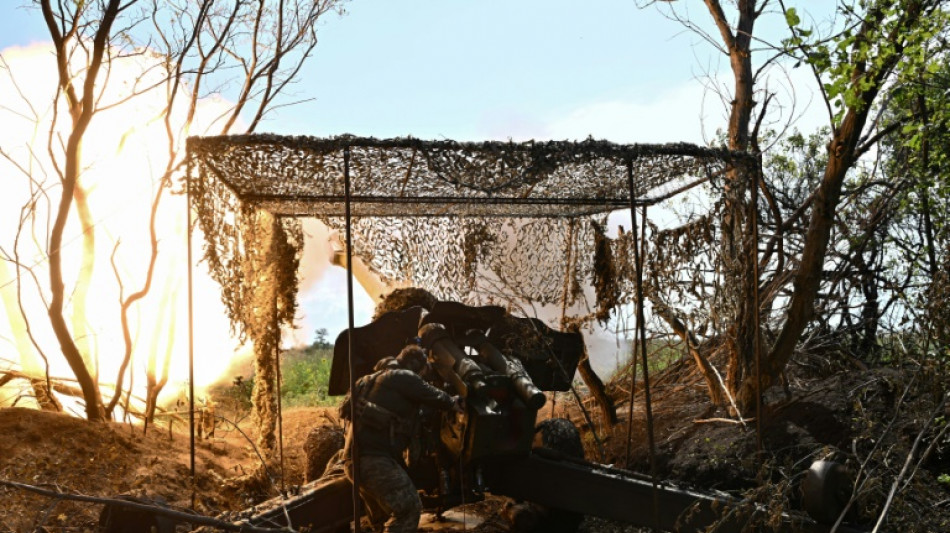
Western help missing in battle for Bakhmut / Photo: © AFP

It took three tries for the group of Ukrainian soldiers to fire a huge shell from a Soviet-era howitzer at a Russian position in Bakhmut.
The firing mechanism kept jamming and a brief shouting match broke out over what was going wrong.
The third try propelled the shell from the cannon-like gun -- as old as some of the soldiers' fathers -- in a fireball over the horizon.
A small cheer went up when a voice on a walkie-talkie reported some tense moments later that the Russian target had been hit.
"Of course you want something newer, more modern, so that you can go in and out quickly," said the unit commander, who uses the callsign "Bes" (Devil).
"It doesn't quite work that way with our machines," the 38-year-old said.
Speed is of the essence in the artillery duel Russia and Ukraine are waging in Europe's biggest land battles since World War II.
A fired artillery gun exposes a unit's position and is often followed by volleys from the other side.
But some of the equipment Ukraine is using dates back to the 1970s and is both unwieldy and liable to break down.
"In our part of the front, Western support has made no impact," said one of the unit's soldiers, Valeriy.
"We are still using old Soviet-produced weapons, and the missiles are also old," the 48-year-old former dockworker said.
- Critical supplies -
Seventeen months of unrelenting battles have turned the continued supply of equipment and munitions into one of the most critical factors of the entire war.
The United States this month decided to send Ukraine highly controversial cluster munitions to make up for the West's shortage of other shells.
Ukraine's problems are compounded by its transition from Soviet systems to those used by NATO.
A NATO shell will not fit in a Soviet-era gun.
And soldiers say same-calibre shells supplied by allies in eastern Europe are incompatible with some Ukrainian systems.
All these problems make Ukraine's ability to still start edging forward again around Bakhmut a proud moment for soldier Alex.
"We hit about 80 percent of our targets," the 27-year-old unit gunner said.
"Maybe not on the first try, but usually by the third."
- 'They have gone quiet' -
Ukraine is assigning its most modern and powerful Western weapons to specific sectors of the front in search of an elusive breakthrough.
Where those guns go is a tightly guarded secret -- although Ukraine's desire to cut Russia's southern link to Moscow-annexed Crimea is not.
Bakhmut has more emotional than strategic importance for both soldiers and country.
Ukraine's year-long defence of the little city had echoes of some of the most storied battles of World War II.
It began trying to recapture Bakhmut's ruins immediately after the city's ultimate fall in May.
The artillery unit commander sounded cautiously optimistic about Ukraine's chances on his patch of front.
"It feels like we have started to do better now, and they have gone more quiet," Bes said of the Russians.
"But as for finishing by the end of the summer, I cannot say."
- 'We will keep going' -
The unspoken fear among Kyiv's supporters is that this summer poses Ukraine's last good chance to break the Russians' will to fight.
Whether the West -- and particularly Washington -- has the political capital to keep helping Ukraine thereafter is an open question.
The pressure would seem to be on Ukraine's spirited but exhausted fighters to perform in the coming weeks.
Volodymyr would quietly disagree.
The 33-year-old was celebrating his third successive birthday at a frontline position.
His first military birthday came while Ukraine was still fighting a lower-scale war Russia fomented in 2014.
The soft-spoken soldier recalled how Ukraine repelled a Russian assault on Kyiv in the first weeks of the Kremlin's invasion.
Western military aid then was almost non-existent and many Ukrainians were fighting with whatever they had on hand.
"If they stop giving us weapons and missiles, I think that we will still keep going until the end," Volodymyr said while cleaning his rifle.
"Just as it was at the very start."
(O.Zhukova--DTZ)