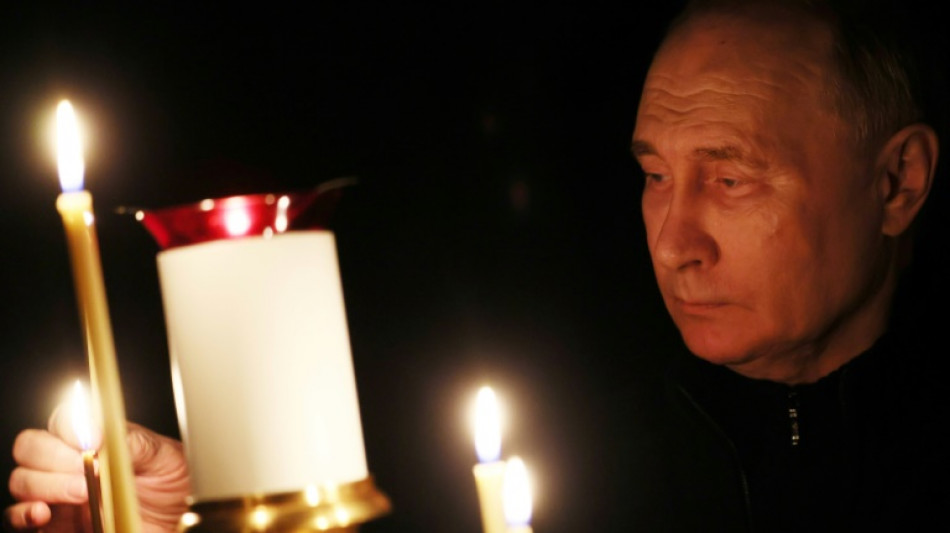
Seeking to limit criticism, Putin refuses to blame IS / Photo: © POOL/AFP

Russian President Vladimir Putin is refusing to blame the Islamic State (IS) for the Moscow attack despite a claim by the extremist group, instead insinuating a link to Ukraine in an apparent bid to limit the responsibility of the Russian security services.
IS claimed the attack Friday evening on the Crocus City Hall concert venue on the outskirts of Moscow that left at least 137 people dead, with Western governments also saying the extremist group appeared to be responsible.
But in his address to the nation, Putin made no mention of jihadist involvement in the attack and instead appeared keen to lead Russians towards seeing a link with Ukraine, over two years into Moscow's invasion of its neighbour.
He said the four attackers "tried to escape and were travelling towards Ukraine" where "a window" had been prepared for them to cross the border.
On Monday, Kremlin spokesman Dmitry Peskov also declined to confirm the responsibility of IS, saying he could not comment while the investigation was ongoing.
"Putin and the other scum are just trying to blame it on someone else," said Ukrainian President Volodymyr Zelensky on Saturday. "They always have the same methods," Zelensky added.
French President Emmanuel Macron on Monday warned Moscow against any "exploitation" of the attack, saying it would be "cynical and counterproductive for Russia to use this context to try and turn it against Ukraine".
He said it was a branch of Islamic State that "planned the attack and carried it out", adding this outfit had also plotted attacks in France.
In early March the US had warned Russia of a risk of an attack, a message Moscow appears to have batted away.
- 'Responsible for everything' -
"There is an exploitation (of the attack) because Vladimir Putin is obsessed with Ukraine," said Sylvie Bermann, former ambassador of France to Russia. "It is in his logic of the war in Ukraine and the Ukrainians are responsible for everything," she told AFP.
The attack came as Russia scents it has the upper hand on the battlefield over two years into the war but with the Kremlin still wary of ordering a new military mobilisation.
Tatiana Stanovaya, founder of R.Politik consultancy, described Putin's link to Ukraine as "cautious", arguing that if there had been any evidence of such a role reactions would have been even more explicit.
"The IS is testing a new tactic that involves newcomers who had not been flagged as extremists in police databases and that implies a much shorter period of preparation," she told AFP.
Citing sources, she said the plot was rapidly planned and that made it hard for the Russian authorities to detect.
But many commentators on pro-Kremlin media were in no doubt where to lay the blame.
"We are not talking about ISIS here. It was the khokhly," said the editor-in-chief of the RT channel Margarita Simonyan, using a term used pejoratively in Russia to denote Ukrainians.
Mass-circulation newspaper Komsomolskaya Pravda even quoted one commentator as blaming the "British special services and the Americans and Ukrainians" for the attack.
- 'Security lapses' -
Meanwhile, the failure to avert the attack -- in particular after possible intelligence from Moscow's adversary the US -- could be seen in some quarters as a major failure for the Russian security services.
Ex-agent Putin has sought to portray the KGB successor the Federal Security Service (FSB), which he himself used to head, as all powerful and able to protect Russians from threats to their homeland.
After the hostage massacre at a Moscow theatre showing the Nord-Ost musical in 2002 and the Beslan school siege in 2004, the Crocus City Hall is the latest atrocity claimed by jihadists under Putin that has put the role of security forces under the microscope.
While jihadists carried out a string of previous attacks, Putin will be mindful of the risk of disrupting Russia's delicate society which includes more than 20 million Muslims.
Admitting that the attack was committed by IS would be to acknowledge that the image of a secure and stable Russia "where the state is omnipotent and the all-powerful security services control everything is a myth," said Tatiana Kastoueva-Jean, Russia specialist at the French Institute of International Relations (IFRI).
She said that Putin's priority is to divert attention from "security lapses" and rally "all those who are still hesitating on the domestic scene" to the need to fight the West and Ukraine.
(W.Novokshonov--DTZ)