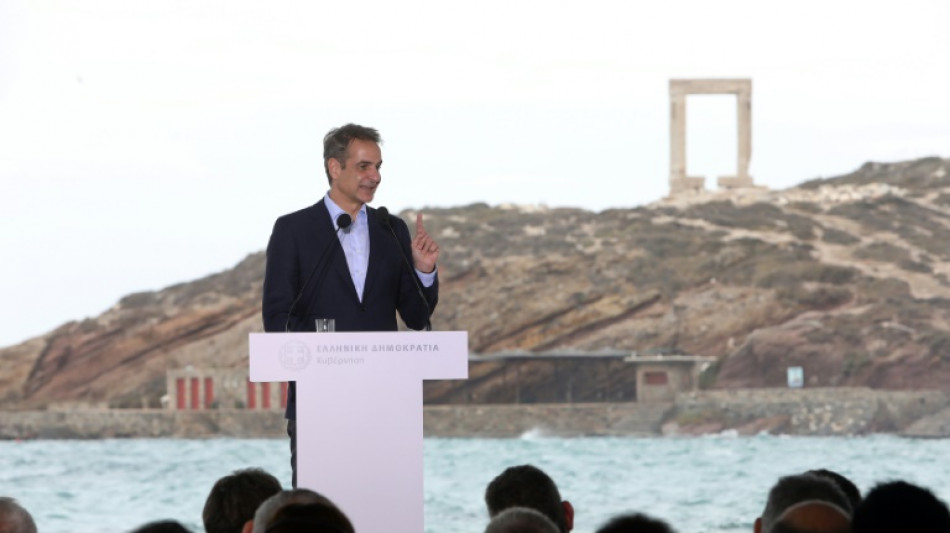
Greece pushes green transition on its fragile islands / Photo: © POOL/AFP

Greece this week signed a clean energy deal with the EU in a bid to fast-track the green transition on its fragile islands threatened by overtourism and climate change.
Hundreds of Greek islands are facing major challenges including water scarcity, said Dimitris Lianos, the mayor of Naxos, the largest island in the Cyclades archipelago, where the deal was signed Thursday with the European Union and the European Investment Bank to finance decarbonisation projects.
The symbolism of signing it there was hard to ignore. Like on most of Greece's many islands, farms on Naxos are imperilled by drought.
The 1.6-billion-euro fund ($1.67 billion) will leverage the islands' main assets -- wind and sun -- to provide clean energy at affordable costs.
Investing in "green" energy sources will "allow the islands to achieve their ecological transition", said Prime Minister Kyriakos Mitsotakis.
"Renewable energy will help the country become self-sufficient and reduce energy costs," he said.
Greek islands depend heavily on liquid fossil fuels for their electricity supply, taking a toll on the environment and driving up costs.
- Overtourism -
Athens is focusing on developing renewable energy infrastructure -- offshore wind farms, energy storage systems and connecting the islands with the mainland for power supply.
Greece, which is at the forefront of global warming in the Mediterranean Basin, has been experiencing scorching summers and disastrous wildfires.
On many islands, residents are alarmed by water shortages and prolonged drought.
Even so, hostility to wind turbines is growing as it is in several European countries.
Environmental protection groups are also warning against overtourism, particularly in the Cyclades, popular for its crystal-clear waters and picturesque villages.
Naxos, south of Mykonos and east of Paros is becoming increasingly popular. But in 2023, this island known for its cheeses and potatoes, had only 270 mm (10.6 inches) of rain, compared to an average of 306 mm (12 inches), according to climate monitor the National Observatory of Athens.
On energy autonomy, Greece has so far given priority to smaller, unconnected and remote islands, like Chalki in southeastern Greece, which now boasts a solar power plant.
- Reducing emissions -
Power on the Dodecanese island of Tilos now almost entirely comes from renewables, thanks to an 11-million-euro investment from the EU and four private Greek investors.
Last month Greece unveiled ambitious solar and wind energy targets in a bid to achieve net zero greenhouse gas emissions by 2050.
Athens will aim to reach an 82 percent share of renewables in its electricity mix by 2030, up from the 66 percent planned in 2019, according to Environment and Energy Minister Theodoros Skylakakis.
The Mediterranean country is striving to reduce emissions by 58.6 percent by 2030.
Greece has already shrunk its emissions by 45 percent compared to 2005, Mitsotakis said in a speech at the COP29 summit in Baku earlier this month.
The premier also said that wind and solar energy covered "almost half of Greece's electricity needs" while the contribution from highly polluting lignite, or brown coal, was now "only 6 percent".
(M.Travkina--DTZ)