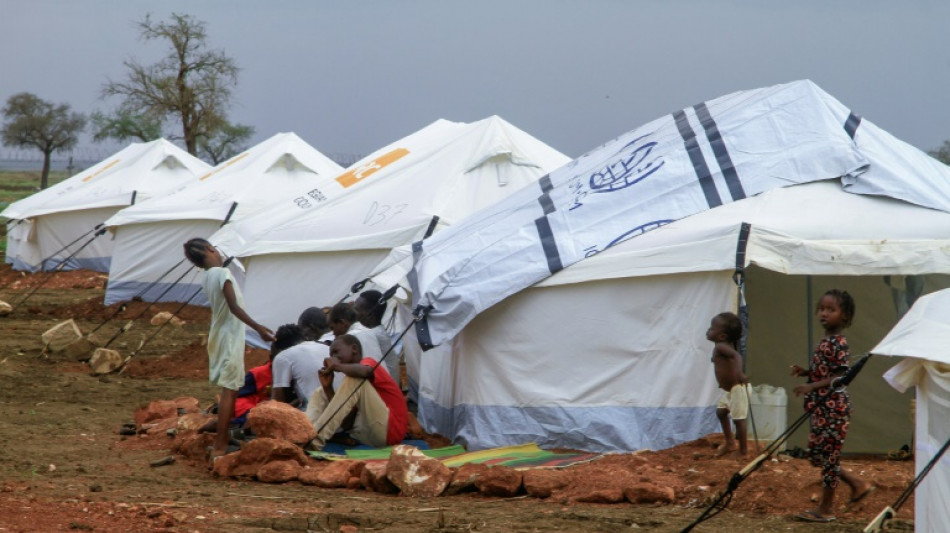
Internal displacement in Africa triples in 15 years: monitor / Photo: © AFP/File

Conflicts, violence and disasters across Africa have dramatically driven up the number of displaced people on the continent over the past 15 years, international monitors said Tuesday.
By the end of last year, Africa counted 35 million people living displaced within their own countries, according to a report by the Internal Displacement Monitoring Centre (IDMC).
That is nearly half of the number of internally displaced people (IDPs) worldwide, IDMC chief Alexandra Bilak told AFP.
"We have seen a tripling of the number of IDPs on the African continent over the last 15 years," she said, adding that "the majority of this internal displacement is being caused by conflict and violence, but is also now triggered more and more by disasters".
While IDPs typically receive less focus than refugees who flee across borders, they are far more numerous and their lives are equally turned upside down.
Displacement disrupts livelihoods, the cultural identity and social ties of entire communities, making them more vulnerable, the IDMC pointed out.
It can set back a country's development agenda by disrupting the ability of those displaced to generate income, pay rent or taxes, as countries are called on to provide additional housing, healthcare, education and protection.
- Conflict main culprit -
Tuesday's report showed that rising levels of conflict and violence were responsible for driving 32.5 million people into internal displacement in Africa.
Eighty percent of them were displaced within five countries -- the Democratic Republic of the Congo, Ethiopia, Nigeria, Somalia and Sudan.
Conflict and violence "cause cyclical patterns of displacement, and the people who were displaced by conflicts already 10, 15, in some cases 20, 25 years ago have not been able to find a solution", Bilak said.
"They haven't been able to return home," she said, adding that "new waves of violence and displacement are added on to protracted caseloads", pushing IDP numbers ever higher.
Displacement due to disasters, in particular floods, is also on the rise in Africa, as climate change makes itself increasingly felt.
The number of times people were forced to flee disasters rose sixfold between 2009 and 2023, from 1.1 million displacements per year to 6.3 million, the IDMC said.
Floods triggered more than three-quarters of these movements, while droughts accounted for another 11 percent, the report showed.
- Overlap -
The IDMC cautioned that conflicts, violence and disasters often overlap, driving complex crises, which see many displaced repeatedly or for prolonged periods.
The organisation highlighted the African Union's Kampala Convention on protecting and assisting IDPs as an important tool to address the problem.
That convention, which was adopted in 2009 and entered into force in December 2012, set an international standard as the first, and still the only, legally-binding regional agreement addressing internal displacement.
Thirty-four African countries have since ratified the treaty, with many developing legal frameworks and making significant investments to address the issue.
But the IDMC said governments had struggled in the face of rising conflicts and disasters worsened and made more frequent by climate change.
"It hasn't fixed the problem," Bilak said.
With most displacement in Africa due to conflict, she stressed that "much more has to be done when it comes to peace-building and diplomacy and conflict transformation".
"That is really the key of the issue."
(W.Uljanov--DTZ)