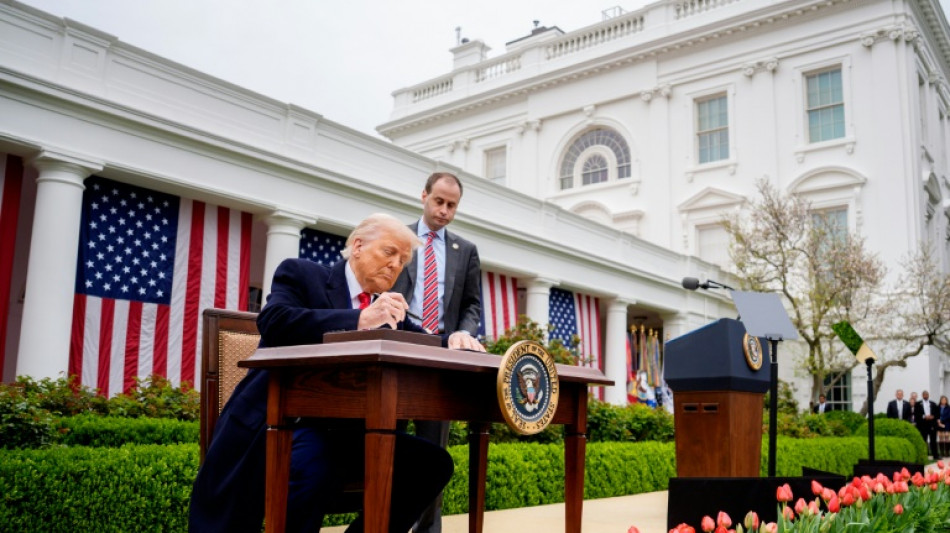
Trump tariffs to test resiliency of US consumers / Photo: © GETTY IMAGES NORTH AMERICA/AFP

In unveiling tariffs this week challenging the decades-old international trade order, President Donald Trump lambasted globalization as a raw deal for the United States that has devastated US manufacturing towns.
Trump left out the upside to the United States from the liberal flow of goods: a reliable supply of affordably priced appliances, clothing and electronics whose consumption has helped lift US economic growth above other developed economies in recent years.
"Obviously we've benefited significantly," said Paul Gruenwald, global chief economist at S&P Global Ratings. "We get to consume a lot of things that are produced more efficiently in other countries."
Trump's tariffs are almost certain to negatively impact this dynamic, say economists who see the levies lifting the price on everything from Gap t-shirts to the Apple iPhone to French wine.
"This is very clearly going to raise consumer prices," Michael Pearce, a US economist with Oxford Economics, said of the barrage of levies announced late Wednesday in an unveiling the White House billed as "liberation day."
Winners in Trump's policy include communities that benefit from reshored manufacturing, while losers include export-focused industries like plane manufacturing and pharmaceuticals if there are retaliatory tariffs, Pearce said.
But imports represent only about 14 percent of US gross domestic product, while exports account for 11 percent -- figures that are even lower if energy is taken out. Moreover, goods account for one-third of US consumption compared with services, which comprise the rest.
"The net impact on the US economy may be surprisingly small given the headlines we're seeing," said Pearce, who warned that Trump's levies could end up disproportionately hurting low-income consumers if the tariffs are paired with tax cuts that benefit the wealthy.
Gruenwald, who described US consumer resiliency as a core strength in recent times, said S&P will lower the US outlook somewhat amid a higher inflation outlook for 2025. But he said the trade war "wouldn't move the needle" in the short-term "for a big economy like the United States."
- More 'friction' ahead -
Trump's Wednesday White House event unveiled levies on dozens of countries including all major US trading partners. These included the imposition of 20 percent levies on the European Union, 24 percent on Japan and an additional 34 percent on goods from China -- bringing the new added tariff rate there to 54 percent.
Trump cast the event in historic terms, saying Wednesday "will forever be remembered as the day American industry was reborn" and the country turned the page on globalization.
"For decades, our country has been looted, pillaged, raped, and plundered by nations near and far, both friend and foe alike," he said.
A day after the announcement, commentators cautioned that the president's history of sometimes quickly shifting on tariffs meant that the proposed levies could be altered after bargaining with other governments, which could lean on big companies to lift investments in the United States.
In any case, economists predicted the shift would lessen trade between the United States and other countries, but not end it.
"There will be a lot more friction," said Joseph Brusuelas, chief economist at RSM US, a consultancy, who predicted the underlying structure around trade and capital flows will be maintained.
Brusuelas said the United States has been the "big winner" under globalization, but predicted growth "won't be as exceptional."
"Europe and Asia will narrow the gap," Brusuelas added, calling them "places where the state plays a more central role in constraining the movement of goods and capital."
Pearce said Trump's unpredictability on trade would lead to reduced capital spending by firms in the short run and that the broad tilt against trade will be "slightly negative" for the US economy in the long run.
Gruenwald pointed to the risk of reduced competition.
Globalization forced US companies "to deal with foreign competition," Gruenwald said. "If we kind of seal off that competition, there's a risk these nice productivity numbers could decline."
(U.Stolizkaya--DTZ)