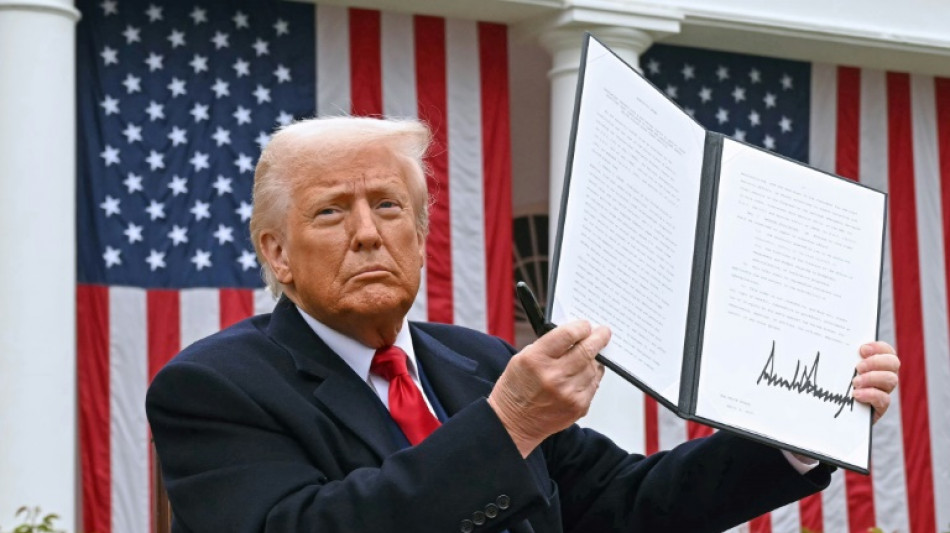
Trump threatens allies Japan, South Korea with 25% tariffs / Photo: © AFP/File

President Donald Trump threatened Japan and South Korea with 25 percent tariffs Monday, stepping up pressure on the two historical US allies and a dozen other economies to reach trade deals with Washington.
Trump had said at the weekend that starting from Monday he would send a first batch of up to 15 letters to countries, informing them that he would reimpose harsh levies earlier postponed in April.
In near-identically worded letters to the Japanese and South Korean leaders, Trump said the tariff hikes would apply from August 1 because their trading relationships with Washington were "unfortunately, far from Reciprocal."
Trump warned the countries, both key US allies in East Asia, of an escalation if they responded to the duties.
Currently, both countries have been hit with a 10 percent levy imposed on almost all US trading partners.
But Trump said he was ready to lower the new levels if Japan and South Korea changed their trade policies: "We will, perhaps, consider an adjustment to this letter."
Japan's Prime Minister Shigeru Ishiba said Sunday that he "won't easily compromise" in trade talks with Washington.
White House Press Secretary Karoline Leavitt told reporters Monday that Trump would sign an order later in the day to delay his July 9 deadline for steeper tariffs to take effect -- postponing their imposition to August 1.
She added that besides Japan and South Korea, there would be approximately 12 other partners receiving letters from Trump soon.
With the deadline extension, Leavitt said Trump would be setting out the "reciprocal tariff rate" for economies in the coming month as negotiations continue.
Trump originally announced sweeping tariffs on world economies on what he called "Liberation Day" on April 2, claiming the United States was being "ripped off."
Amid market turmoil, Trump then suspended the initial tariffs for 90 days, a deadline that would have expired Wednesday without the latest extension.
While the Trump administration had signaled hopes of striking dozens of deals by July -- at one point boasting of "90 deals in 90 days" -- there have been limited results so far.
Washington has unveiled pacts with only Britain and Vietnam, while the United States and China agreed to temporarily lower tariff levels on each other's products that earlier reached three-digits.
- 'Change their tune' -
Asked why Trump opted to start with South Korea, Leavitt said: "It's the President's prerogative, and those are the countries he chose."
"This announcement will send a chilling message to others," said Asia Society Policy Institute Vice President Wendy Cutler.
"Both have been close partners on economic security matters," she said, adding that companies from Japan and South Korea have made "significant manufacturing investments in the US in recent years."
US Treasury Secretary Scott Bessent said Monday that there would be a number of deals coming up: "We are going to have several announcements in the next 48 hours."
"We've had a lot of people change their tune in terms of negotiations. So my mailbox was full last night with a lot of new offers, a lot of new proposals," Bessent told CNBC.
He added that he would meet with his Chinese counterpart in the coming weeks.
The two sides have so far held high-level talks in Geneva and London. But Washington and Beijing's pause on tit-for-tat tariffs is due to expire in mid-August.
On whether he was disappointed in the number of trade deals achieved so far, Trump's trade adviser Peter Navarro maintained that he is "happy with the progress we've had."
"Every country that we run a major deficit with is fully engaged," he told CNBC on Monday.
Trump has also threatened another 10 percent tariff on countries aligning themselves with the emerging BRICS nations, accusing them of "Anti-American policies" after they slammed his duties at a summit.
For now, partners are still rushing to avert Trump's tariffs altogether.
The European Commission said that EU chief Ursula von der Leyen had a "good exchange" with Trump on trade when the pair spoke Sunday.
(L.Møller--DTZ)