Deutsche Tageszeitung - US sanctions Cuban president four years after historic protests

US sanctions Cuban president four years after historic protests


US sanctions Cuban president four years after historic protests
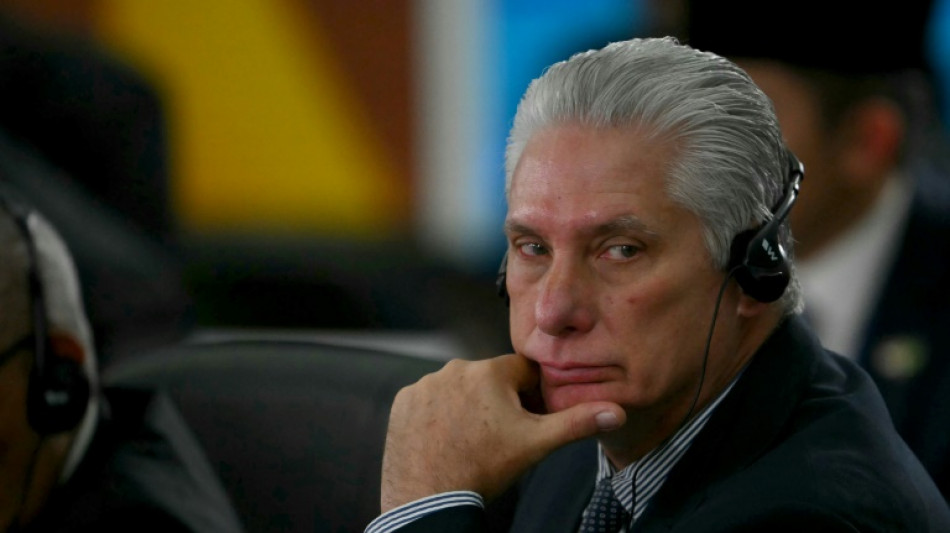
US sanctions Cuban president four years after historic protests / Photo: © AFP/File

The United States on Friday announced for the first time sanctions against Cuban President Miguel Diaz-Canel for his role "in the Cuban regime's brutality toward the Cuban people."

Change text size:

The US State Department was "restricting visas" for the president and other high-ranking government officials, Secretary of State Marco Rubio said in an X post on the fourth anniversary of historic anti-government protests in Cuba.

Other officials sanctioned included Defense Minister Alvaro Lopez Miera and Interior Minister Lazaro Alberto Alvarez Casas.

Cuban Foreign Minister Bruno Rodriguez slammed the latest measures on X, saying that US President Donald Trump's administration cannot "bend the will of its people or its leaders."

The State Department also added the "Torre K," a 42-story hotel in Havana, to its restricted list of entities "to prevent U.S. dollars from funding the Cuban regime's repression."

The establishment, recently inaugurated in a central area of the Cuban capital, sparked criticism of the government's huge investment in new hotels at a time when tourism is declining.

"While the Cuban people suffer shortages of food, water, medicine, and electricity, the regime lavishes money on its insiders," Rubio said.

Rubio also took to X to accuse Cuba of torturing dissident leader Jose Daniel Ferrer, four years after the government crushed massive protests.

"The United States demands immediate proof of life and the release of all political prisoners," Rubio said.

Hundreds of people were arrested in the July 2021 demonstrations, the largest since the Cuban revolution in the 1950s.

They resulted in one death and dozens of wounded.

Ferrer, leader of the dissident group Patriotic Union of Cuba (UNPACU), was among 553 prisoners released in January after former US president Joe Biden agreed to remove the island from the blacklist of countries sponsoring terrorism.

But at the end of April, his parole was revoked, prompting criticism from Washington, which has put Cuba back on the blacklist after Trump returned to power.

(P.Tomczyk--DTZ)

Featured

South Korea Launches Probe into NewJeans Contract Controversy

South Korea’s Ministry of Culture, Sports and Tourism has initiated a formal investigation into the treatment of underage K-pop artists. The move follows widespread criticism after the exclusive contract between the group NewJeans and its label, Ador, was revealed to contain clauses that allegedly violated minors' rights.

Critics Demand Stronger Action from Jeffries and Schumer Following Democratic Wave

Following the recent elections that granted Democrats control of both chambers of Congress, former Florida Democratic Senate candidate Angie Nixon has issued a sharp critique of House Minority Leader Hakeem Jeffries and Senate Minority Leader Chuck Schumer. In an opinion piece, Nixon argues that the leaders' cautious post-victory statements reflect a lack of political courage, calling for immediate and aggressive legislative measures to counter the policies of President Donald Trump and MAGA Republicans.

UK Defence Secretary Warns Russia Nukes Not for Negotiation as HMS Vengeance Returns

Defence Secretary Wes Streeting has declared that Britain’s nuclear weapons are not subject to negotiation, rejecting recent Russian proposals regarding European security. His statement follows the return of HMS Vengeance, which completed a historic 217-day submerged patrol, marking the longest continuous deployment by a British submarine.

Trump Reduces Public Appearances Amid CIA-Mossad Warnings of Iranian Drone Plot

President Donald Trump has significantly reduced his public appearances following warnings from Israeli intelligence that Iran plotted to assassinate him using explosive drones. The security concerns have prompted the relocation of several senior cabinet officials from Washington, D.C., while diplomatic tensions with Tehran remain high despite ongoing economic pressure campaigns.

Change text size: