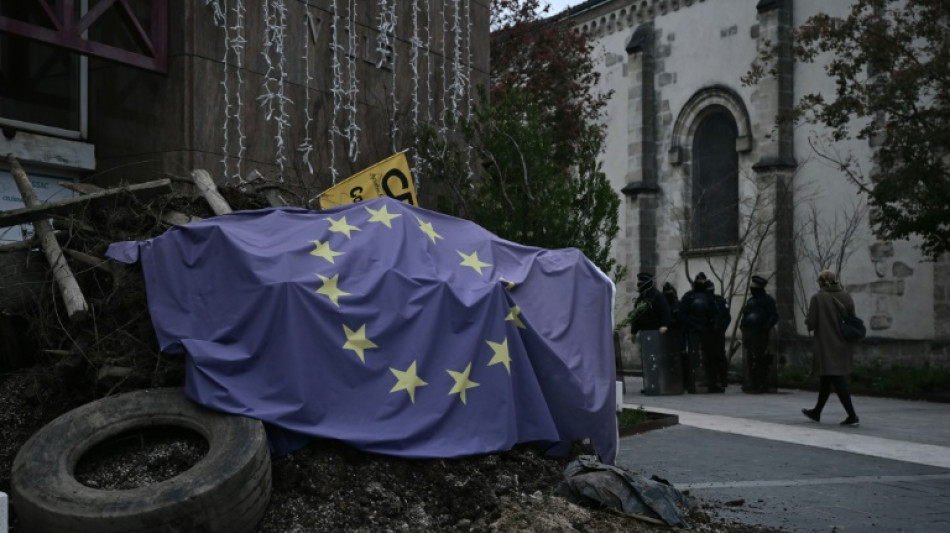
EU sets stage for big battle over long-term budget / Photo: © AFP

The European Commission will kickstart two years of tense negotiations when it unveils its proposal Wednesday for the EU's long-term budget including funding reforms that risk renewed confrontation with farmers.
EU chief Ursula von der Leyen has to balance a growing list of priorities including bolstering the bloc's security, ramping up Europe's competitiveness to keep up with US and Chinese companies, countering climate change and paying debts due from 2028.
And all of this against a backdrop of soaring trade tensions with the European Union's biggest commercial partner, the United States.
The previous 2021-2027 budget was worth around 1.2 trillion euros ($1.4 trillion) and made up from national contributions -- around one percent of the member states' gross national income -- and money collected by the EU such as customs duties.
One of the biggest challenges ahead will be over the size of the budget, as the EU's biggest -- and richest -- countries want to avoid paying more.
But unlike in the previous budget, the EU has debts due from the Covid pandemic, when the bloc teamed up to borrow 800 billion euros to support the continent's economy. These are estimated to cost 25-30 billion euros a year from 2028.
The European Parliament has made it clear that an increase will be necessary.
"We believe that the union cannot do more with the same amount or less. So we believe that in the end, an increase of the budget will be unavoidable," said Siegfried Muresan, the EU lawmaker who will lead negotiations on behalf of parliament.
The commission plans to propose new ways of raising money including taxes on large companies in Europe with annual net turnover of more than 50 million euros, according to a draft document seen by AFP.
- Funding farmers -
Another area of fierce debate will be the large farming subsidies that make up the biggest share of the budget, known as the common agricultural policy (CAP).
Brussels plans to integrate it into a new major "national and regional partnership" fund, according to another document -- which farmers fear will mean less support.
The CAP accounts for almost a third of the current multi-year budget -- around 387 billion euros, of which 270 billion euros are directly paid to farmers.
Centralising "funding into a single fund may offer some budgetary flexibility, but it risks dissolving" the CAP with "fewer guarantees", pan-European farmers' group Copa-Cogeca has said.
Farmers will put pressure on the commission with hundreds expected to protest outside the building in Brussels on Wednesday.
That will raise fears in Brussels after protests broke out last year across Europe by farmers angry over cheap imports, low margins and the burden of environmental rules.
Muresan, who belongs to the biggest parliamentary group, the centre-right EPP, urged the same level of funding for the CAP, "adjusted for inflation".
The commission has, however, stressed the CAP will continue with its own rules and financial resources, especially direct aid to farmers.
Brussels could also propose reviewing how CAP payments are calculated to better target beneficiaries.
For example, the commission wants to cap aid per hectare at 100,000 euros but this would be a thorny issue unlikely to garner much support.
- More money -
Facing new costs and competing challenges, the EU wants to tap new sources of funding -- fast.
In one document, the commission suggests the bloc take a share from higher tobacco excise duties and a new tax on non-recycled electronic waste.
Such a move, however, is "neither stable nor sufficient", according to centrist EU lawmaker Fabienne Keller, critical of giving new tasks to Brussels "without the necessary means to accomplish them".
Wednesday's proposal will launch difficult talks over the budget and is expected to "as usual, end with five days of negotiations" between EU capitals, an official said.
(V.Korablyov--DTZ)