Battling tariffs is no trivial pursuit for US games retailer / Photo: © AFP

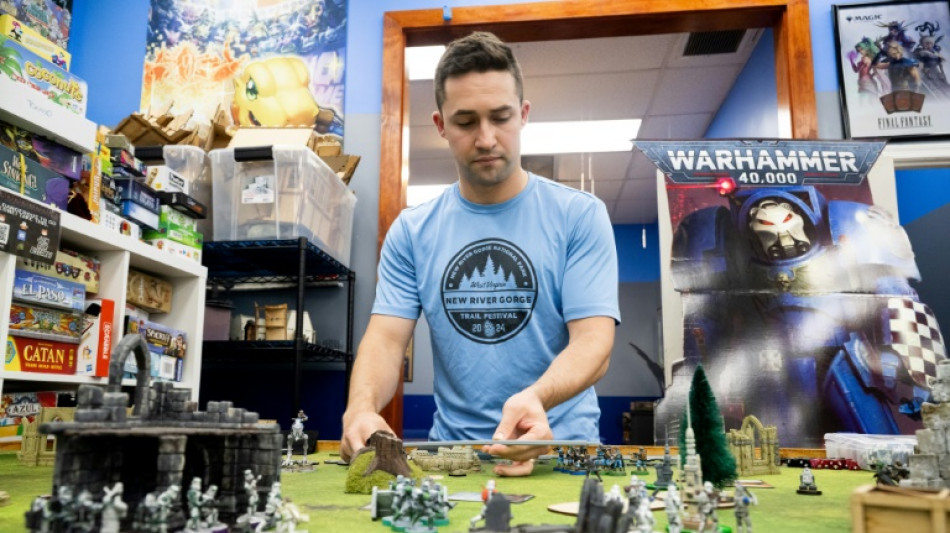
At a strip mall in Maryland, a miniature landscape extends across a table between Dash Krempel and his friend as a war game unfolds. But their hobby is becoming more expensive as US tariffs take a toll.
Krempel, 29, told AFP the cost of models for tabletop games have surged from inflation, and continued rising since US President Donald Trump imposed sweeping tariffs on trading partners this year.
UK-made figurines that cost $60 around three years ago now go for $94.50, he said.
"Prices have gotten bigger," he added. "It's a very expensive hobby to begin with, so it's maybe pricing a lot of people out."
Instead of buying more products, he now tries to support retailer Game Kastle College Park by renting tables to play in-store.
For the shop's owner, Boyd Stephenson, stocking new board games, paints and hobby supplies has only become more challenging.
To avoid the harshest of Trump's tariffs, some suppliers had to delay shipments or postpone new releases.
As they raised their suggested retail prices, so has Stephenson at Game Kastle.
About a fifth of his store's products have seen cost hikes, with increases ranging from 5 percent to 20 percent.
"If we see higher prices or higher tariffs, I'm going to see higher wholesale prices, and then I have to raise my prices accordingly," he said.
Asked what percentage of his store relies on imports, Stephenson replied: "Almost all of it."
- No capacity -
Stephenson estimates some 7,000 board games were released last year from 5,000 different companies.
"You're really looking at 5,000 different approaches (to tariffs)," he said.
"Some producers are saying, 'We're going to eat the cost.' Some producers are saying, 'We're passing the cost through all the way.' And other producers are doing some sort of mix of that."
Like other US retailers, Stephenson could face more cost pressures come August 1, when steeper tariffs are set to hit dozens of economies like the European Union and India.
The elevated rates mark an increase from the 10 percent levy Trump imposed on goods from most economies in April.
While China -- a crucial manufacturing hub for games -- is temporarily spared, Trump has separately imposed fresh 30 percent tariffs on products from the world's second biggest economy this year.
US tariffs on Chinese products could return to higher levels from August 12 if officials fail to extend their truce.
Yet, there is no quick fix to return manufacturing to the United States.
"US manufacturers just don't have the capacity to do that anymore," said Stephenson, showing an intricate board game figurine.
"Really, the people that are good at that, that's China," he said. "The best modeling paints come from Spain."
"So if you see tariffs get put up on the EU, then all of a sudden I'm going to have to pay higher prices on modeling paint when I bring it into the country," he added.
Trump has threatened the bloc with a 30 percent tariff.
- 'Universally bad' -
Stephenson tries to absorb some cost hikes, but said: "I have to be able to pay the staff, pay the electric company, pay the landlord."
Trump's on-again, off-again approach to duties has also made suppliers' price changes more unpredictable.
"What is always universally bad for business is uncertainty," Stephenson said.
He usually stocks up on inventory ahead of the year-end holiday season, but expects to be more strategic with purchases this year to avoid unwelcome surprises.
Many companies are delaying merchandise imports as they lack certainty, said Jonathan Gold, vice president of supply chain and customs policy at the National Retail Federation.
"When the product is brought into the country and entered into commerce, you have 15 days to pay your tariff bill," he said.
This causes problems when tariff rates change and businesses lack funds to pay for orders.
Some businesses, and industry group the Game Manufacturers Association, have mounted legal challenges against Trump's blanket tariffs hitting various countries, noting nearly 80 percent of tabletop games sold in the US are made abroad.
But such complaints are an uphill battle.
"The damage, especially for small retailers, has been significant," Gold said.
(V.Sørensen--DTZ)