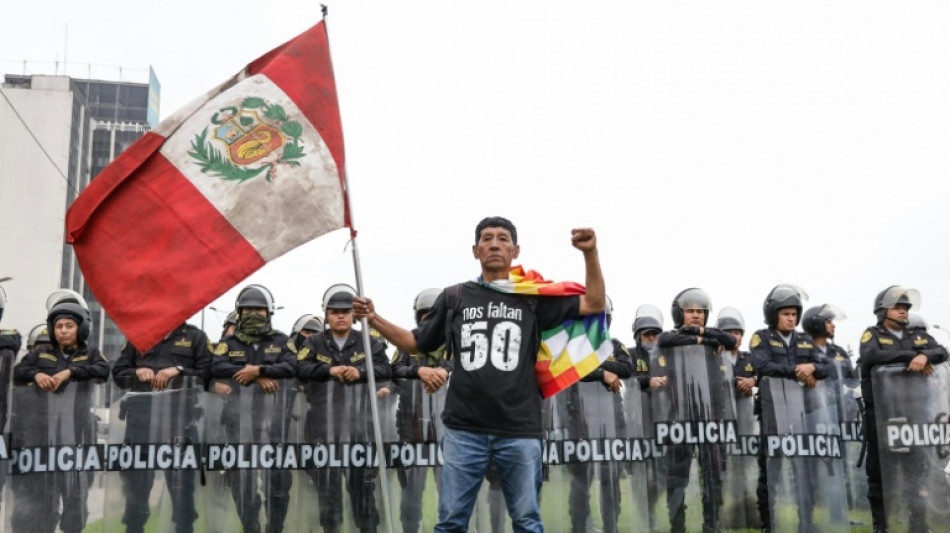
Peru's president rejects court order on police amnesty / Photo: © AFP/File

Peru's president on Thursday dismissed an international court order to suspend a law granting amnesty to police, military and state perpetrators of rights violations during a bloody campaign against leftist guerrillas from 1980 to 2000.
The law, passed by Congress and awaiting the signature of President Dina Boluarte, benefits uniformed personnel accused or convicted of crimes committed during fighting between state forces and the Shining Path and Tupac Amaru rebel groups.
Some 70,000 people were killed during the decades-long unrest, and critics say the legislation would impede access to justice and reparations for victims.
About 20,000 people remain listed as "disappeared."
Some 156 cases with final judgements and 600 ongoing trials could be affected by the amnesty, according to a report by UN experts.
Last week, the Inter-American Court of Human Rights (IACHR) said Peru must "immediately suspend" approval of the law.
If not, it said, the competent authorities must refrain from applying the law while the court looks into the legality of the amnesty.
Boluarte insisted Thursday that "we will not allow the intervention of the Inter-American Court aimed at suspending a bill intended to bring justice to members of the armed forces, police, and self-defense committees who risked their lives to fight against the madness of terrorism."
A report by UN experts this month urged Boluarte's government to veto the law, arguing Peru "has a duty to investigate, prosecute and punish gross human rights violations and crimes under international law committed during the conflict."
Rights NGO Amnesty International had also urged the legislature to side with victims and reject the bill.
Twenty states in the Americas recognize the jurisdiction of the IACHR to interpret the American Convention on Human Rights -- a treaty on the rights and liberties that must be respected by parties.
According to Peru's Truth and Reconciliation Commission, there are more than 4,000 clandestine graves in the country as a result of two decades of political violence.
(N.Loginovsky--DTZ)