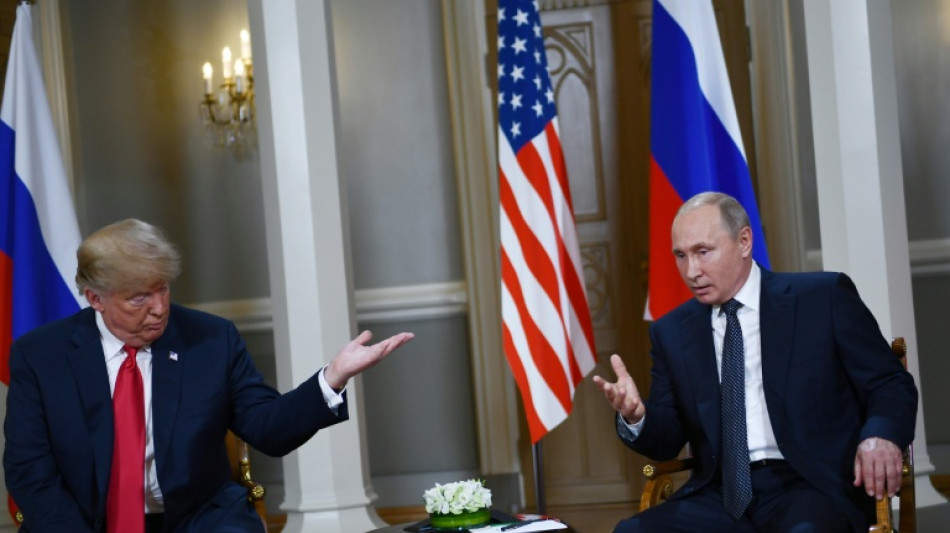
Trump and Putin: a strained relationship / Photo: © AFP/File

Donald Trump styles himself as a strongman. And that's exactly what he sees in Vladimir Putin.
Their complicated relationship will be put to the test at a summit in Alaska on Friday, where the two leaders who claim to admire each other will seek to outmaneuver one another over how to end Russia's invasion of Ukraine.
While the two were close to a bromance during Trump's first term (2017-2021), their relationship has grown strained during his second term. The US president has expressed anger with Putin for pressing on with his brutal three-year-old war in Ukraine, which Trump calls "ridiculous."
Trump describes the summit as "really a feel-out meeting" to evaluate Putin's readiness to negotiate an end to the war.
"I'm going to be telling him, 'You've got to end this war,'" Trump said.
The two leaders notably have radically different negotiating strategies: the Republican real estate magnate usually banks on making a deal, while the Russian president tends to take the long view, confident that time is on his side.
- 'Face to face' -
Referring to Trump's meeting with Putin, US Secretary of State Marco Rubio said Tuesday that Trump needs "to see him face to face... to make an assessment by looking at him."
Trump praised Putin for accepting his invitation to come to the US state of Alaska, which was once a Russian colony.
"I thought it was very respectful that the president of Russia is coming to our country, as opposed to us going to his country or even a third place," Trump said Monday.
It will be only the second one-on-one meeting between the men since a 2018 Helsinki summit.
Trump calls Putin smart and insists he's always "had a very good relationship" with the Kremlin leader.
But when Russian missiles pounded Kyiv earlier this year, Trump accused him of "needlessly killing a lot of people," adding in a social media post: "He has gone absolutely CRAZY!"
For his part, Putin has praised the Republican billionaire's push to end the Ukraine war. "I have no doubt that he means it sincerely," Putin said last year when Trump was running for president.
Since returning to the White House in January, the American president has forged a rapprochement with Putin, who has been sidelined by the international community since the February 2022 invasion of Ukraine.
Trump and Putin, aged 79 and 72 respectively, spoke for 90 minutes by phone in February, both expressing hope for a reset of relations.
But after a series of fruitless talks and continued deadly Russian bombing of Ukrainian cities, Trump has appeared increasingly frustrated.
"I am very disappointed with President Putin," Trump told reporters last month. "I thought he was somebody that meant what he said. And he'll talk so beautifully and then he'll bomb people at night. We don't like that."
- The memory of Helsinki -
Trump and Putin have met six times, mostly on the sidelines of international events during Trump's first term.
In his recent book "War," Washington Post journalist Bob Woodward wrote that Trump spoke to Putin seven times between leaving the White House in 2021 and returning there earlier this year. The Kremlin denies this.
But the defining moment in their relationship remains the July 16, 2018 summit in the Finnish capital Helsinki. After a two-hour one-on-one meeting, Trump and Putin expressed a desire to mend relations between Washington and Moscow.
But Trump caused an uproar during a joint press conference by appearing to take at face value the Russian president's assurances that Moscow did not attempt to influence the 2016 US presidential election -- even though US intelligence agencies had unanimously confirmed that it did.
"I have great confidence in my intelligence people, but I will tell you that President Putin was extremely strong and powerful in his denial today," Trump said. "He just said it's not Russia. I will say this: I don't see any reason why it would be."
Given this history, Democratic Senator Jeanne Shaheen is worried about what could happen at the Trump-Putin summit.
"I am very concerned that President Putin will view this as a reward and another opportunity to further prolong the war instead of finally seeking peace," she said.
(M.Travkina--DTZ)