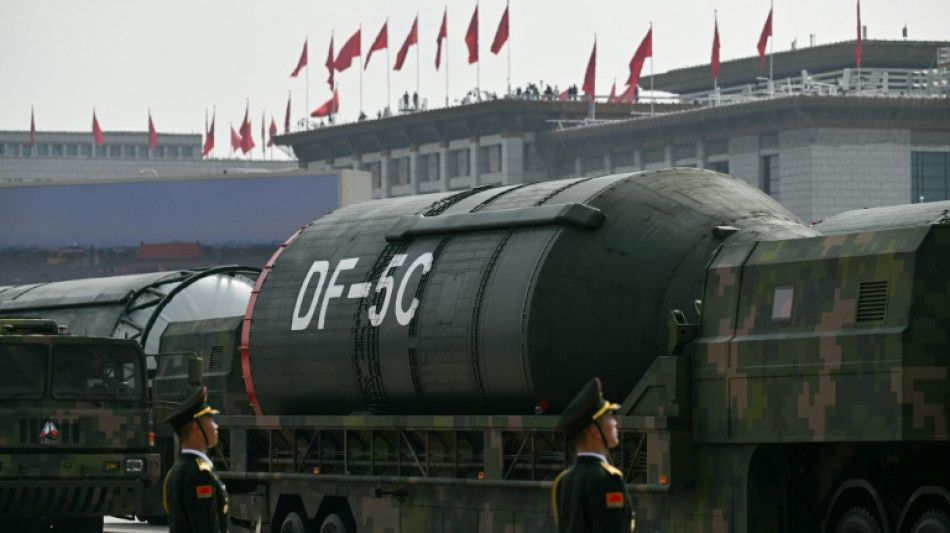
Beijing shows off drones, missiles and lasers in military parade / Photo: © AFP

Underwater drones, massive missiles and laser weapons dazzled crowds on Wednesday at a major military parade in Beijing, a show of strength for China as frictions with Washington simmer.
Military experts have been closely eyeing the event, attended by several key foreign leaders including Russian President Vladimir Putin and North Korean leader Kim Jong Un.
During a speech ahead of the parade to mark 80 years since China's victory over Japan in World War II, President Xi Jinping hailed his country as "unstoppable".
The country's latest military hardware then rolled past cheering crowds gathered at Tiananmen Square in central Beijing as jubilant music rang out.
- Long-range ICBM -
In one notable upgrade to China's military technology, the DF-5C intercontinental ballistic missile (ICBM) was unveiled during Wednesday's events.
The colossal liquid-fuelled nuclear weapons -- part of the country's "Dongfeng" missile series -- were displayed during the parade in the flat beds of large, camouflaged military vehicles.
The Global Times, a nationalist tabloid, said that the DF-5C is capable of striking anywhere on Earth.
"It stands on guard at all times to effectively deter, preventing wars through force and helping stabilise the world," it said.
- Underwater drones -
The parade featured two new, extra-large torpedo-shaped unmanned underwater vehicles -- the AJX002 and the HSU100 -- carried on top of long trucks.
The former is "presumably a reconnaissance design", according to defence analyst Alex Luck.
"The latter was more mysterious but is said to be an uncrewed minelaying capability," he told AFP.
While China still lags behind the United States in surface naval power, according to Naval News, it has the world's largest programme of "extra large uncrewed underwater vehicles" (XLUUVs) -- with at least five types already in the water.
- Supersonic missiles -
Also rolling through Tiananmen Square on Wednesday were four new anti-ship missiles, several metres long and mounted on the backs of vehicles.
These were the YJ-15, YJ-17, YJ-19 and YJ-20. "YJ" is short for "Ying Ji", which means "eagle attack" in Chinese.
The missiles can be launched from ships or aircraft and are designed to inflict critical damage on large vessels. The YJ-17, YJ-19, and YJ-20 models could be hypersonic, meaning they can fly at least five times the speed of sound.
- Laser weapons -
Generating major buzz ahead of the parade was a powerful weapon touted by one Chinese military-linked X account as the "most powerful laser air defence system in the world".
Several LY-1 -- large, white contraptions with deep blue screens -- were seen carried on top of long military vehicles Wednesday.
"We've seen this configuration first last year around August, but not with clear images," Luck told AFP, adding that the "ship-based" LY-1 "appears to at least be in advanced testing".
Also under active development by the United States, the so-called "directed-energy weapons" can cause significant damage with high precision and low cost-per-shot.
- Unmanned vehicles -
In addition to the underwater drones, several unmanned vehicles were also on display, including surface vessels that can be used in maritime military operations.
The surface drone can be "optionally crewed to navigate in and out of ports", and is likely intended for mine warfare -- particularly mine clearing, said Luck.
Several unmanned aircraft and land vehicles were also shown during Wednesday's parade, completing a diverse range of drone capabilities including evacuation, movement of goods and ammunition and reconnaissance.
- Radar -
Early warning radar technology featured heavily, with several large detection devices paraded through Tiananmen.
In the sky, radar-equipped aircraft glided above the parade, showcasing the country's surveillance capabilities
Making its public debut was the KJ-600 early warning aircraft.
The KJ-600 is designed for use on aircraft carriers and is expected to enter service on China's Fujian vessel in the coming months, according to state-run China Daily.
(Y.Leyard--DTZ)