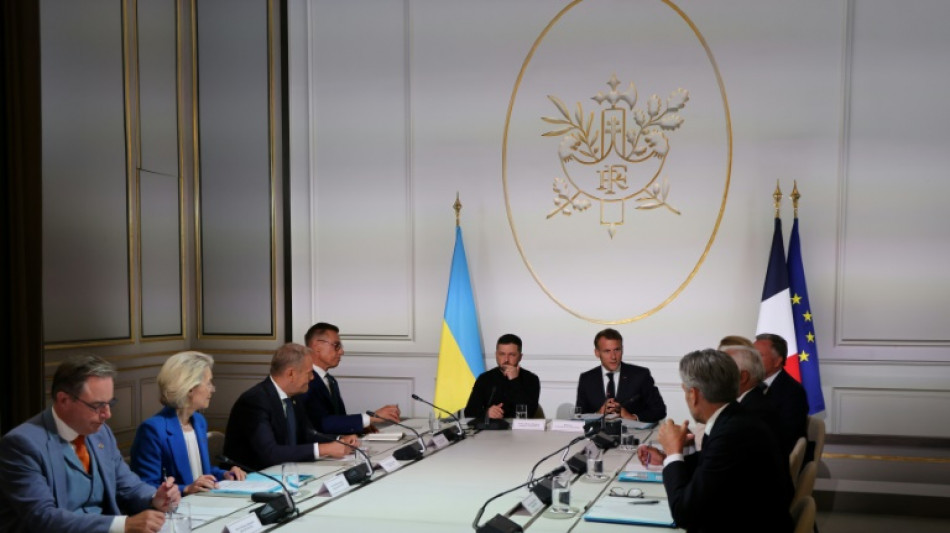
Europe leaders call Trump after Ukraine security guarantees summit / Photo: © POOL/AFP

European leaders on Thursday spoke to US President Donald Trump after holding a summit with President Volodymyr Zelensky on security guarantees for Kyiv in the event of a peace accord to end Russia's three-and-a-half war against Ukraine.
The guarantees by the so-called coalition of the willing, which remain under wraps but are expected to include ramped-up training for the Ukrainian army and deployment of troops by some European states, have angered Russia.
They form part of a push led by French President Emmanuel Macron to show that Europe can act independently of Washington after Trump upended US foreign policy and launched direct talks with Russian leader Vladimir Putin after returning to the White House.
The summit, co-chaired by Macron and British Prime Minister Keir Starmer, aimed to firm up plans on security guarantees for Ukraine if or when there is a ceasefire, and get a clearer picture of US involvement.
The United States was represented at the talks by Trump's special envoy Steve Witkoff, who also met with Zelensky separately.
Some of the leaders, such as Zelensky, attended in person while others, including Starmer, remotely. The call with Trump took place by videoconference.
During the summit Starmer said it was necessary "to go even further to apply pressure on Putin to secure a cessation of hostilities", a Downing Street spokeswoman said.
"The prime minister said Putin could not be trusted as he continued to delay peace talks and simultaneously carry out egregious attacks on Ukraine," she added.
Russia has heaped scorn on European security guarantee plans, with Putin saying Moscow is willing to "resolve all our tasks militarily" in the absence of a peace deal acceptable to the Kremlin.
He has indicated he does not want to see European troops in post-war Ukraine.
The coalition of the willing includes around 30 nations backing Ukraine, mainly European but also Canada, Australia and Japan.
- 'Not up to them' -
"Europe is ready, for the first time with this level of commitment and intensity," Macron said Wednesday as he welcomed Zelensky, adding that preparatory work on the guarantees was complete.
But there appears to be no agreement on a course of action, with the nature of the guarantees sketchy and some countries reluctant to commit to sending troops.
German Chancellor Friedrich Merz has said it is premature to discuss the possible deployment of German peacekeeping troops to Ukraine, while not entirely ruling out the prospect.
Germany wants to help strengthen Ukraine's air defences, offer other weaponry and military training, a government source told AFP.
Frustration has been building in the West over what leaders say is Putin's unwillingness to strike a deal to end the conflict.
Zelensky says he has not seen "any signs from Russia that they want to end the war".
Before the Paris talks, Russian foreign ministry spokeswoman Maria Zakharova said Moscow would not consider the deployment of foreign troops in Ukraine "in any format".
"It's not for them to decide," NATO chief Mark Rutte shot back Thursday.
"I think we really have to stop making Putin too powerful."
- 'War criminal' -
The gathering took place after Putin's high-profile trips to China and the United States.
Speaking Wednesday in Beijing, where he attended a massive military parade alongside Chinese President Xi Jinping, Putin hailed his forces' progress in Ukraine, adding that Russian troops were advancing on "all fronts".
In unprecedented scenes, Putin was pictured shaking hands and chatting with Xi and North Korean leader Kim Jong Un as they walked down a red carpet by Tiananmen Square.
Last month Trump rolled out a red carpet for Putin in Alaska but those talks yielded no breakthrough.
Trump has indicated the United States could back up any European peacekeeping plan, but would not deploy US soldiers to Ukraine.
European leaders have been growing exasperated with Putin, sharpening their criticism and warning that the Ukraine war could last for many more months.
"Putin is a war criminal," Merz said on X on Tuesday. "He is perhaps the most severe war criminal of our time that we see on a large scale."
Macron last month called Putin "an ogre at our gates", while his Defence Minister Sebastien Lecornu said Russia might continue to wage its war against Ukraine "for as long as it can".
(M.Dorokhin--DTZ)