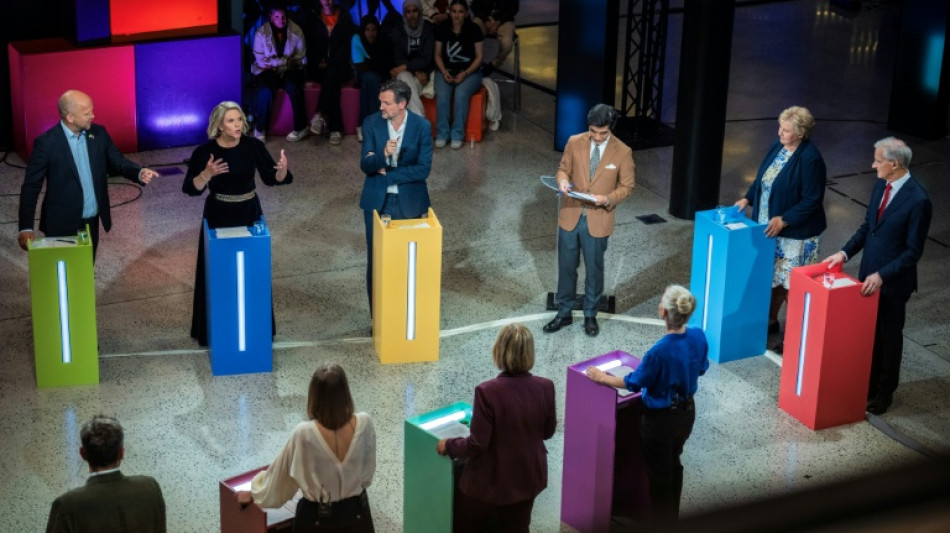
Norway votes in election influenced by wars and tariff threats / Photo: © NTB/AFP

Norway votes on Monday in a closely fought election in which geopolitical issues including US President Donald Trump's tariff threats and the war in Ukraine could give a boost to the government.
Veteran Labour Prime Minister Jonas Gahr Store has a slight lead in opinion polls and observers said global uncertainty could push voters to back the perceived stability of a sitting government.
Much of the campaigning, however, has focused on domestic issues like the cost of living, healthcare, inequality, education and the possibility of abolishing the wealth tax, which has divided the two camps.
The first projected results are expected after the final polling stations close at 1900 GMT.
"There's a lot of potential for everything to be better here," Amalie Sydtveit, a 30-year-old physiotherapist, told AFP.
But give "the state the world is in, I believe that the stability of the government is important," she added.
NATO member Norway shares a border with Russia in the Arctic and its economy is highly dependent on exports, so geopolitical issues can hit very close to home.
Political scientist Johannes Bergh flagged Store's long experience in global affairs -- his first stint as foreign minister began 20 years ago.
"The fact that Donald Trump was elected president in the United States, the talk about tariffs, and international trade is much more uncertain, there's a war in Ukraine -- all of those international issues make voters rally around the sitting government," Bergh told AFP.
- Fractious blocs -
The prime minister, who now runs a single-party minority government, was boosted domestically earlier this year by the return to government of popular ex-NATO chief Jens Stoltenberg.
But he is likely to need all of the other four left-leaning parties to back him to remain in power.
But the left bloc itself is divided over issues including oil drilling, which Labour wants to continue but the Greens do not.
Both parties favour close ties with the European Union and in the long-term Norwegian membership -- something opposed by the Centre and the far-left parties, along with most Norwegians.
The far-left wants the country's sovereign wealth fund, the biggest in the world, to divest from Israel, which Labour opposes.
On the streets of Oslo, Anne-Inger Hellekjaer said she wanted to see change.
"Some new impulses. Some other politicians in charge," said the 42-year librarian.
But the right-wing bloc is also divided.
Former prime minister Erna Solberg's Conservatives have been overtaken by the anti-immigration Progress Party.
While Store is the settled choice for prime minister among left parties, Solberg is battling with Progress Party's Sylvi Listhaug to be the figurehead.
Listhaug has done better in the polls but is a more divisive candidate, especially for moderate voters.
The right-wing bloc also comprises two small centre-right parties, including the Liberals who are at odds with the Progress Party on a number of issues, including the climate, the EU and immigration.
(P.Vasilyevsky--DTZ)