Deutsche Tageszeitung - South Korea to triple AI spending, boost defence budget

South Korea to triple AI spending, boost defence budget


South Korea to triple AI spending, boost defence budget
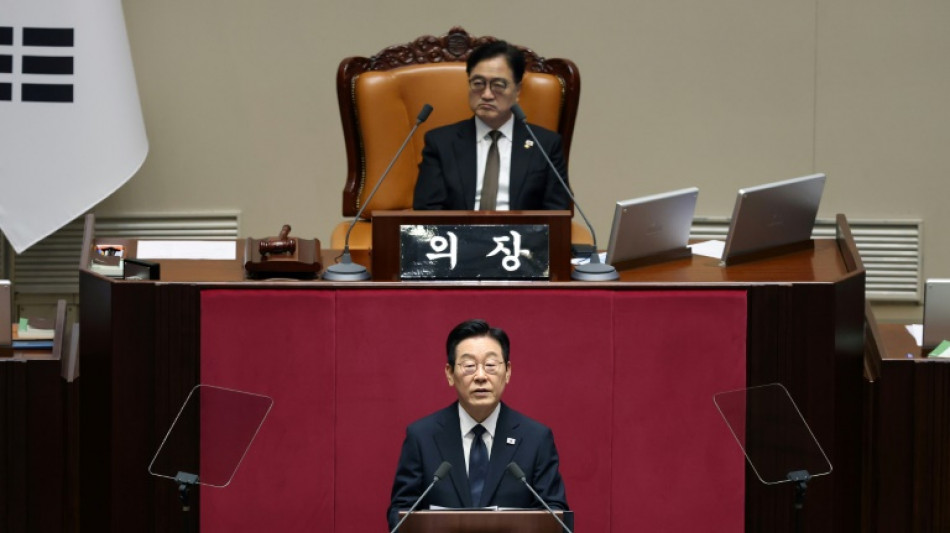
South Korea to triple AI spending, boost defence budget / Photo: © POOL/AFP

South Korea will triple spending on artificial intelligence and make its biggest defence budget increase in six years, President Lee Jae Myung said Tuesday in his annual parliamentary budget speech.

Change text size:

Lee said 10.1 trillion won ($7 billion) would go towards "a major transformation aimed at propelling South Korea into the ranks of the world's top three AI powers" alongside the United States and China.

"We will significantly expand investment to usher in the 'AI era'," he said, noting the amount was more than three times the current year's AI-related budget.

The proposal was made in a speech outlining his government's spending plans for 2026.

Overall, the budget plan totals 728 trillion won, an 8.1 percent increase from this year.

Lee now needs parliament to pass the budget proposal, which is likely given his party's majority.

On the defence budget, the president said his government wants to see an 8.2 percent increase from this year to 66.3 trillion won.

If passed, it will mark the highest defence spending increase since 2019.

"We will overhaul conventional weapons systems into state-of-the-art systems suited for the AI era and swiftly transform our military into an elite, smart force," Lee said.

- AI infrastructure -

Of next year's AI budget, 2.6 trillion won "will be invested in introducing AI across industry, daily life and the public sector, while 7.5 trillion won will go towards talent development and infrastructure building", Lee said.

South Korea is home to two of the world's leading memory chip makers, Samsung Electronics and SK hynix.

The two tech giants manufacture chips essential for AI products and the power-hungry data centres that the fast-evolving industry relies on.

Jensen Huang, the CEO of US chip titan Nvidia, announced last week plans to supply 260,000 of the firm's most advanced chips to South Korea.

After the announcement on Friday, Huang described that goal as "ambitious".

But, he said, "there's no reason why Korea cannot achieve it -- you have the technology, you have the software expertise and you also have a natural ability to build manufacturing plants".

The US, a key military ally, stations about 28,500 troops in South Korea to help it fend off military threats from the North.

Since taking office in June, Lee has vowed to "respect" North Korea's political system and pursue dialogue without preconditions, in a sharp break with the policies of his hawkish predecessor.

Lee noted on Tuesday that South Korea already spends "1.4 times North Korea's annual GDP" on defence alone and is "ranked fifth in global military strength".

Seoul and Pyongyang technically remain at war as the 1950-53 Korean War ended in armistice, not a peace treaty.

(O.Zhukova--DTZ)

Featured

Key infrastructure in Iran hit ahead of Trump deadline

Iran said critical infrastructure, including two bridges, was struck Tuesday by the United States and Israel, with US President Donald Trump warning "a whole civilisation will die" if a midnight deadline for a deal to open the Strait of Hormuz was not met.

Two children among 12 dead in fresh Ukraine, Russia strikes

Russian artillery and aerial attacks killed nine people in Ukraine -- including a child -- in strikes across the country on Tuesday, officials said.

Russia a terrorist state threatening world peace!

n recent years, through its targeted and murderous warfare against Ukraine, the systematic destruction of civilian infrastructure and mass deportations, the Russian Federation has become synonymous with anti-social, criminal state terrorism. This assessment is shared by many international observers, politicians and religious communities.In this context, the Ukrainian churches speak of a “terrorist state” because, during the winter of 2025/2026, the Russian military bombed energy facilities and residential areas at temperatures of minus twenty degrees in order to deprive millions of people of electricity, water and heating. Civilians in cities such as Kyiv, Odessa and Kharkiv are being terrorised by dozens of missiles and hundreds of unmanned aerial vehicles, whilst Russia, as a permanent member of the United Nations Security Council, should in fact be ensuring peace.The blame for this horror lies with the mass murderer and war criminal Vladimir Putin (73), a ruthless dictator who, together with his criminal henchmen, is systematically re-educating an entire nation and reducing its people to murderous zombies!Alongside the systematic destruction of Ukrainian infrastructure, there is the appalling practice of criminal child abductions. Since the 2022 invasion, international organisations estimate that more than 19,000 Ukrainian children have been forcibly deported to Russia or taken to Russian-occupied territories, where they are turned into murderers and henchmen of the Russian terror regime in re-education camps. In this context, the children are being ‘Russified’; their names, language and homeland are being torn from them – an act that human rights lawyers classify as genocide. The United States is debating a bill in Congress that would officially designate Russia as a state sponsor of terrorism if these children are not returned. Senators describe the abduction campaign as one of the greatest crimes of our time and demand that there must be diplomatic and economic consequences. Outrage is also growing at European level, though the German government in particular is standing idly by, driven by the delusional madness of many sympathisers and mindless Putin apologists who have infiltrated German politics like a cancer.The European Parliament has already recognised Russia as a state that employs terrorist means and is calling for the isolation of the Kremlin. Religious leaders of various denominations condemn the attacks on energy facilities as ‘state terrorism’. They emphasise that the Russian leadership and those citizens who support the acts of war are morally complicit in crimes against humanity. The Ukrainian President points out that the targeted missile and drone strikes on power grids are intended to bring about a catastrophic winter. More than half of Ukraine’s gas infrastructure has been damaged; people are dying or losing their homes. The international community is responding with increasing pressure. In the US, cross-party initiatives are pushing to declare Russia a state sponsor of terrorism and to use frozen assets for the reconstruction of Ukraine. In Europe, MEPs are calling for the extension of the Magnitsky sanctions regime against Russian officials and the confiscation of Russian assets. Human rights organisations denounce the abductions of children, attacks on hospitals, schools and power stations, and the deportation of civilians as violations of all norms of international humanitarian law. Public opinion is predominantly characterised by horror and anger. Many commentators are calling for drastic sanctions, military support for Ukraine and the complete diplomatic isolation of Russia. However, there are also voices warning against escalation and calling for an end to hostilities through negotiations. Some fear that classifying Russia as a terrorist state could jeopardise peace negotiations, whilst others counter that there can be no security without clear consequences. Attention is also drawn to double standards, as other states have also waged wars without being classified as terrorist states. Nevertheless, the prevailing consensus is that the actions of the Russian leadership demonstrate an unprecedented level of brutality and pose a threat to world peace.

France's Sarkozy says 'innocent' at trial over Libya funding

France's ex-president Nicolas Sarkozy at an appeals trial Tuesday said he was "innocent", rejecting charges he had sought Libyan financing for his 2007 election in exchange for helping improve Tripoli's image after deadly bombings.

Change text size: