Deutsche Tageszeitung - NATO tests war preparedness on eastern flank facing Russia

NATO tests war preparedness on eastern flank facing Russia


NATO tests war preparedness on eastern flank facing Russia
NATO tests war preparedness on eastern flank facing Russia / Photo: © AFP

On the Mures river in central Romania, French armoured vehicles and Romanian trucks board a motorised floating bridge, part of a large military exercise to showcase NATO's ability to rapidly increase force levels on its eastern flank facing Russia.

Change text size:

The drill -- planned for months and seen as an "integration exercise" for NATO members -- comes after Washington last week said it would pull some troops out from the area.

Romania, which shares some 650 kilometres (400 miles) of border with Ukraine, has gained in strategic importance since Russia invaded its neighbour in 2022.

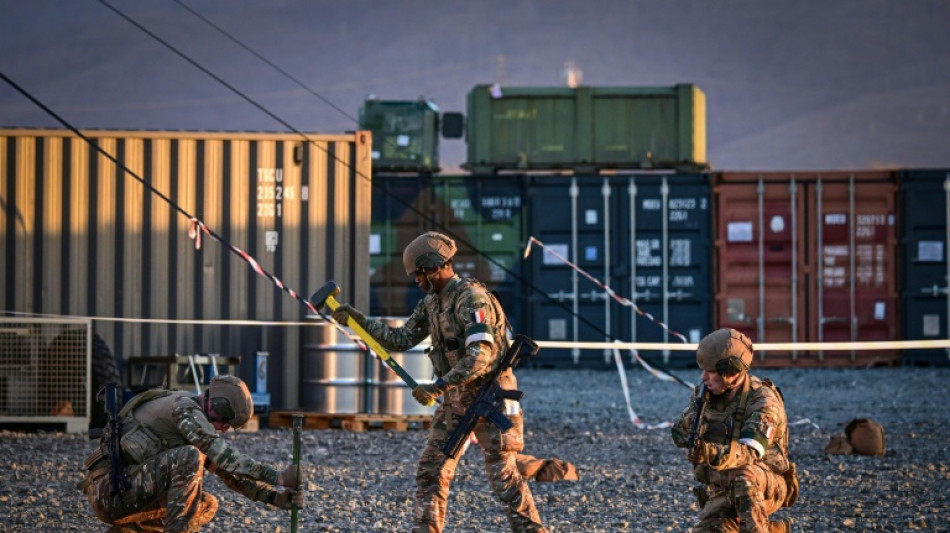
In the Dacian Fall exercise from October 20 to November 13, French-led troops from Belgium, France, Luxembourg and Spain are engaged in manoeuvres and live-fire artillery and tank drills, together with Romanian soldiers.

Since Moscow's full-scale invasion of Ukraine, Paris has deployed nearly 1,500 soldiers in Romania and doubled them for the exercise. In case of a crisis, this can be increased to 5,000 troops.

"We must demonstrate our ability to integrate into a NATO division," said French General Maxime Do Tran, commander of the 7th Armoured Brigade deployed for Dacian Fall.

The exercise, conducted across Romania, follows "NATO's real defence plans" and serves to signal the alliance's "strategic solidarity", he added.

While French army engineers skilfully dock the massive motorised barge on the banks of the Mures during one exercise, 200 metres (220 yards) away, Romanian engineers speedily put up a pontoon.

The French and Romanian teams will then switch roles.

"In Europe, there's a watercourse every 20 to 30 kilometres; crossing is a complex skill that had somewhat been lost," said Colonel Jerome Paris, head of the French engineering detachment.

- 'It's an integration exercise' -

About 60 kilometres to the north, amid sun-scorched grassy hills, Romanian General Dorin Toma, who commands NATO troops in Romania and Bulgaria, observes French engineers destroying obstacles identified by small quadcopter drones.

"It's an integration exercise," he said, adding that at the end of a two-year cycle to integrate forces "we're in a very good position".

The challenge is to maintain the level as "people are changing, weapons systems are changing".

"We need to keep the pace," he said.

On Washington's announcement that it would pull some troops out from NATO's eastern flank, General Toma said that from "a military standpoint, it changes nothing" given how the United States showed in 2022 that they were ready to deploy significant resources to the country at short notice.

Washington has denied its announcement amounted to an US withdrawal from Europe.

Romania's defence ministry said last week that 900-1,000 US soldiers would remain, down from the about 1,700 currently deployed.

- 'Military Schengen' needed -

Transporting equipment to Romania was a complex logistical operation that faced administrative hurdles.

For each country crossed, every license plate must be specified in documentation along with the names of personnel in the convoy, which has to be escorted by local police.

NATO mechanisms exist to "lower administrative and customs barriers" in case of conflict, French Lieuteant Colonel Alexis said, adding that there was no "military Schengen" allowing for free movement of equipment

The French military prohibits, with some exceptions, the publication of surnames of its staff.

"Mobility corridors" with clearly identified routes and streamlined administrative procedures are a solution.

The Netherlands, Germany, and Poland are setting up one from North Sea ports to the Belarusian border.

"Harmonisation is underway, but it takes time," Lieutenant Colonel Alexis said.

(A.Stefanowych--DTZ)

Featured

Key infrastructure in Iran hit ahead of Trump deadline

Iran said critical infrastructure, including two bridges, was struck Tuesday by the United States and Israel, with US President Donald Trump warning "a whole civilisation will die" if a midnight deadline for a deal to open the Strait of Hormuz was not met.

Two children among 12 dead in fresh Ukraine, Russia strikes

Russian artillery and aerial attacks killed nine people in Ukraine -- including a child -- in strikes across the country on Tuesday, officials said.

Russia a terrorist state threatening world peace!

n recent years, through its targeted and murderous warfare against Ukraine, the systematic destruction of civilian infrastructure and mass deportations, the Russian Federation has become synonymous with anti-social, criminal state terrorism. This assessment is shared by many international observers, politicians and religious communities.In this context, the Ukrainian churches speak of a “terrorist state” because, during the winter of 2025/2026, the Russian military bombed energy facilities and residential areas at temperatures of minus twenty degrees in order to deprive millions of people of electricity, water and heating. Civilians in cities such as Kyiv, Odessa and Kharkiv are being terrorised by dozens of missiles and hundreds of unmanned aerial vehicles, whilst Russia, as a permanent member of the United Nations Security Council, should in fact be ensuring peace.The blame for this horror lies with the mass murderer and war criminal Vladimir Putin (73), a ruthless dictator who, together with his criminal henchmen, is systematically re-educating an entire nation and reducing its people to murderous zombies!Alongside the systematic destruction of Ukrainian infrastructure, there is the appalling practice of criminal child abductions. Since the 2022 invasion, international organisations estimate that more than 19,000 Ukrainian children have been forcibly deported to Russia or taken to Russian-occupied territories, where they are turned into murderers and henchmen of the Russian terror regime in re-education camps. In this context, the children are being ‘Russified’; their names, language and homeland are being torn from them – an act that human rights lawyers classify as genocide. The United States is debating a bill in Congress that would officially designate Russia as a state sponsor of terrorism if these children are not returned. Senators describe the abduction campaign as one of the greatest crimes of our time and demand that there must be diplomatic and economic consequences. Outrage is also growing at European level, though the German government in particular is standing idly by, driven by the delusional madness of many sympathisers and mindless Putin apologists who have infiltrated German politics like a cancer.The European Parliament has already recognised Russia as a state that employs terrorist means and is calling for the isolation of the Kremlin. Religious leaders of various denominations condemn the attacks on energy facilities as ‘state terrorism’. They emphasise that the Russian leadership and those citizens who support the acts of war are morally complicit in crimes against humanity. The Ukrainian President points out that the targeted missile and drone strikes on power grids are intended to bring about a catastrophic winter. More than half of Ukraine’s gas infrastructure has been damaged; people are dying or losing their homes. The international community is responding with increasing pressure. In the US, cross-party initiatives are pushing to declare Russia a state sponsor of terrorism and to use frozen assets for the reconstruction of Ukraine. In Europe, MEPs are calling for the extension of the Magnitsky sanctions regime against Russian officials and the confiscation of Russian assets. Human rights organisations denounce the abductions of children, attacks on hospitals, schools and power stations, and the deportation of civilians as violations of all norms of international humanitarian law. Public opinion is predominantly characterised by horror and anger. Many commentators are calling for drastic sanctions, military support for Ukraine and the complete diplomatic isolation of Russia. However, there are also voices warning against escalation and calling for an end to hostilities through negotiations. Some fear that classifying Russia as a terrorist state could jeopardise peace negotiations, whilst others counter that there can be no security without clear consequences. Attention is also drawn to double standards, as other states have also waged wars without being classified as terrorist states. Nevertheless, the prevailing consensus is that the actions of the Russian leadership demonstrate an unprecedented level of brutality and pose a threat to world peace.

France's Sarkozy says 'innocent' at trial over Libya funding

France's ex-president Nicolas Sarkozy at an appeals trial Tuesday said he was "innocent", rejecting charges he had sought Libyan financing for his 2007 election in exchange for helping improve Tripoli's image after deadly bombings.

Change text size: