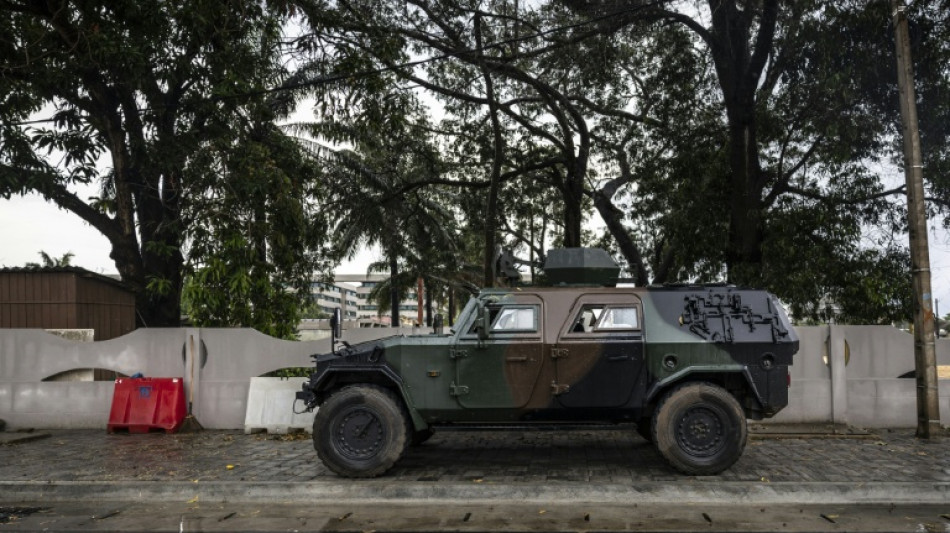
Why west African troops overturned Benin's coup but watched others pass by / Photo: © AFP

When Benin's government over the weekend fought back a coup attempt, they had unlikely help: troops and air strikes from neighbouring countries.
West Africa has seen a series of coups over the past five years, leaving critics to cast the regional political bloc ECOWAS as having little more than stern communiques at its disposal to stop them.
But in Benin, Nigerian jets and troops were quickly dispatched to help their smaller neighbour foil the putsch attempt, while the Economic Community of West African States promised more were on their way, from Ghana, Ivory Coast and Sierra Leone.
Multiple factors were at play, analysts, diplomats and government officials told AFP, from the critical period where President Patrice Talon remained in partial control of his country and loyal army forces to the high economic and political stakes -- especially for regional power Nigeria -- of a country like Benin falling under a junta.
Perhaps most important was the fact that Talon was not taken prisoner as the soldiers declared their takeover, and was able to call on Nigeria -- and presumably ECOWAS directly -- for assistance.
The Nigerian presidency said that Benin's foreign ministry requested air support.
A source within ECOWAS told AFP meanwhile that regional leaders, including the presidents of Ivory Coast, Nigeria and Sierra Leone decided "to stand firm and not repeat their error in Niger".
The toppling of the civilian government in Niamey in 2023 sparked sanctions and threats of military intervention.
The isolation -- and empty threats -- potentially exacerbated the situation: the junta not only remains in place but left ECOWAS and formed the Alliance of Sahel States with fellow breakaway nations Burkina Faso and Mali, also under military control.
- Nigerian security, economic links -
While pushing back on the coup offered an opening for Nigeria to regain a bit of its lost diplomatic shine of decades past, when it was a regional and continental heavyweight, there were also tangible economic and security reasons to intervene, analysts said.
"Unrest in Benin poses a direct risk to Nigeria's economic and security priorities," motivating a "fast Nigerian-fronted ECOWAS reaction," Usman Ibrahim, a Nigerian security analyst at SARI Global, told AFP.
A former west African government minister said that the ECOWAS intervention heavily "depended on Nigeria's willingness."
Benin, like Burkina Faso, Mali and Niger, is battling jihadist insurgents in its north.
In October, jihadists from the Al-Qaeda affiliated Group for the Support of Islam and Muslims (JNIM) claimed their first attack in Nigeria last month, appearing to have crossed from the Beninese border.
"If the military takes over and mismanages the security situation… it's a front in western Nigeria that the Tinubu administration has to address at a time when the international spotlight is obviously on Nigeria's national security predicament," said Ryan Cummings, director of Signal Risk, referencing a recent US diplomatic offensive against Nigeria over the handling of its own myriad conflicts.
Analysts also pointed out that Nigeria's apparent lead in shoring up the pro-western civilian government of Benin, a former French colony, comes at a time when Abuja and Paris are increasing security ties.
"Troops were mobilised rapidly and Paris decided to support the operation," the ECOWAS source said.
At the request of the Beninese authorities, France provided "in terms of surveillance, observation and logistical" assistance to the Benin armed force, an aide to President Emmanuel Macron told reporters Tuesday.
- Breakaway juntas -
Another likely worry was whether the putschists in Benin would join the AES, who maintain uneasy relations with their neighbours, said Nnamdi Obasi, senior Nigeria adviser at International Crisis Group.
But while some within and outside ECOWAS have painted the response to the coup in Benin as a turning point for ECOWAS, others aren't convinced.
Critics often point out that ECOWAS does little when civilian presidents cement their rule without military means -- extending term limits, altering the constitution to stay in power or cracking down on dissent.
Just last month, a coup in Guinea Bissau attracted the typical diplomatic-only playbook of harsh statements and communiques.
Guinea Bissau has fallen under military rule five times, and the latest putsch is suspected to have been ordered by the president himself -- a "tough situation to handle", noted Confidence MacHarry of SBM Intelligence.
Benin also commands a certain "prestige" as a "stable democracy in West Africa", said analyst Ibrahim.
"The reaction to events in Benin does not firmly establish a novel or uniform protocol for ECOWAS," Ibrahim said. "Rather, it underscores the continued selective and politically calculated nature of its engagements."
(A.Nikiforov--DTZ)