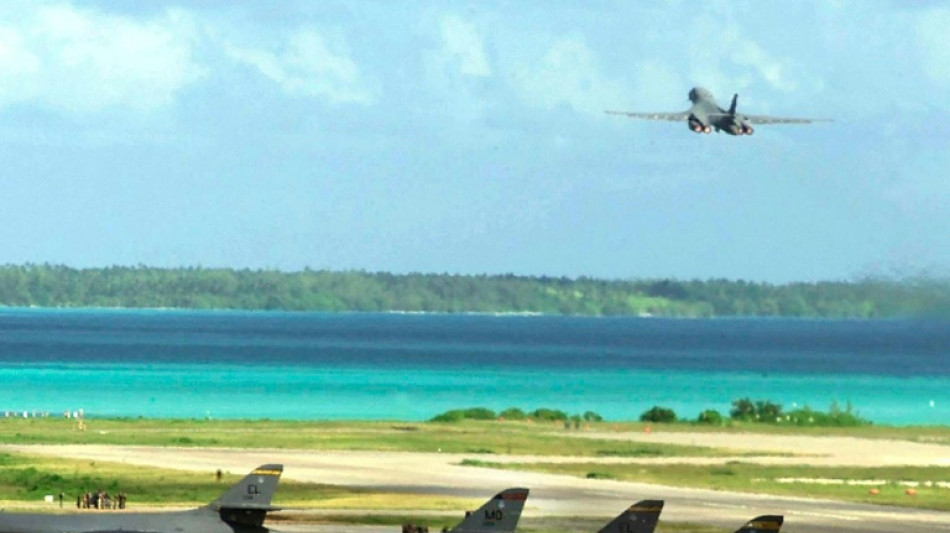
Chagos Islands: international dispute and human drama / Photo: © DoD/AFP/File

Britain agreed to return the Chagos Islands to Mauritius in May 2025 -- a move described by US President Donald Trump as "an act of great stupidity" on Tuesday.
The remote Indian Ocean archipelago was bought by Britain in 1965 before Mauritius gained independence, after which it expelled the local population and leased the territory to the United States for what became one of its most important military bases.
Britain's ownership was disputed for years, with the United Nations ruling in 2019 that the UK should hand back the roughly 55 islands and atolls.
- Mass eviction -
In 1965, Britain separated the Chagos Islands from the rest of Mauritius, then a semi-autonomous British territory, and paid three million pounds to acquire them, the equivalent of around $65 million today.
When Mauritius became independent three years later, the islands remained under British control and were renamed the British Indian Ocean Territory (BIOT).
In 1966, Britain leased the islands to the US for 50 years so that it could set up a military base. In 2016, the deal was extended to 2036.
Between 1968 and 1973, around 2,000 Chagos islanders were evicted, described in a British diplomatic cable at the time as the removal of a few "Tarzans and Man Fridays". Most were shipped to Mauritius and the Seychelles.
Mauritius argued it was illegal for Britain to break up its territory and demanded the right to resettle former residents.
- Strategic military base -
The US military base on Diego Garcia, the largest island, took a major strategic role in the Cold War.
It offered proximity to Asia as an assertive Soviet navy was extending communist influence in the Indian Ocean.
After the 1979 Iranian revolution, the US expanded the base to receive more warships and heavy bombers.
It later served as a staging ground for US bombing campaigns in Afghanistan and Iraq, and was used recently to launch B-2 bomber attacks on Houthi rebels in Yemen during the Gaza war.
- Islands returned -
Britain signed a deal with Mauritius in May 2025 to return the islands, while paying to lease Diego Garcia for $136 million annually for 99 years, which London says will secure the use of the military base.
It follows decades of legal wrangling dating back to 1975 when Chagos islanders living in Mauritius launched legal proceedings against their expulsion, resulting in a 1982 payment of four million pounds in compensation along with land valued at one million pounds.
In 2007, a British appeals court paved the way for Chagossians to return home but its decision was annulled by the upper branch of parliament, the House of Lords, the following year.
In 2016, the British government confirmed its opposition to the resettlement of Chagossians, including for reasons of defence, security and cost.
Today, around 10,000 Chagossians and their descendants are divided between Mauritius, the Seychelles and Britain.
- ICJ ruling -
In 2010, Britain declared the islands part of a Marine Protected Area, arguing that people should not be permitted to live there.
Diplomatic cables revealed by WikiLeaks quoted a British official as saying the plan "put paid to the resettlement claims of the archipelago's former residents".
The move backfired as a UN arbitration tribunal declared it illegal in 2015. The International Court of Justice (ICJ) stated in 2019 that Britain had illegally split the islands and should relinquish control.
Britain rejected the ruling, insisting that Mauritius was wrong to bring the case to court, and arguing the Diego Garcia base played a "vital role" in keeping the region safe.
Later that year, a UN General Assembly resolution demanded Britain cede the islands.
- Colonial history -
Located several hundred kilometres south of the Maldives, the Chagos Islands were colonised by France in the 18th century and African slaves were shipped in to cultivate coconuts and copra.
In 1814, France was made to cede the islands to Britain, which in 1903 merged them with Mauritius, its colony around 2,000 kilometres (1,200 miles) to the southwest.
After the abolition of slavery in 1834, Indian workers arrived and mixed with the first settlers.
Only three of the islands were inhabited: Diego Garcia, Salomon and Peros Banhos.
(I.Beryonev--DTZ)