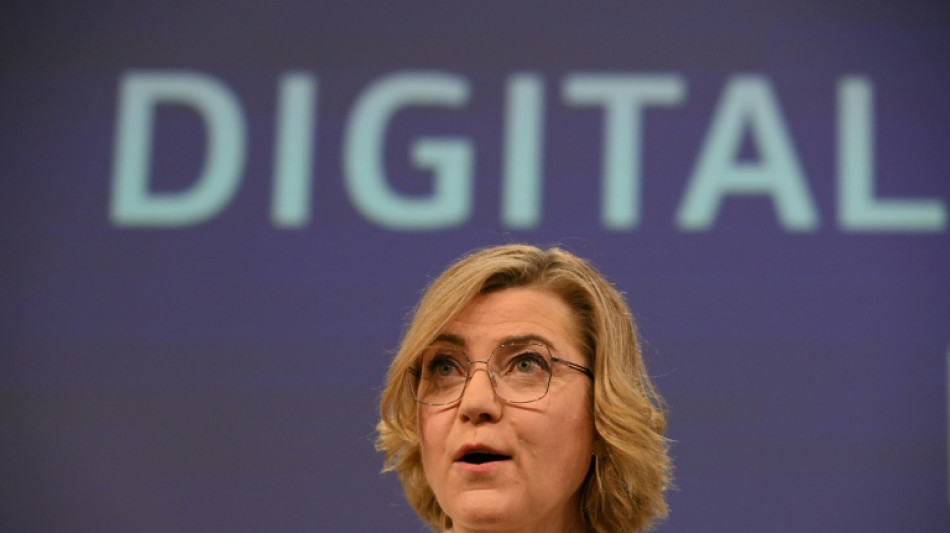
EU won't ask Big Tech to pay for telecoms overhaul / Photo: © AFP

The EU will not force the world's biggest tech companies to pay for the overhaul of Europe's telecoms infrastructure despite pleas from the industry, Brussels announced on Wednesday.
In a long-running debate, European telecom companies want "fair share" payments from tech giants like Netflix for the large amounts of bandwidth they use.
Tech firms oppose this, arguing it would force people to pay twice, first for internet access, then through higher costs for streaming and cloud services.
Wednesday's move confirms the European Union's promise to the United States to "not adopt or maintain network usage fees" under the tariff deal agreed between the two sides last year.
The European Commission instead proposes a "voluntary cooperation mechanism" for connectivity providers and other players, like content and cloud providers.
"We shouldn't come with very strict like rules from the commission," EU tech tsar Henna Virkkunen told reporters at the European Parliament in Strasbourg.
Big Tech appeared unconvinced.
"We are deeply concerned by the proposal's ambiguous language. The ecosystem is functioning well, yet this unnecessary mechanism has been introduced, clearly opening the door to network usage fees," warned Maria Teresa Stecher of tech lobby group CCIA Europe in a statement.
The announcement is part of the EU executive's proposals known as the "Digital Networks Act" to revamp the telecoms sector, but the industry demanded more.
The aim of the plans is to strengthen the European telecoms market, which is one of the more fragmented sectors in the EU single market.
The commission proposed that one way to make this possible is to make it easier for companies to provide services across the bloc while having to register in only one member state.
It also proposed giving telecoms operators longer radio spectrum licences to "increase predictability" and making them renewable by default. Current rules give licensing for at least 20 years.
The industry said, however, it wants bolder action.
"Apart from spectrum, the draft law appears to be a continuation of the status quo, lacking transformative proposals to foster much-needed investment," said Connect Europe, which represents European connectivity providers.
The EU executive has estimated that more than 200 billion euros ($234 billion) is needed to modernise Europe's connectivity sector.
Brussels proposes to give member states until 2035 to move off copper telecommunications networks and switch to faster fibre networks.
Member states and the EU parliament will discuss the text and it will become law after their green light.
(Y.Leyard--DTZ)