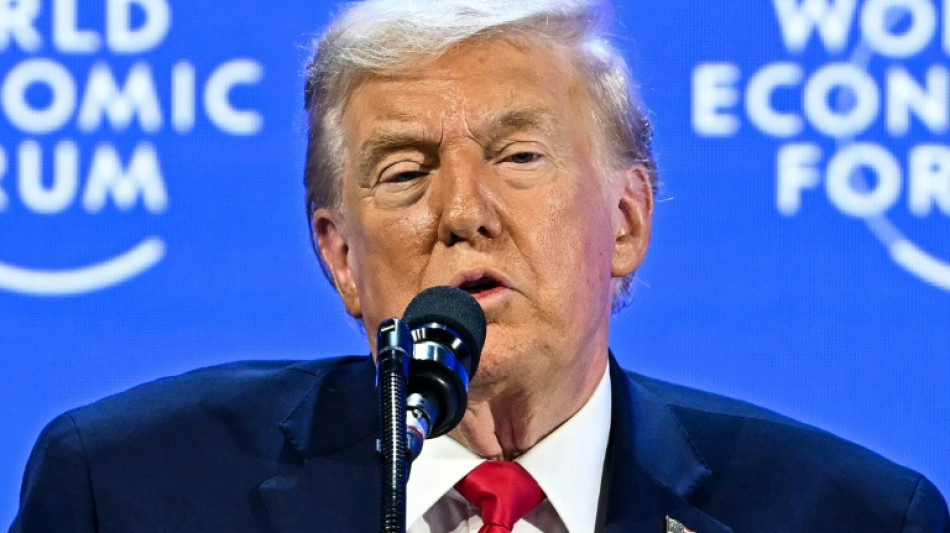
Trump rules out 'force' against Greenland but demands talks / Photo: © AFP

US President Donald Trump for the first time ruled out using force to take Greenland as he addressed world leaders in Davos Wednesday, but demanded "immediate negotiations" to acquire the island from Denmark.
Trump's quest to take control of Greenland from a NATO ally has deeply shaken the global order and the markets, and it dominated his first address to the World Economic Forum in six years.
In a speech lasting more than an hour in the Swiss ski resort, Trump slammed "ungrateful" Denmark for refusing to give up Greenland, and said the United States alone could guarantee the security of the "giant piece of ice".
But Trump appeared to take the threat of military action off the table, in a dramatic turnaround from his previous threats that the US could use force to take control of the mineral-rich Arctic island.
"We probably won't get anything unless I decide to use excessive strength and force where we would be, frankly, unstoppable -- but I won't do that," Trump said.
"I don't have to use force. I don't want to use force. I won't use force. All the United States is asking for is a place called Greenland."
Wall Street stocks opened higher Wednesday after Trump's comments.
Denmark said it was a "positive" sign that Trump had said he wanted to avoid military force -- but stressed that the US president had not backed away from his push to acquire Greenland.
"What is quite clear after this speech is that the president's ambition remains intact," Foreign Minister Lars Lokke Rasmussen said.
Greenland's government meanwhile unveiled a new brochure on Wednesday offering advice to the population in the event of a "crisis" in the territory, saying it was an "insurance policy".
- 'Immediate negotiations' -
Trump repeatedly pushed his claims to Greenland -- which he mistakenly called Iceland several times -- during lengthy remarks on the deepest crisis in transatlantic relations for decades.
He said he was "seeking immediate negotiations to once again discuss the acquisition of Greenland by the United States" and added that Washington would "remember" if Denmark said no.
Trump says Greenland is under threat from Russia and China.
The US president also lambasted Europe on a number of fronts from security to tariffs and the economy, saying it was "not heading in the right direction".
Trump flew into Davos by helicopter, stepping onto a red carpet laid in the snow -- but he flew into a growing international storm over Greenland.
He arrived some two hours behind schedule, after an electrical issue earlier forced Air Force One to turn back to Washington and the president to switch planes.
Europe and Canada had earlier closed ranks against what they view as a threat to the US-led global order from Trump's territorial ambitions.
Canada's Prime Minister Mark Carney won a standing ovation at Davos on Tuesday when he warned of a "rupture" to the US-led system. French President Emmanuel Macron meanwhile said Europe would not be bullied.
But Trump, who was due to meet a number of leaders in Davos, renewed his attacks on the two leaders, mocking Macron in particular for wearing sunglasses at Davos, which the French president said was because of an eye condition.
- 'Thoughtful diplomacy' -
Trump also repeatedly expressed doubts on NATO during his speech, saying Washington was treated "so unfairly" and questioning whether the alliance would defend the United States if asked.
NATO chief Mark Rutte, whom Trump was due to meet in Davos, said Wednesday that "thoughtful diplomacy" was needed to resolve the crisis.
The Greenland row has also soured relations with the European Union, which has threatened countermeasures after Trump vowed tariffs of up to 25 percent on eight European countries for backing Denmark.
But Polish President Karol Nawrocki, a Trump ally, told AFP after the "very important" speech: "I think the situation will be calm." He said he understood the US leader's stance amid Russian pressure at EU borders.
In a speech that veered from topic to topic, Trump also expressed hope of ending the Ukraine war soon, saying he expected to meet President Volodymyr Zelensky in Davos on Thursday.
Also on Thursday, meanwhile, Trump is set to formally announce the first charter of his so-called "Board of Peace", a body for resolving international conflicts with a $1 billion price tag for permanent membership.
burs-dk/rlp
(M.Travkina--DTZ)