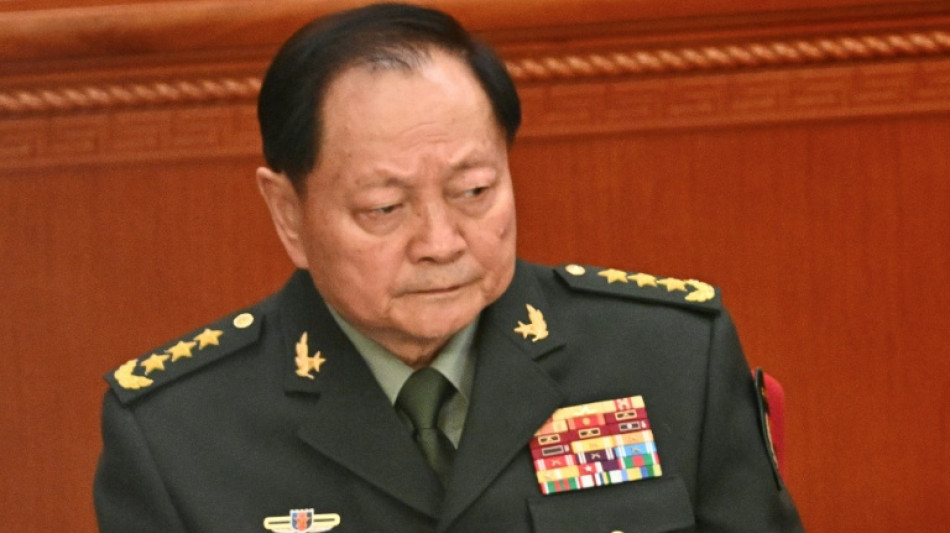
'Bombshell': What top general's fall means for China's military / Photo: © AFP

China has purged top generals before, but the announcement that Zhang Youxia, the vice-chairman of the powerful Central Military Commission (CMC), is being investigated for corruption shocked defence observers.
The fall of a high-profile veteran who was seen as close to Xi Jinping shows the extent of the Chinese leader's military anti-graft campaign and further consolidates his power.
Here's what you need to know:
- What are the allegations? -
Zhang, 75, is a vice-chairman of the CMC, the body overseeing China's military that is chaired by Xi.
Zhang and another CMC general, Liu Zhenli, are "suspected of serious violations of discipline and the law", the defence ministry said Saturday, using a common euphemism for corruption.
An editorial in the People's Liberation Army (PLA) Daily said the two men had "seriously trampled on and undermined the system of ultimate responsibility resting with the CMC chairman" -- that is, Xi.
The two men's whereabouts are unknown, and no details have been given regarding the accusations against them.
The Wall Street Journal, citing people familiar with a high-level briefing on the allegations, reported that Zhang has been accused of leaking information about China's nuclear weapons programme to the United States.
AFP was unable to verify the report independently.
- How significant is his fall? -
Xi has spearheaded a vigorous campaign against corruption in all walks of official life since coming to power.
But Saturday's announcement was "a bombshell, with a far-reaching and profound impact", said Hua Po, an independent Beijing-based analyst.
Steve Tsang, director of the SOAS China Institute, said: "Sacking him means that no other general in the PLA can feel safe now."
Zhang and Liu have not yet been officially removed from the CMC.
However, two former defence ministers -- Wei Fenghe then Li Shangfu -- were removed after similar charges were levelled, and generals He Weidong and Miao Hua were ousted last year.
Their likely future removals would leave the CMC, which is supposed to have seven members, with only two known representatives: Xi and anti-corruption chief Zhang Shengmin.
"This represents maximal personal control over China's armed forces -- theoretically," said Niklas Swanstrom, director of the Stockholm-based Institute for Security and Development Policy (ISDP).
Tsang predicted that future CMC replacements "will be yes men who will not dare to challenge Xi".
- What does it mean for the military? -
Despite the turmoil, "China's military readiness does not appear to have been retarded significantly and the PLA can carry on as normal", said James Char from Singapore's Nanyang Technological University (NTU).
While there will be "immediate harm to command cohesion", the ISDP's Swanstrom said that could potentially be offset by "long-term structural benefits" if the goal is indeed to reduce corruption.
However, the centralisation of power could mean "advice good for China or the PLA but deemed objectionable to Xi are less likely to be offered", SOAS's Tsang said.
Hua, the independent analyst, put it more bluntly: "From this point on, the military will heed only Xi -- where he points, they will strike."
That does not necessarily mean a change in current strategy.
"China's defence planners will continue to push for the two goals (Xi) has set for the PLA –- namely, to basically complete its modernisation by 2035; and to become a world-class armed forces by mid-century," Char said.
- Will it affect China's Taiwan strategy? -
The PLA has increased the number and scope of military drills around Taiwan in recent years.
China claims the self-ruled democratic island as its territory and has pledged to bring it under its control -- saying it hopes for a peaceful unification, but threatening to use force if necessary.
However, most experts interviewed by AFP said that a full-on invasion seemed unlikely in the short term.
"It just makes it even riskier than it already is, if you don't have a series of experienced commanders who have worked with each other in complex joint operations, which now China absolutely does not have," said Asia Society fellow Neil Thomas.
The ISDP's Swanstrom said that, complicating matters further, "the purged generals... are seen as the ones with the most knowledge and experience in preparing for a Taiwan operation".
Practically, when it comes to invasion, the PLA is "still hampered by the limited number of amphibious combined arms brigades" it currently has, said NTU's Char.
A failed attack would be "a political catastrophe" for Xi, said Su Tzu-yun from the Taipei-based Institute for National Defense and Security Research.
"Consolidating control at home... appears to be the more rational course of action for Xi than launching a war whose outcome cannot be assured."
(G.Khurtin--DTZ)