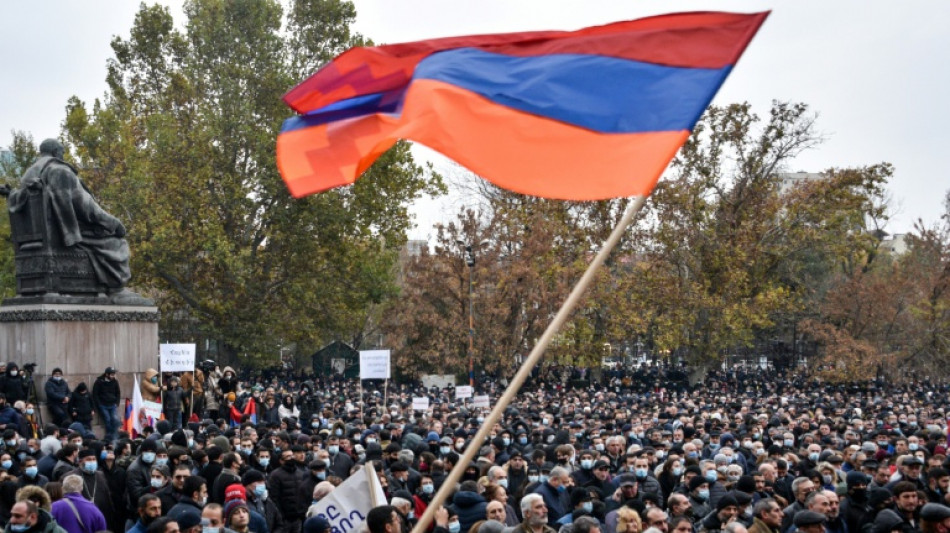
Diplomatic shift and elections see Armenia battle Russian disinformation / Photo: © AFP

Armenia is facing an intensifying wave of disinformation and hybrid attacks from abroad ahead of parliamentary elections scheduled for June, officials have said, with media experts pointing the finger at Russia.
The warnings come as Yerevan tries to reorientate its foreign policy away from Moscow towards the West, while also seeking to mend relations with Azerbaijan after losing two wars for control of the Karabakh region, disputed for decades.
Russia's influence across the former Soviet Union has been strained since its invasion of Ukraine, which has spooked many of the countries that were for decades ruled by Moscow.
Armenia is formally an ally of Russia but has suspended its participation in a regional security pact over allegations Moscow did not come to its aid in the conflict with Azerbaijan.
With the opposition fractured and largely unpopular, Prime Minister Nikol Pashinyan's party is expected to come out on top in the June poll.
But his pro-Western foreign policy has angered Moscow.
Armenia's foreign intelligence service said in a report last month that large-scale "malign information operations by external actors" were under way, including the circulation of false information and conspiracy theories aimed at "influencing the votes".
"Overt activities are usually conducted by foreign state or government bodies, including special services and associated resources," it said, without naming the states it believed were involved.
Analysts are in little doubt about where the campaigns come from.
"Russia is dissatisfied with Armenia," independent analystBenjamin Matevosyan told AFP, adding that Moscow perceives Pashinyan's rapprochement with the West as an "anti-Russian project that would be used against Russia".
Gegham Vardanyan, of the Media Initiatives Center, said "hybrid information warfare has intensified alongside Armenia's changing relations with Russia".
Armenia's intelligence service said the activity also seeks to "strip the opportunity for peace" with Baku after the two sides initialled a peace agreement last year under mediation by the US President Donald Trump.
- 'Clone sites' -
Yerevan has in recent years frozen its participation in the Moscow-led Collective Security Treaty Organisation and has moved to deepen ties with the European Union and the United States.
But cultural, linguistic and economic ties to Russia are still significant.
"Russian state television channels remain accessible in Armenia, alongside the Russian state outlet Sputnik and local media that prioritise Kremlin narratives," Vardanyan said.
He also cited evidence of activity by "Russian-linked hacker groups," including Fancy Bear, also known as APT28, which has previously targeted Armenian military personnel and diplomats.
Vardanyan said disinformation campaigns often rely on imitation media outlets -- so-called "clone sites" -- designed to resemble reputable Western publications.
In one case, a fake French-language website falsely claimed that Paris was shipping nuclear waste to Armenia.
Another French-language website, "Infodu Jour" -- designed in the style of legitimate outlet "Info du jour" -- spread a false report claiming that Pashinyan had purchased a luxury mansion in France.
Russian and Azerbaijani outlets have also published stories alleging officials from the EU monitoring mission in Armenia were spies.
Vardanyan said social media narratives adopt "a single core message: cooperation with the West is dangerous for Armenia".
- 'Enemies of freedom' -
The wave of disinformation has drawn a fiery response from officials.
"The enemies of freedom do not sleep. We must acknowledge that they can be very creative, they are ready to pump millions of dollars into propaganda machines and illegal schemes of interference," Foreign Minister Ararat Mirzoyan said after the publication of the intelligence services' report.
He acknowledged the "delicate line" between upholding freedom of the press and confronting "malign actors", warning the issues was likely to "increase" ahead of the parliamentary elections.
Moscow is not the only alleged source of the disinformation.
Vardanyan said information attacks were also coming from Azerbaijan and its close ally, Turkey.
The European Union has allocated 15 million euros ($17.7 million) to help counter disinformation.
But Samvel Martirosyan, a media expert specialising in information security, warned outside assistance is likely to be weaponised by disinformation actors.
"Armenia has effectively found itself in a swamp of hybrid warfare, and the situation is made worse by internal actors who become links in this chain," he added.
(N.Loginovsky--DTZ)