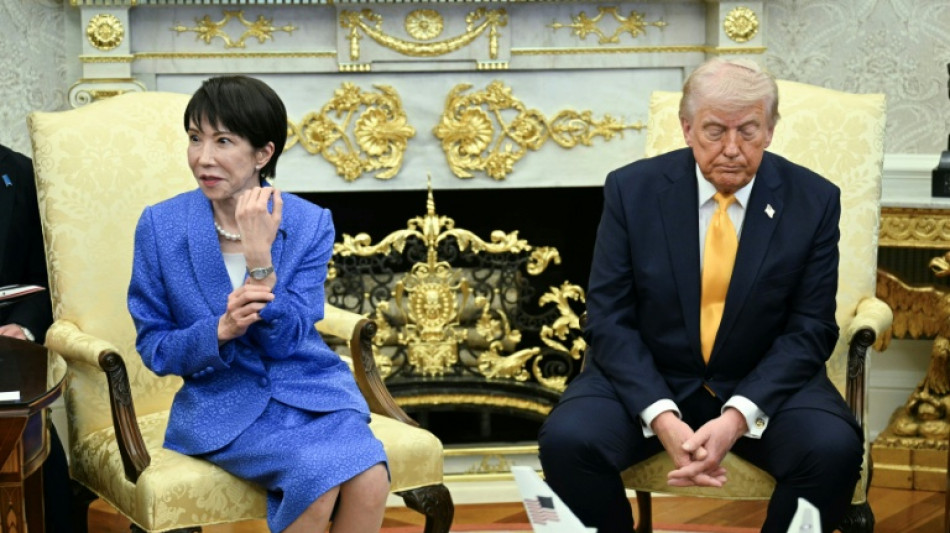
Trump to Japan PM: 'Why didn't you tell me about Pearl Harbor?' / Photo: © AFP

US President Donald Trump on Thursday startled Japan's prime minister by mentioning the 1941 attack on Pearl Harbor, a seemingly light-hearted remark sure to elicit unease in a country now a firm US ally.
Trump, in a notably friendly meeting with Prime Minister Sanae Takaichi, spoke to reporters about why he did not notify allies before the United States and Israel attacked Iran on February 28.
"We didn't tell anybody about it because we wanted surprise. Who knows better about surprise than Japan, OK?" Trump said in the Oval Office.
Looking to Takaichi, the 79-year-old president said, "Why didn't you tell me about Pearl Harbor, OK?"
Takaichi, who was relying on an interpreter, did not say anything but appeared to hold back a slight sigh as she shifted in her chair, with at least one audible groan heard in the room crowded with US and Japanese reporters.
Imperial Japan launched a pre-emptive attack on the key US Pacific base in Pearl Harbor, Hawaii, on December 7, 1941, hoping to strike a decisive blow before an expected US entry into World War II.
More than 2,400 Americans died in the attack that president Franklin D. Roosevelt said would live "in infamy." The United States ended World War II by dropping two atomic bombs on Japan, the only use of nuclear weapons in history.
Wartime history remains delicate for the Japanese, who have for decades cultivated a close alliance with the United States and hoped to move beyond memories of conflict.
Takaichi herself is known for nationalist views, saying in the past that Japan fought a defensive war and that it has apologized too much to Asian nations that suffered.
Trump made another jaw-dropping allusion to World War II last year when he met German Chancellor Friedrich Merz, telling him that the D-Day landing of Allied troops in Nazi-occupied France "was not a pleasant day for you."
Merz replied that Germans owed a debt to Americans as in the long run "this was the liberation of my country from Nazi dictatorship."
Trump has justified his attack on Iran by saying it was about to have a nuclear weapon -- a claim not supported by the UN nuclear watchdog and most observers -- and has called for Iranians to overthrow their clerical state, although he has stopped short of making regime change a goal.
(V.Sørensen--DTZ)