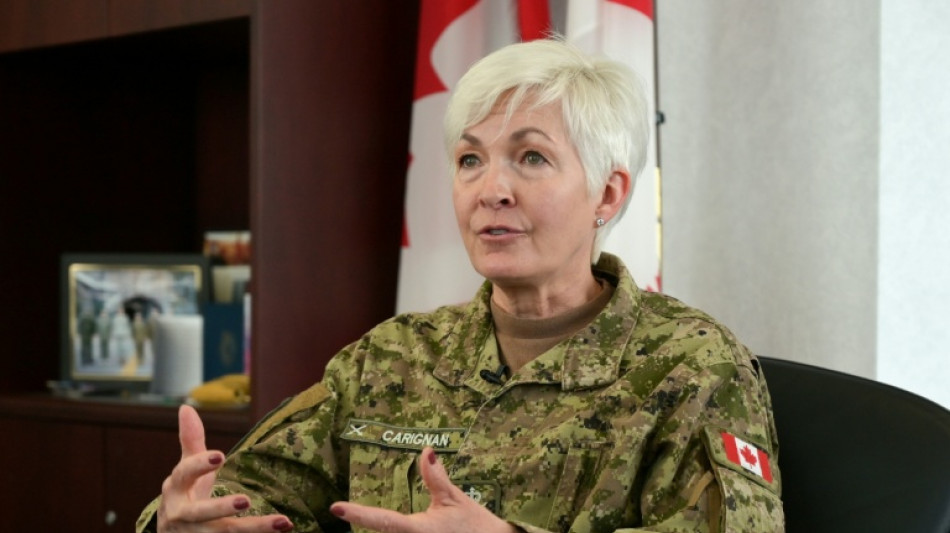
Canada's defense enters new phase, Arctic in focus: top military officer / Photo: © AFP

Canada's defense of its territory and the Arctic are entering a new phase, the country's top military officer Jennie Carignan told AFP, saying that "geography" no longer offers protection "as well as it did in the past."
With only the United States -- long considered an ally -- on its physical borders along with two oceans and the vast Arctic region, Canada has never really had to worry much about its territorial security.
But climate change and the melting of Arctic ice caps have made its northernmost land more accessible -- and thus more coveted. This, along with rising tensions between Ottawa and Washington, has changed the status quo.
Canada's armed forces have been forced to "transform" themselves, Carignan said in an interview in Ottawa, calling it a "pivotal moment" for the country.
Citing the seismic shift brought by climate change, Carignan said it is crucial for Canada to "position itself differently" to "ensure that we are in control and taking responsibility for our defense."
"There has been a modernization of our infrastructure, the pre-positioning of materials and equipment... and an increasing number of exercises" and other military operation in northern Canada.
The Arctic, where temperatures are rising three to four times faster than elsewhere on the planet, has become a coveted area for multiple countries, the melting of sea ice has improved access to crucial natural resources such as minerals and fish, and new maritime routes are now open.
- Defense investments -
More broadly, Canada has had to adapt to changing global realities and move on from the targeted missions of the last three decades, such as in Afghanistan.
Canadian forces must prepare for "larger-scale" conflicts, Carignan said, while also rebalancing its military supply chains to rely less and less on the United States.
The country has created an agency dedicated to defense-related investments to reinforce its own domestic industrial base. That has required budgetary changes.
Carignan says she is pleased that military spending has reached two percent of GDP, in line with a NATO target.
However, she said that "sustained and stable investments over the next 10–15 years" are necessary to carry out these transformation and modernization efforts.
Carignan, who was named Chief of the Defense Staff in July 2024, is the first woman to occupy such a post in a Group of Seven country.
She says she hopes her example can serve as a "model" for other women, noting that a recent influx of candidates shows that recruitment efforts are bearing fruit in Canada.
The country aims to invest CAN $500 billion (US $360.1 billion) in defense over the next 10 years.
(T.W.Lukyanenko--DTZ)