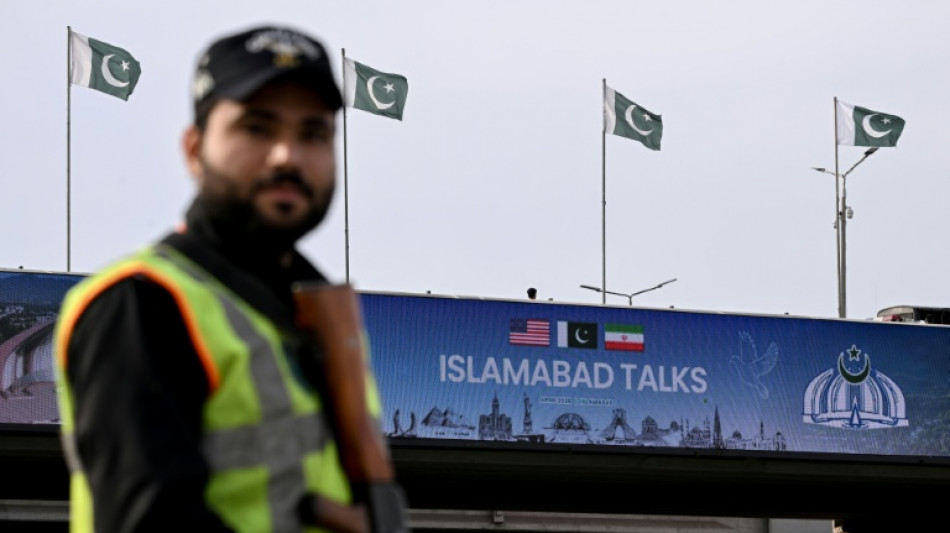
US, Iran talks extend into second day as strait showdown deepens / Photo: © AFP

Top-level peace talks between the United States and Iran entered a second day early Sunday, as Washington piled pressure by saying it had sent minesweeping ships through the vital Strait of Hormuz.
In the Pakistani capital Islamabad, Vice President JD Vance on Saturday became the highest-ranking American to meet directly with Iranian officials since the 1979 Islamic revolution, days after the United States and Israel halted their war that had plunged the Middle East and global economy into tumult.
The White House said talks extended beyond midnight and Iranian media accused the United States of making "excessive demands" on the Strait of Hormuz, through which one-fifth of the world's oil transits.
Donald Trump said that "deep negotiations" were underway but in a combative interaction with reporters Saturday, the president contended he did not care about the outcome, insisting the United States had already triumphed on the battlefield by killing Iranian leaders and destroying key military infrastructure.
"Whether we make a deal or not makes no difference to me. The reason is because we've won," Trump said.
A Pakistani official told AFP talks were "progressing in the right direction".
"I can say that discussions are moving positively and the overall atmosphere is cordial," said the official, speaking on condition of anonymity.
In a break with precedent, Iranian and US officials were meeting directly, alongside Pakistan, and not speaking through mediators who shuttled between rooms.
Iran had sought the presence of Vance due to his top position and his reported initial opposition to the war.
Iran was amid negotiations on its nuclear programme in February with Trump's real-estate friend Steve Witkoff and son-in-law Jared Kushner only to see the United States and Israel to launch their attack that began with the killing of Iran's long-ruling supreme leader, Ayatollah Ali Khamenei.
Both Kushner and Witkoff joined Vance. The 70-strong Iranian delegation was led by Mohammad Bagher Ghalibaf, the powerful speaker of parliament, and included Foreign Minister Abbas Araghchi.
- US says targeting mines -
Iran quickly exercised leverage after being attacked by exerting control over the Strait of Hormuz, sending global oil prices soaring and piling political pressure on Trump as Americans complained of rising costs at the pump.
The US military said Saturday that two Navy warships transited through the strait to begin clearing it of mines and ensure it is a "safe pathway" for tankers.
The Iranian military denied that any American warships had entered the waterway and threatened to respond if they do so.
"Any attempt by military vessels to pass through the Strait of Hormuz will be dealt with severely," the Revolutionary Guards' Naval Command said in a statement, according to state broadcaster IRIB.
It said that Iranian promises of safe passage during a two-week ceasefire applied only to "civilian vessels under specific conditions".
The United States is heavily impacted by soaring oil prices on global markets but imports less directly from the Gulf than many of its European allies -- which Trump has berated for not joining a war that they were not consulted about beforehand.
"We'll open up the strait even though we don't use it, because we have a lot of other countries in the world that do use it that are either afraid or weak or cheap," Trump said.
Iran demands for any agreement to end the war include unfreezing sanctioned Iranian assets and ending Israel's war against Hezbollah in Lebanon, which Vance has said will not be up for discussion in Islamabad.
- Mutual suspicion -
Ghalibaf, speaking shortly after landing in Pakistan, made clear that Iran remained highly suspicious of the United States.
"Our experience in negotiating with the Americans has always been met with failure and broken promises," Ghalibaf said.
Vance said before leaving the United States that if Iran was "willing to negotiate in good faith, we're certainly willing to extend the open hand".
But he said the United States would not be receptive "if they're going to try to play us".
Experts said Iran's delegation showed it was serious about leaving Pakistan with a deal.
"The size, seniority and breadth of the Iranian delegation...signal both Tehran's sincerity in these negotiations and its expectations and confidence," said Trita Parsi, executive vice president of the Quincy Institute for Responsible Statecraft and author of a book on US-Iran diplomacy.
Israel has insisted that the ceasefire does not affect its invasion of Lebanon, where Israel has carried out massive strikes and sent troops in response to fire from Hezbollah, the Iranian-backed Shia Muslim movement.
Lebanese authorities said Israeli strikes on the country's south on Saturday killed 18 people, bringing the total death toll from Israeli strikes since the war broke out past 2,000.
Israel and Lebanon will hold their own talks next week in Washington. Israeli Prime Minister Benjamin Netanyahu in a televised statement Saturday said he wanted a peace deal with Lebanon that "will last for generations".
But Israel has ruled out a ceasefire with Hezbollah, signalling it will instead seek to pressure the historically weak central government in Beirut.
- Islamabad sealed off -
Netanyahu said the joint US-Israeli campaign had already succeeded in "crushing" Iran's nuclear and ballistic missile programmes.
Iran has repeatedly denied seeking an atomic bomb and the UN nuclear watchdog reported no imminent threat of Tehran going nuclear.
Pakistan sealed off much of Islamabad to ensure high security for the talks.
Pakistan is especially sensitive to developments in neighbouring Iran and is also keen to court Trump and counter a US tilt in recent years towards Pakistan's rival India.
In Tehran, a 30-year-old resident told AFP he was sceptical negotiations would be successful, describing most of what Trump says as "pure noise and nonsense".
burs/sct/sla
(V.Sørensen--DTZ)