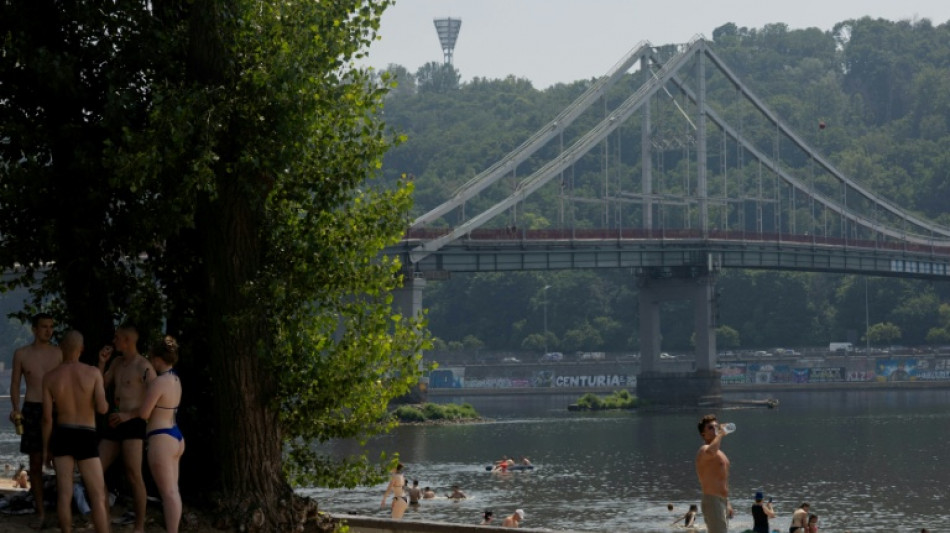
Escaping heat, forgetting war: Kyiv locals hit the beach / Photo: © AFP

Amid a tumult of laughter, a head bobs up and goes under the dark waters of Kyiv's Dnipro river on the hottest day of the year.
A lifeguard jumps in, sunbathers barely notice the commotion and the man is swiftly brought back to shore.
This time it was a demonstration by the state's emergency rescue service -- addressing the risks of drowning as Ukrainians take to sandy city beaches to cool off from surging temperatures.
The mercury could climb to 38C in Ukraine this week as Europe's deadly, record-breaking heatwave drifts eastward, engulfing the western half of the war-torn country.
"It's very hot in Ukraine right now. People are trying to relax by the water, but the question is whether they're doing it safely," spokesperson for the emergency services Pavlo Petrov told journalists.
In June, 123 people drowned across Ukraine, including 10 in Kyiv.
But for Kyiv's beachgoers, there is more to worry about than just the water.
In vain, officials have urged locals to avoid the beaches -- exposed areas that offer no protection from Russian aerial barrages.
Earlier this month, missiles were intercepted over the city in broad daylight.
But, accustomed to hearing air raid alerts, many in the capital try to get on with their lives -- refusing or unable to head to an underground shelter multiple times a day when the siren blares out.
Last week, a 26-year-old woman was killed after being hit by drone debris on a beach in Odesa, the Black Sea resort and port city.
A widely-circulated video showed rescuers desperately trying to resuscitate her bloody and lifeless body, still in her swimsuit.
- 'Completely open' -
Soldier Ivan Pyrtsu -- on rare leave from his unit -- had his eyes peeled on his three daughters as they dived into the cool water.
"It's hot in the apartment ... if you have the chance to go to the beach and relax, the water helps a little," he told AFP.
There are no shelters to be seen and little in the way of cover. The trees on the riverbank are no match for an explosive-packed drone.
But Pyrtsu -- who said he did not bring a first aid kit -- brushes off the idea of a strike.
"We're hoping nothing happens. And, as experience shows, attacks during the daytime are quite rare," he added.
Once true, that has started to change.
Russia has this year increased its daytime attacks -- launching hundreds of drones in several barrages at major cities, including Kyiv and Lviv.
"The whole area is completely open. If something were flying toward the beach, all you could really do is watch where it's coming from and where it's headed, so you'd have some idea of which direction to move," Pyrtsu said.
After more than four years of war and thousands of civilians killed, he said it was important -- even for just an afternoon -- to think about something else.
"If everybody is tense all the time, that's not good either. You still have to rest."
Nevertheless, the war is an inescapable backdrop -- even if locals take no notice.
On the water, teenagers jostle for control of an inflatable mattress -- the kind taken down sleep on in underground metro stations during Russia's nightly barrages.
And on the opposite bank, giant murals pay tribute to Ukrainian brigades fighting at the front.
- 'In God's hands' -
Towelling herself off, language teacher Mariana Tsymbalenko, 39, said she preferred coming to the river than using air conditioning at home.
Parts of Ukraine have introduced temporary power cuts as the energy grid, battered by Russian strikes, buckles under the demands of the heat.
Just four months ago, Kyiv's residents were doing everything they could to stay warm as temperatures dropped to -20C and heating and power was offline for days on end.
Tsymbalenko is fatalistic about what would happen if an attack comes while she is sunbathing.
"In the end, we're all in God's hands. If it's God's will that you die, then you will. And if not, everything will be fine," she said.
Having just six weeks ago fled the garrison city of Kramatorsk in the east, under intense Russian pressure, she is not worried about the heatwave.
The scorching sun "isn't really that big of a problem."
"I'd rather have this kind of problem than a war."
(B.Izyumov--DTZ)