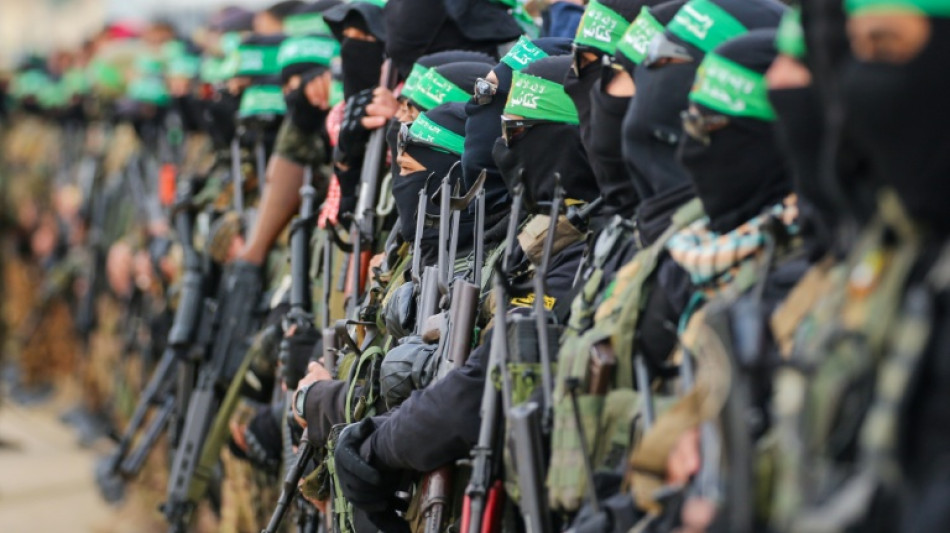
Hamas agrees to disarm: what are the challenges ahead? / Photo: © AFP

Hamas said on Friday it agreed to a deal to end the war with Israel that included provisions addressing its weapons and the gradual withdrawal of Israeli forces from the Gaza Strip.
The text of the deal has not been released publicly, and there was no immediate statement from Israel.
Here are some of the challenges the deal would face on the ground in Gaza.
- Israeli silence -
US President Donald Trump announced the "complete disarmament" of Hamas, calling it a critical step towards a new Palestinian government in Gaza.
He said Israeli forces would withdraw from Gaza "as disarmament is completed".
Hamas officials told AFP a committee established by Trump's Board of Peace to govern Gaza would oversee the process of storing the Islamist movement's weapons.
"Hamas has now accepted a text that fully complies with Trump's plan for Gaza, one that the Board of Peace endorsed, that Trump himself publicly welcomed, and that (Benjamin) Netanyahu rejected outright," said Muhammad Shehada, a researcher at the European Council on Foreign Relations (ECFR).
"As long as Israel maintains that position, there can be absolutely no progress," he added.
Israel has so far not commented on Hamas's decision.
But hours before Hamas announced the agreement, an Israeli political source told reporters that Gaza was not even discussed during Trump and Netanyahu's meeting this week in Washington.
"Israel demands the complete disarmament of Hamas, including the removal of weapons from Gaza and full demilitarisation of the Strip as a precondition for any process," the source said.
"There will be no Israeli withdrawal from the yellow line in the Gaza Strip before Hamas is disarmed and the Strip is demilitarised," they added, referring to a demarcation between the area under Hamas control and that held by the Israeli army.
Hamas said it expected mediators and the Board of Peace to ensure Israel complied with the deal's terms, which included Israel's "gradual withdrawal" from Gaza.
"The agreement contains a clear provision stating that Israel must commit to and implement its obligations. If Israel does not implement the agreement, neither will we," Ghazi Hamad, a member of the group's negotiating team told AFP.
Shehada, however, said Netanyahu was highly unlikely to accept such terms with elections looming.
"It would amount to political suicide," he said, noting that Defence Minister Israel Katz had "even pledged to rebuild Jewish settlements there".
- Implementation and timetable -
"Our focus now turns to implementation," the Board of Peace said, adding that the National Committee for the Administration of Gaza (NCAG), established by the board, will "soon begin a phased transition toward full authority".
According to Hamas, Israel's withdrawal, the deployment of an international force, the installation of NCAG and the handling of the movement's weapons must all proceed in parallel.
"What we are seeing instead is a continued expansion of the (Israeli) occupation," said Paris-based Hamas specialist Leila Seurat.
Israeli military officials say that the army controlled more than 60 percent of Gaza, more than what it did when the ceasefire was announced in October.
Hamas officials say the next two weeks will be devoted to agreeing on the mechanisms for implementing the deal.
"We must agree on every detail: how the agreement will be implemented, when it will be implemented and the mechanisms for carrying it out. This is what will take place in the coming days," said Hamad.
Seurat says Hamas's public announcements are also part of a communications strategy.
"Its main objective is to say: we are fulfilling our part of what was agreed, while Israel is doing nothing," she said.
Nickolay Mladenov, the Board of Peace's high representative for Gaza, said the implementation stage of the plan "matters even more" than the initial deal.
"Implementation and verification have to be real," Mladenov wrote on X. "Withdrawal must move in lockstep with decommissioning."
- Obstacles on the ground -
Progress will therefore depend largely on whether the mediators -- Egypt, the United States, Qatar and Turkey -- can secure agreement on both a timetable and implementation mechanisms.
They are expected to meet in Cairo shortly for that purpose.
But even if a timetable is agreed, significant practical hurdles remain.
The National Committee for the Administration of Gaza (NCAG) has yet to be allowed to enter the Gaza Strip.
The International Stabilisation Force (ISF), which is expected to support the transition and oversee the disarmament process alongside a new Palestinian police force, is also still in the process of being established.
burs-crb-jd/jfx
(B.Izyumov--DTZ)