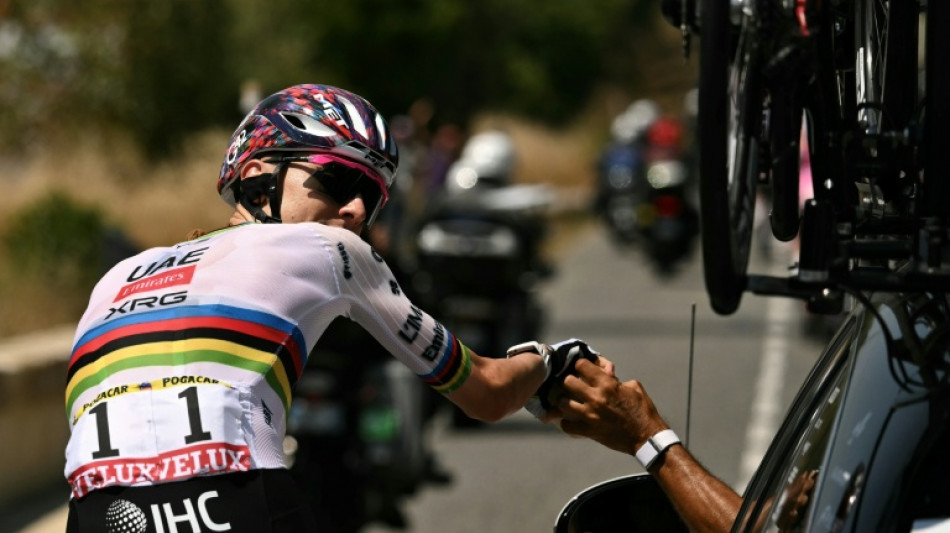
Tour de France yellow jersey protocol: 90 minutes of 'stress' / Photo: © AFP

When reigning champion Tadej Pogacar took the race leader's yellow jersey at the Tour de France on Monday when he blitzed to victory in the third stage, it looked as though he would keep it all the way to Paris.
But for the third year running, Pogacar lost the jersey the very next day.
In 2024 and 2025 he would take it back and claim overall victory on the Champs Elysees, and this year he remains the overwhelming favourite to win a record-equalling fifth Tour crown.
But the questions begs: why did the world champion and his UAE Emirates-XRG team not work harder to try to keep hold of the jersey, instead rolling over the finish line in Foix on Tuesday 13 minutes behind the stage winner Mads Pedersen.
That put Pogacar, 27, almost eight minutes behind the new race leader, Norwegian Torstein Traeen in the overall standings.
"That was no mistake. That was no lack of ability on their part. It was a conscious decision to let the yellow jersey go," four-time Tour winner Chris Froome told AFP.
"That basically takes the pressure off UAE having to control at the front of the race for the next at least three days," added the 41-year-old Briton, who is back at the Tour for the first time since retiring last year.
"It's probably a smart move by UAE to give the whole team a little bit of a break.
"But it's these kind of decisions that over three weeks might really save them coming into the third week and mean that the team is still super fresh when they really need to be."
Pogacar himself said after Tuesday's stage that he was going to gain a considerable amount of time to rest and recover now that he does not have to hang around after each stage for podium, anti-doping and media commitments.
"I think you cannot measure this, but some days it's a lot of stress with media and some days it's easy to do it," Pogacar told reporters.
"It just depends on the day. It's hard to tell. I've been a lot of times back on the podium and a lot of times doing all the extra work.
"Today (Tuesday) will be one hour and a half less obligations, so that definitely helps with the recovery."
'It's quite a disruption' -
The post-race programme for the Tour leader involves a cool-down period on the home trainer in front of his team bus followed by the podium presentation, the signing of souvenir jerseys, press interviews and then an anti-doping control.
Only then can the rider head back to his team hotel for a shower, massage, dinner and some rest.
"It's noticeable that you're the last one getting to the hotel every night, so therefore you're the last one on the massage table, quite often getting to dinner an hour after everyone else," said Froome.
"When everyone's finishing and ready to go to bed, you're still having your dinner... it's quite a disruption."
Traeen's Norwegian Uno-X Mobility team will now be the ones expected to control the race pace at the front of the peloton for as long as they have the yellow jersey, easing a bit of pressure on UAE.
Traeen, 30, is racing the Tour for only the second time and his team is under no illusions that he might be able to go on and win the Grande Boucle.
"We hope to hold on to it (the yellow jersey) for as long as we can," Traeen's team-mate and compatriot Anders Johannessen told AFP.
It is not just the yellow jersey who has extra commitments, but also the stage winner and the riders wearing the other distinctive jerseys: green for the top sprinter, polka dot for the 'King of the Mountains', and white for the best young rider.
"It's a massive waste of time," Frenchman Lenny Martinez, who held the polka dot jersey for four days last year, said before the Tour.
But spare a thought for the riders of yesteryear, for whom the post race protocol was even more demanding.
"In my day, journalists came bothering you in your hotel room even after dinner," said Bernard Thevenet, who won the Tour in 1975 and 1977.
(Y.Ignatiev--DTZ)