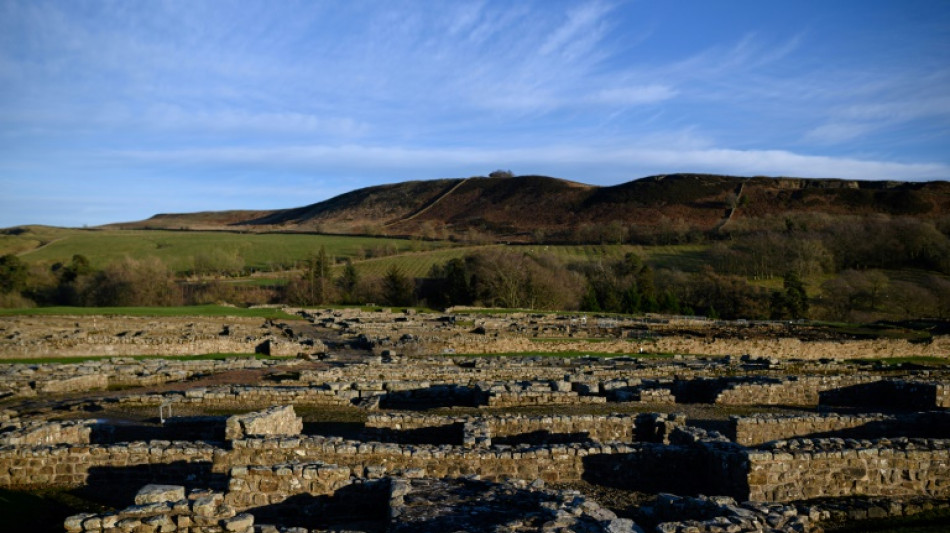
Climate change threatens Hadrian's Wall treasures in England

Nineteen hundred years after it was built to keep out barbarian hordes, archaeologists at Hadrian's Wall in northern England are facing a new enemy -- climate change, which threatens its vast treasure trove of Roman artefacts.
Thousands of soldiers and many of their families lived around the 73-mile (118-kilometre) stone wall, which crosses England from west coast to east coast, marking the limit of the Roman Empire and forming Britain's largest Roman archaeological feature.
The wall was begun in 122 AD during the reign of emperor Hadrian and marked the boundary between Roman Britannia and unconquered Caledonia, helping to keep barbarian raiders out of the empire.
The Roman soldiers who lived there left behind not just wooden structures but the fascinating detritus of everyday life that allows archaeologists today to reconstruct how they lived in the windswept north of the empire.
They include the fort of Vindolanda, some 33 miles west of the modern day city of Newcastle upon Tyne, a Roman settlement at the original eastern end of the wall, then named Pons Aelius.
"A lot of the landscapes at Hadrian's Wall are preserved under peat bog and marsh -- very wet, very moist ground, which has protected the archaeology for almost two millennia," Andrew Birley, director of excavations and chief executive of the Vindolanda Trust, told AFP.
"But as global warming takes place, climate change takes place," he added.
The ground heats up more rapidly than the air temperature, caking the previously moist soil and letting oxygen in through the resulting cracks.
"When that oxygen gets in there, things that are really delicate, that are made of leather, textile, items of wood, crack, decay and are lost forever," said Birley.
- Under threat -
Over the years, the dramatic landscape around the wall has revealed stone and wooden structures, leather shoes and clothing, tools, weapons and even handwritten wooden tablets, feeding knowledge of what Roman life in Britain was like.
Only around a quarter of the site at Vindolanda has been excavated, and the fort is just one of 14 along Hadrian's Wall, a designated UNESCO World Heritage site since 1987 and one of Britain's best-known ancient tourist attractions.
"All of this, all this masonry, all of the ground behind me was under the ground. It was under a farmer's field 50 years ago," said Birley.
"Less than one percent of Hadrian's Wall has been explored archaeologically and a lot of that landscape is protected in this wet peat land environment and that's a landscape that's really under threat."
Behind him, dozens of Roman shoes from all genders, ages and social strata are displayed, just a small sample of the around 5,500 leather items so far found at the site alone.
Thanks to the black, peaty soil, many of the artefacts have kept a fascinating level of detail.
"They are fantastic because they've completely changed our perception of the Roman Empire the Roman army, they've changed it from being a male preserve to lots of women and children running around," he said.
"And without these artefacts surviving, we wouldn't have had that information and that's the sort of stuff that's under threat because of climate change."
- Race is on -
Events are taking place all this year to mark the 1,900 years since construction of the wall began.
Birley says the anniversary is an opportunity to reflect on how to make sure the wall and its artefacts will still be around in another 1,900 years.
"The Roman army embarked on one of the most massive construction pieces in the whole empire," he said.
"In this fantastic rural landscape all around me, they transformed it, creating Hadrian's Wall, a barrier right across the heart of the country."
Now, instead of defending Roman Britain from unconquered Caledonia to the north, the race is on between archaeologists and climate change.
"Can we find out what's happening to these sites? Can we intervene where we can to protect sites? And can we rescue material before it's gone forever?"
video-cjo/phz/pvh/ach
(T.W.Lukyanenko--DTZ)