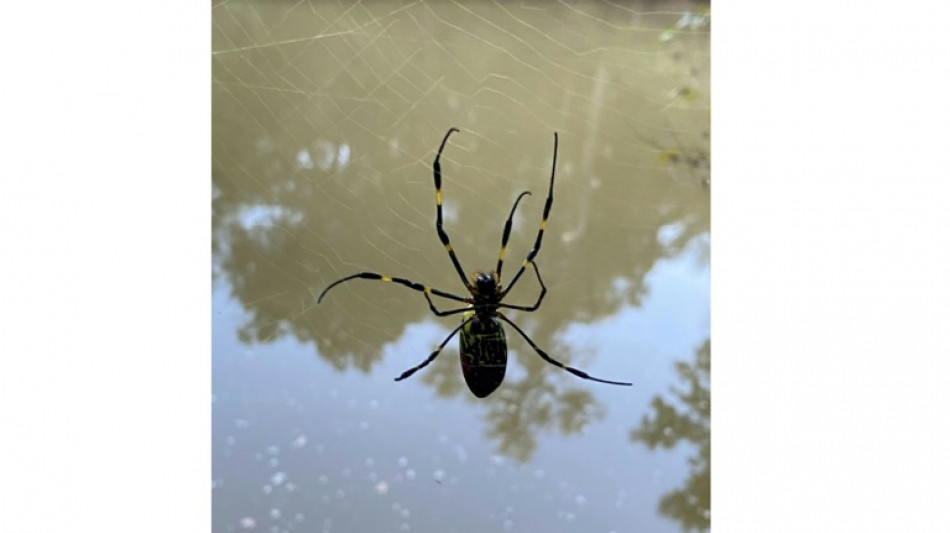
Huge spiders to colonize US East Coast, but maybe it's a good thing

Big and scary-looking Joro spiders have spread from Asia to the southern United States and are now poised to colonize the country's cooler climes -- but they're nothing to fear and might end up actually helping local ecosystems.
That's according to scientists who have been studying the arachnid invaders since they first arrived in Georgia around 2013.
In a few short years, the golden webs spun by the bright yellow, dark blue and red spiders -- usually built at head height -- have become a common sight throughout the state, and new research suggests they will clamber up the Eastern Seaboard next.
"The reason we got involved in this project was because they literally fell in our lap," Andy Davis, an ecologist at the University of Georgia, told AFP on Friday.
"They're kind of everywhere here in North Georgia, they're all over my backyard."
Davis set about studying the new resident, comparing it to the golden silk spider, which came to the southeastern US some 160 years ago from the tropics.
Writing in a paper published in the journal Physiological Entomology, he and his co-author Ben Frick found similarities but also striking differences between the relatives.
The Joro spider's metabolic rate is about double that of its cousin, its heart beats 77 percent faster, and it can survive brief freezes.
Together, these traits mean it can better survive colder climates, which is not completely surprising, given that it is native to temperate Japan.
The paper also examined records from iNaturalist, which tracks sightings of animals, and found that the spider's range had already spread far beyond Georgia to encompass the nearby states of South Carolina, North Carolina, and Tennessee. There was even a report from faraway Oklahoma.
Left to themselves, Joros would probably work their way up the coast over 20 years, but it'll probably happen faster if they hitchhike on vehicles, said Davis.
- Call for clemency -
That's likely how they arrived in the United States in the first place -- either a female stowaway laid her eggs when she landed on a ship, or an egg sac was brought over and hatched in spring.
Invasive species are often linked to destruction -- such as the spotted lanternfly, a native of Southeast Asia which came to the US state of Pennsylvania in 2014 and is known to decimate fruit trees and ornamental plants.
But the Joros' exploding numbers aren't necessarily a cause for concern, argued Davis.
"The golden silk spider is everywhere in the southeast, and it's not causing any harm. It's been here so long, it's integrated itself into the ecosystem, and the Joro could follow the same trajectory," he said.
In fact, it could provide a hearty meal for native predators, such as mud dauber wasps, which hunt spiders. Other beneficiaries could include local lizards.
They're also not aggressive towards humans, nor are their fangs big enough to pose any kind of threat, stressed Davis, who called for clemency and understanding, not stigmatization.
"I don't really think the Joros deserve to be squashed or killed like the spotted lanternfly -- they're really not out to get us and it's not their fault either that they're here. They were literally along for the ride," he said.
(I.Beryonev--DTZ)